
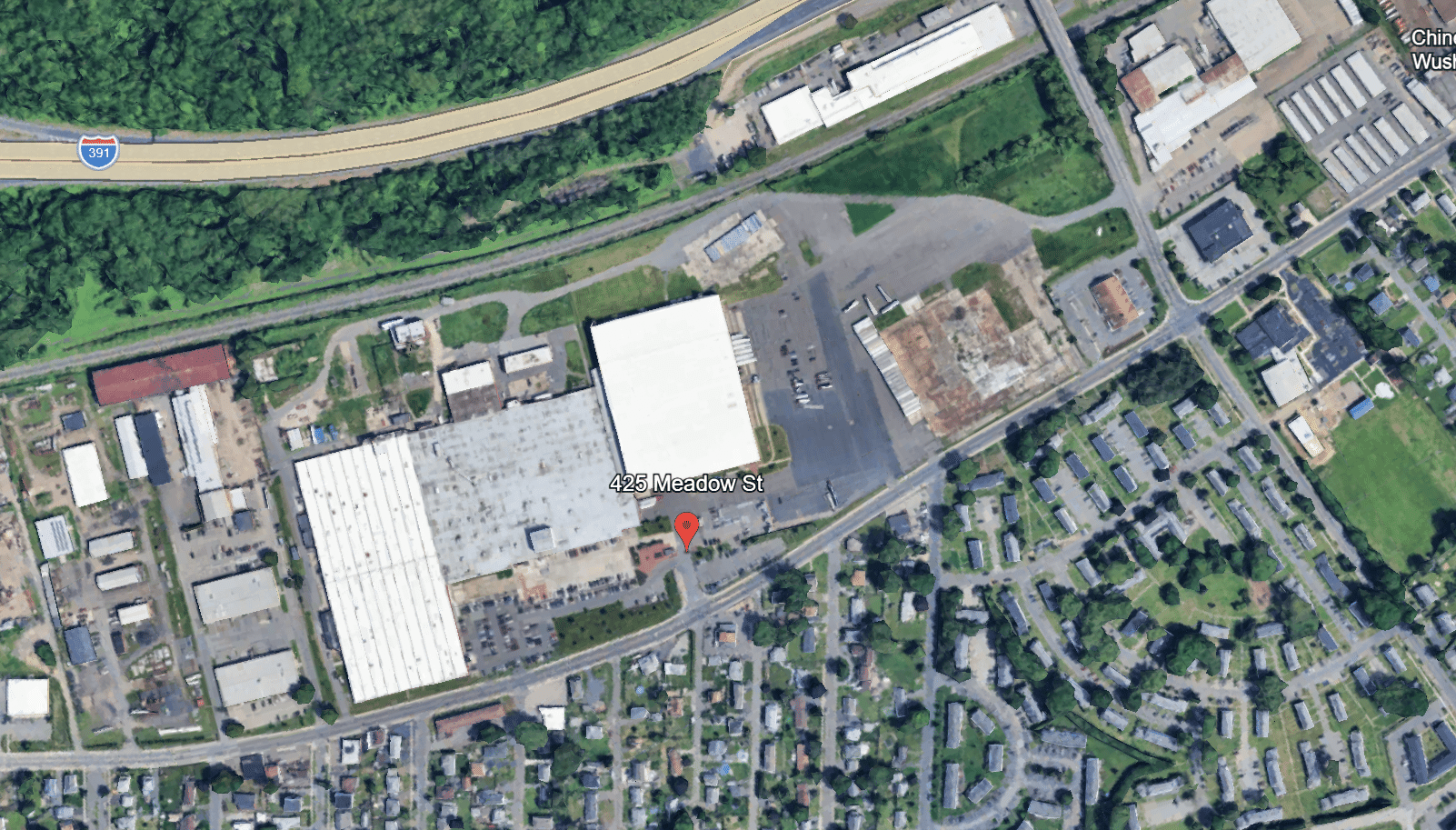
A satelite view of 425 Meadow St.
Photo credit: Google Earth
CHICOPEE — Representatives from Silo Electric, Uriel Renewables and other stakeholders hosted a public meeting on June 4 to discuss plans for a new battery storage facility located at 425 Meadow St. that is set to begin operating in July.
Ryan McGlothlin, founder of Silo Electric, led the meeting to discuss the parameters of the project.
Silo Electric is a Massachusetts-based energy storage developer with three similar five MW projects under construction in the state – Chicopee, Framingham and Lunenburg. Uriel Renewables is the United States arm of a family-owned group that has operated for nearly 100 years with wind, solar, hydro and storage projects across more than nine countries.
Silo Electric develops battery energy storage systems in urban locations and other key intersections on the grid.
According to its website, without these battery storage systems, the intermittent electricity production of wind and solar facilities must be supplemented by power plants burning fossil fuels. These power plants release harmful emissions and are often located in economically disadvantaged communities.
The battery storage system is a “cleaner backup” according to McGlothlin and it does the job the gas-fired peaker plants used to do during high-demand hours but in a faster, quieter way without burning fuel. McGlothlin compared the system to a giant rechargeable battery. It charges up when electricity is cheap and plentiful and gives it back when demand is highest. The project power capacity will be five Megawatts or has about 20 megawatt-hours stored.
The batteries store electricity and send it back to the grid when the region needs it most. No fuel is burned, there are no emissions, no smokestacks and no water use.
As Massachusetts adds more solar and wind, storage fills the gap – keeping power available when the sun isn’t shining or the wind isn’t blowing.
McGlothlin talked about the potential impact the battery storage plant could have on an electric bill.
“I’m not going to tell you that this is going to lower you electric bill in some direct way or whatever, it does not. That would be a misrepresentation but ultimately these kinds of facilities do allow for lower electric bills because they allow the grid to run more efficiently,” he explained.
The project will look like a few cabinets, each about the size of a 20-foot shipping container behind a chain-link fence. McGlothlin also explained that the system is quiet and about as loud as a large commercial air-conditioning unit.
McGlothlin said the project sits on a small corner of a much larger industrial property already used for business. The battery storage system is about an 8,000 square foot fenced area on a 46-acre site.
The project is located by Callaway Golf and is tucked away by the parking lot of Granite City Electric Supply.
Once the site is completed, there will be no onsite staff. The system runs automatically and is watched remotely 24 hours a day.
The project has been in development since 2021 and is expected to begin operating in July.
In terms of safety, McGlothlin said it is built to fire code, is tested before it is installed, has layers of protection and is designed to contain a problem.
McGlothlin explained that in a large-scale test, a fire-burning inside one container for 15 hours did not spread to the container next to it. Chicopee firefighters have also received site specific training in case of an incident at the battery storage system.
McGlothlin also talked about the benefits for Chicopee. He stated it will bring in new tax revenue, increase local jobs for the construction and support the city’s clean energy goals. Chicopee has been a state-designated Green Community since 2017. The project advances those goals and reduces reliance on fossil-fuel peaker plants.
The project will also not drain city services as it needs no water, no sewer services and adds little traffic.
McGlothlin also explained that Chicopee is not the first community to host one of the battery storage projects. Lithium-ion battery costs have fallen by about 90% in the last decade. More than a dozen stand-alone battery systems already operate across Massachusetts – the first built in 2019, including two larger sites than the one in Chicopee.