
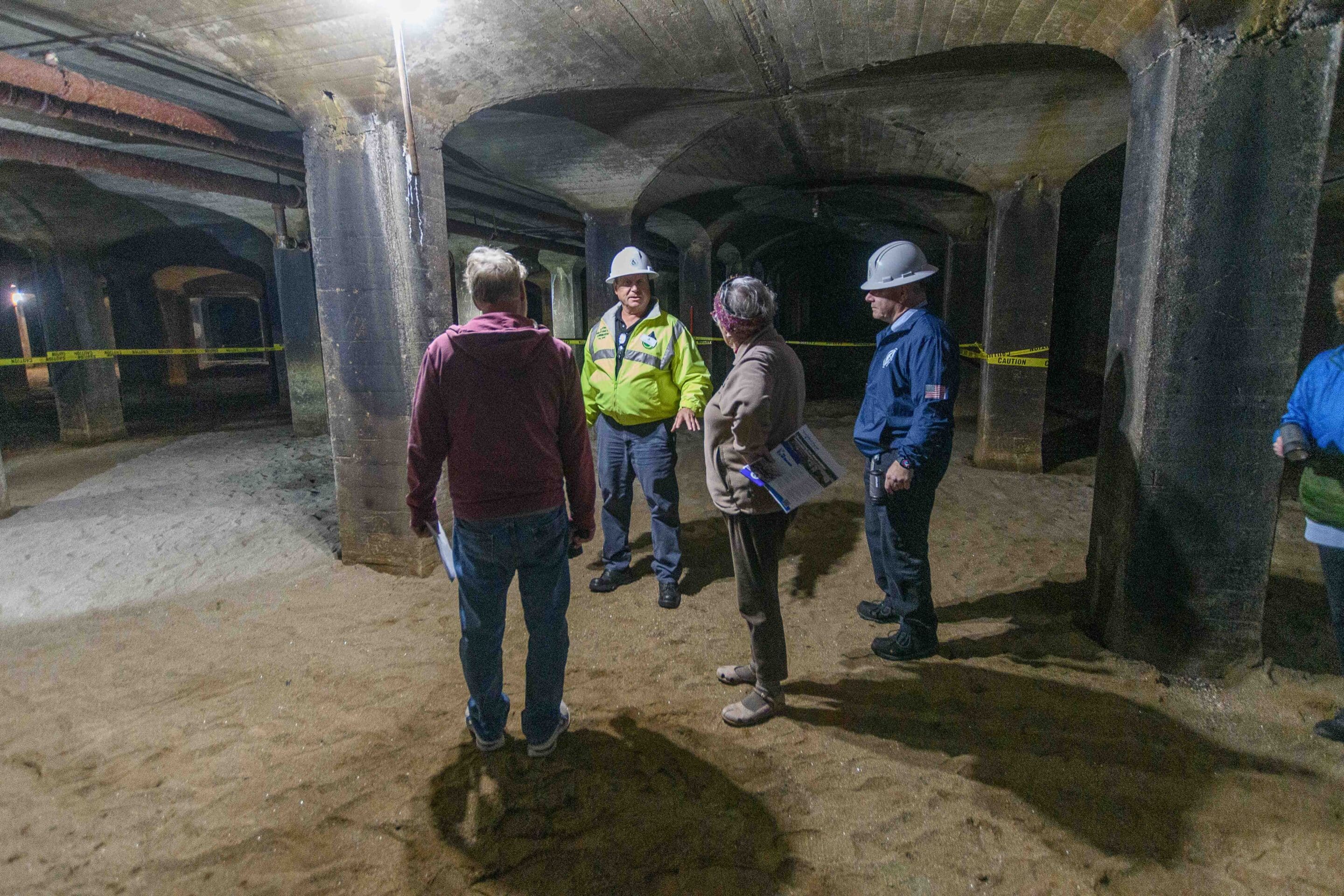
Process control manager Alex Roseweir speaks with visitors in the underground slow filter chamber during an open house at the Springfield Water and Sewer Commission’s West Parish Water Treatment facility in Westfield. pringfield and Ludlow both receive water from the Springfield Water and Sewer Commission and the water for Agawam, Southwick, Longmeadow and East Longmeadow are treated by the SWSC. The SWSC gets its water from the Little River Watershed in Blandford and Russell.
Reminder Publishing file photo
The Massachusetts Senate recently voted 36-3 in favor of a $3.64 billion bill to address climate change, protect the state’s natural resources and make much needed infrastructure improvements across the state, including in Western Massachusetts.
State Sen. Jake Oliveira, who represents the Hampden, Hampshire and Worcester District explained that environmental bond bills, like the Mass Ready Act, are usually taken up by the Legislature every five years.
A bond bill utilizes the state’s ability to take on debt to fund policy priorities and infrastructure. Massachusetts’ general obligation bond rating from Standard & Poor is AA+ and stable, which Oliveira said allows the state to borrow money at favorable interest rates and spread-out costs over time.
“With the budget, we have to make sure the state keeps operating and moving forward,” said state Sen. Adam Gómez, who represents most of Springfield and part of Chicopee. Therefore, he said, “With some of these bigger projects, the only way they’ll happen is with bond money.”
Because the state takes on these projects and policies once every few years, Oliveira said the Mass Ready Act is “a pretty intense bill.”
Water and sewer
Much of Oliveira’s work on the bill focused on clean water. He recalled the contaminated water situations that occurred recently in Flint, Michigan, and Jackson, Mississippi, and said those issues took a significant toll on the local economies, as well as impacting people’s health.
Many of the water and sewer lines in Massachusetts are about 100 years old and made of cast iron. Municipalities have slowly been replacing them with modern PVC pipes, but the projects are expensive. “It’s not just the pipes but it’s also filtration systems,” Oliveira said.
Oliveira said the Mass Ready Act also includes provisions that increase how much input Western Massachusetts towns have when it comes to regional water supplies. Springfield and Ludlow, where Oliveira lives, both receive water from the Springfield Water and Sewer Commission. Additionally, the water for Agawam, Southwick, Longmeadow and East Longmeadow are treated by the SWSC. Further, the SWSC gets its water from the Little River Watershed in Blandford and Russell.
“A significant portion of the people who get their water through Springfield Water and Sewer Commission live outside the city,” he said. Oliveira filed an amendment to the bond bill that expanded the commission from three people to seven and guaranteed representation for area towns on the commission’s advisory committee.
Meanwhile, in Chicopee, South Hadley and Wilbraham, residents receive their water from Quabbin Reservoir through the Massachusetts Water Resources Authority. Oliveira said he fought to ensure a seat on the MWRA board is reserved for someone from Western Massachusetts.
“If you’re a rate payer, if your resources are being used, you deserve a seat at the table,” Oliveira said.
In addition to these changes, Oliveira said $5 million was allotted to help remediate the polychlorinated biphenyls, banned chemicals also known as PCBs, which were found in the Westfield River. Also in the bill is $4.5 million in a clean water trust, $15 million to filter water in schools and child care settings, and $120 million to filter per- and polyfluoroalkyl substances, widely referred to as PFAS, from private drinking water wells.
A fund was created to replace channel markers in the Connecticut River near the Holyoke Dam, and $20 million was provided to update the antiquated McLaughlin Fish Hatchery in Belchertown, which Oliveira has fond memories of visiting with his grandfather.
Air quality
While Oliveira was focused on clean water, Gómez had his sights set on clean air. He secured a $5 million amendment to the bill, establishing a pilot program to improve indoor air quality in schools, public housing, correctional facilities and other public spaces.
“For communities like mine in Springfield, this is not theoretical — it’s everyday life,” Gómez said in a press release. “This amendment is about something fundamental: the right of every person in the Commonwealth to breathe clean, safe air, no matter their zip code, income, or the condition of the building they live, learn, or work in.”
He later told Reminder Publishing, “This is an environmental justice issue. It’s a matter of dignity.”
Gómez said the air conditions at the Roderick L. Ireland Courthouse, which have long made employees sick and drove the state to build a new courthouse, was one of the main reasons he pursued the amendment. Another was Springfield’s Gerena School, which has seen similar issues linked to poor air quality.
“We’re still an asthma capital,” Gómez said about Springfield, which had the highest rates of asthma in the country in 2021. He said, “Poor air quality contributes to asthma in communities along highways and train tracks,” a situation present in many neighborhoods in Springfield. Smog and pollutants settle in those low-lying areas. He said, “That’s why you see these levels in Black and brown communities.”
Gómez previously filed a bill to establish a framework that will identify, monitor and remediate indoor air pollution and mold contamination in public buildings. He said it was the first program of its kind in Massachusetts. Gómez said, “It’s a preventative policy, but it will save money” in subsequent health care costs.
Other priorities
Among other Mass Ready Act provisions is one that bans single-use plastic bags from retail checkouts. Oliveira said the environmental impact of single-use plastics, which do not degrade over time, but instead break apart into microplastics, can not be overstated.
“These bags can get into drinking water,” he said, adding that they are ubiquitous. When participating in an Earth Day cleanup recently, he saw bags “go by like tumbleweeds.”
Oliveira said he did not receive any comments or emails in opposition to this change. He noted many municipalities have already adopted similar bans and supermarkets, like Big Y, provide paper bags at a minimal cost, or otherwise incentivize people to bring reusable bags.
Three million dollars would be used to address a levee on Riverside Drive in Springfield, which Gómez said has caused sinkholes, while $1 million would go to fix a road in Blunt Park that Gómez described as “dilapidated.”
Over the past decade, the PFAS in firefighter equipment have been identified as a cause of cancers among fire personnel that are otherwise rare. The bill set aside $25 million to help departments replace the expensive equipment with new, safer versions.
Another fund was created to help with reforestation to address the dead and dying trees left in the wake of a gypsy moth infestation nearly a decade ago. Beyond the aesthetic value of trees, Oliveira said they help cool communities, and one tree provides a person with a year’s worth of oxygen.
Now that the bill has passed in the Senate, it moves to the state House of Representatives for review.
