
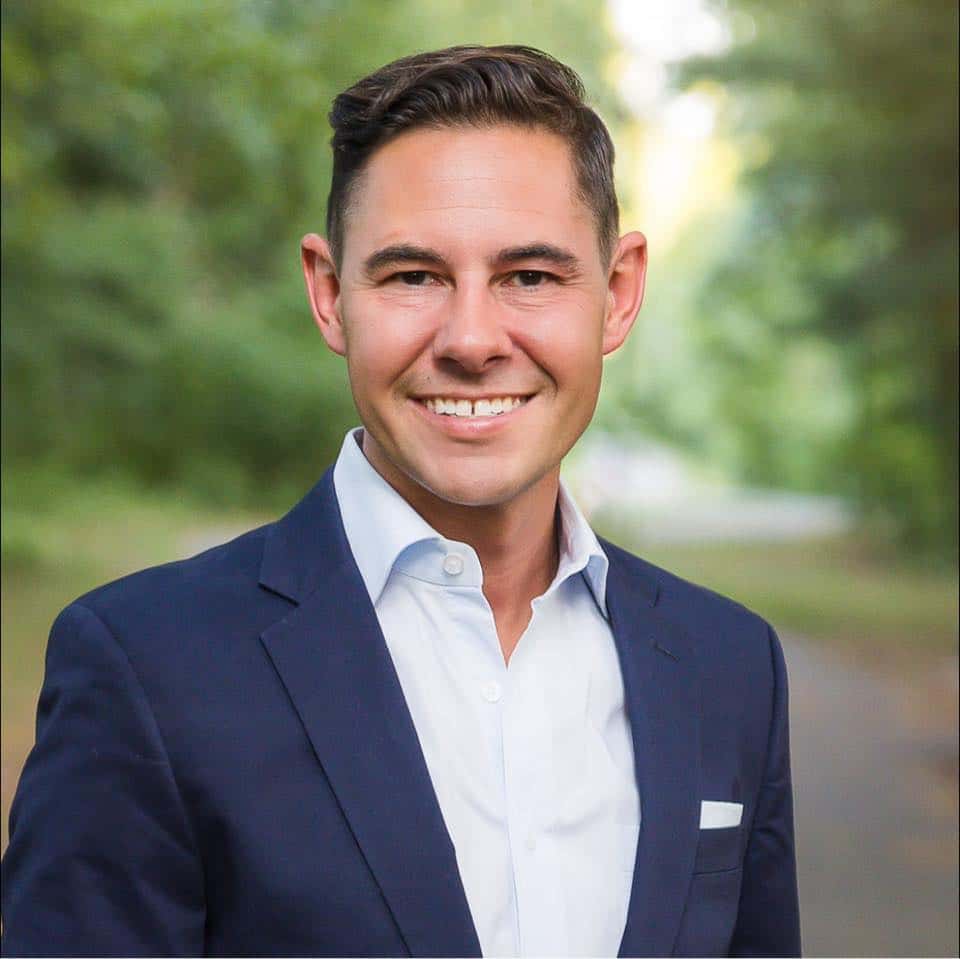
State Sen. Jake Oliveira represents the Hampden, Hampshire and Worcester District in the state Senate.
Reminder Publishing file photo
In the latter half of the session, though, the bills work their way through committee and will, ideally, be taken up on the floor of the Senate.
Many of those bills will address one major issue with several heads. Like the hydra of Greek mythology, the monster that is affordability must be attacked from multiple angles.
Oliveira explained that utility costs are “crippling” seniors and those on fixed incomes. When it comes to electricity, he said, “Delivery charges frustrate me, frustrate my constituents. They’re higher sometimes than the supply cost.”
Delivery charges are the set fees utilities charge to use their wires and poles to carry electricity to customers. In most municipalities, one utility owns most of the infrastructure, forcing people to pay their delivery charges. It does not have to be that way, though. He said cities and towns with a municipally owned utility, like Chicopee, charge nearly half the distribution fee of Eversource. He said the state Department of Public Utilities is investigating why delivery costs are so high.
“People shouldn’t have to choose between paying for electricity and buying groceries, or paying a bill or buying medicine,” Oliveira said.
Another issue Oliveira is working on is the housing crisis. Despite the 2024 passage of the Affordable Homes Act, a five-year housing bond bill, people are still being priced out of the housing market.
“I’m a big fan of mixed-use housing,” Oliveira said, referring to buildings that contain a combination of housing units, offices, restaurants and shops. Redeveloping vacant buildings from the state’s industrial past lends itself to such uses. He cited the mixed-use redevelopment of the Ludlow Mills in his hometown. The housing there is age-restricted for seniors.
“We need to end a lot of these age caps,” Oliveira said. This would allow more young and middle-aged people who are currently priced out of homeownership to buy units in housing developments. “Springfield used to be the City of Homes,” he said. “Now, it’s a city of renters. A lot of that goes to affordability.”
Not everyone is sold on state-initiated housing changes. Since the Affordable Homes Act was passed, many municipalities have expressed concern and frustration that the state is mandating housing changes, such as allowing accessory dwelling units and affordable housing. Oliveira rejects the assertion that the Affordable Homes Act is forcing new restrictions on municipalities.
Chapter “40B has been on the books for decades. It just wasn’t enforced,” he said of a law setting a threshold of 10% affordable housing in each municipality. He said the Legislature tried to partner with each of the state’s 351 municipalities to avoid a one-size-fits-all approach. “There needs to be a balance and a recognition that residents in Massachusetts can’t afford to buy houses. A lot of young people are leaving, and when you ask why, they say it’s because its unaffordable.”
Then, there is the issue of healthcare. The passage of the federal One Big Beautiful Bill, which Oliveira called the “Big Ugly Bill,” changed health and tax credits. Some of Oliveira’s constituents are going to pay “tens of thousands” of dollars more this month than they did in 2025. He said it is most harmful to those people who are retired but not yet old enough to qualify for Medicare.
The state and municipalities are seeing 10% annual increases in health care costs, while tax revenue typically increases by just 3% each year. Healthcare is “crowding out” other government programs and initiatives, he said.
Healthcare is also the largest employer in Oliveira’s district, which encompasses towns from Warren to South Hadley and from Belchertown to the Connecticut line. He also represents parts of Chicopee and Springfield, the latter of which is home to Baystate Health and Mercy Medical Center. Cuts to health care will have significant repercussions on the economy and jobs in Western Massachusetts, he said.
Oliveira said that part of the problem is a lack of medical professionals licensed in Massachusetts. Legislation that he filed allowing physician assistants licensed in other states to work in Massachusetts is in committee.
Supply is only one aspect of the issue, though. Pharmaceutical benefit managers work as intermediaries between insurance companies and pharmacies, managing drug prices. Oliveira said those intermediaries — the three largest of whom are Optum RX, CVS Caremark and Express Scripts — are profitable and drive up prices. In 2024, the state Legislature passed licensing requirements for pharmaceutical benefit managers.
The healthcare issue, like housing, requires an “all-hands-on-deck” approach, but “unless the federal government is a partner,” Oliveira said the situation will not improve.

- Sarah Heinonen
- Sarah Heinonen
- Sarah Heinonen
- Sarah Heinonen
- Sarah Heinonen
- Sarah Heinonen
- Sarah Heinonen
- Sarah Heinonen
- Sarah Heinonen
- Sarah Heinonen
- Sarah Heinonen
- Sarah Heinonen
- Sarah Heinonen
- Sarah Heinonen
- Sarah Heinonen
- Sarah Heinonen
- Sarah Heinonen
- Sarah Heinonen
- Sarah Heinonen
- Sarah Heinonen
- Sarah Heinonen
- Sarah Heinonen
- Sarah Heinonen
- Sarah Heinonen
- Sarah Heinonen
- Sarah Heinonen
- Sarah Heinonen
- Sarah Heinonen
- Sarah Heinonen
- Sarah Heinonen
- Sarah Heinonen
- Sarah Heinonen
- Sarah Heinonen
- Sarah Heinonen
- Sarah Heinonen
- Sarah Heinonen
- Sarah Heinonen
- Sarah Heinonen
- Sarah Heinonen
- Sarah Heinonen
- Sarah Heinonen
- Sarah Heinonen
- Sarah Heinonen
- Sarah Heinonen
- Sarah Heinonen
- Sarah Heinonen
- Sarah Heinonen
- Sarah Heinonen
- Sarah Heinonen
- Sarah Heinonen
- Sarah Heinonen
- Sarah Heinonen
- Sarah Heinonen
- Sarah Heinonen
- Sarah Heinonen
- Sarah Heinonen
- Sarah Heinonen
- Sarah Heinonen
- Sarah Heinonen
- Sarah Heinonen
- Sarah Heinonen
- Sarah Heinonen
- Sarah Heinonen
- Sarah Heinonen
- Sarah Heinonen
- Sarah Heinonen
- Sarah Heinonen
- Sarah Heinonen
- Sarah Heinonen
- Sarah Heinonen
- Sarah Heinonen
- Sarah Heinonen
- Sarah Heinonen
- Sarah Heinonen
- Sarah Heinonen
- Sarah Heinonen
- Sarah Heinonen
- Sarah Heinonen
- Sarah Heinonen
- Sarah Heinonen
- Sarah Heinonen
- Sarah Heinonen
- Sarah Heinonen
- Sarah Heinonen
- Sarah Heinonen
- Sarah Heinonen
- Sarah Heinonen
- Sarah Heinonen
- Sarah Heinonen
- Sarah Heinonen
- Sarah Heinonen
- Sarah Heinonen
- Sarah Heinonen
- Sarah Heinonen
- Sarah Heinonen
- Sarah Heinonen
- Sarah Heinonen
- Sarah Heinonen
- Sarah Heinonen
- Sarah Heinonen
- Sarah Heinonen
- Sarah Heinonen
- Sarah Heinonen
- Sarah Heinonen
- Sarah Heinonen
- Sarah Heinonen
- Sarah Heinonen
- Sarah Heinonen
- Sarah Heinonen
- Sarah Heinonen
- Sarah Heinonen
- Sarah Heinonen
- Sarah Heinonen
- Sarah Heinonen
- Sarah Heinonen
- Sarah Heinonen
- Sarah Heinonen
- Sarah Heinonen
- Sarah Heinonen
- Sarah Heinonen
- Sarah Heinonen
- Sarah Heinonen
- Sarah Heinonen
- Sarah Heinonen
- Sarah Heinonen
- Sarah Heinonen
- Sarah Heinonen
- Sarah Heinonen
- Sarah Heinonen
- Sarah Heinonen
- Sarah Heinonen
- Sarah Heinonen
- Sarah Heinonen
- Sarah Heinonen
- Sarah Heinonen
- Sarah Heinonen
- Sarah Heinonen
- Sarah Heinonen
- Sarah Heinonen
- Sarah Heinonen
- Sarah Heinonen
- Sarah Heinonen
- Sarah Heinonen
- Sarah Heinonen
- Sarah Heinonen
- Sarah Heinonen
- Sarah Heinonen
- Sarah Heinonen
- Sarah Heinonen
- Sarah Heinonen