
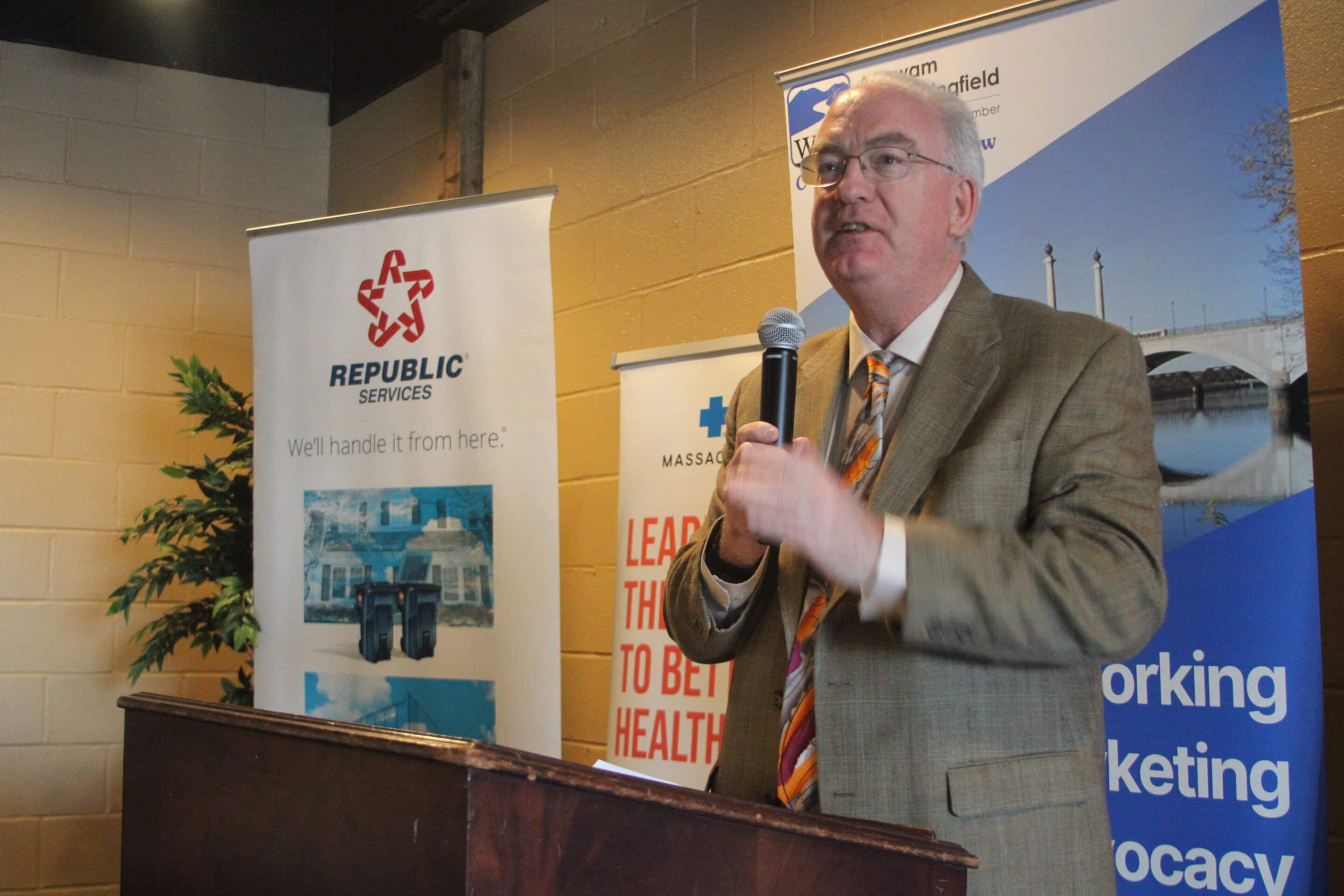
Mayor Christopher Johnson, pictured in this file photo, called a split tax rate a “balancing act.”
Reminder Publishing file photo
AGAWAM — The Agawam City Council voted Dec. 1 to set a split tax rate, with the average residential tax bill set to increase by $156 and businesses shouldering a larger burden.
The council agreed with Mayor Christopher Johnson, who called the split “a balancing act.”
Johnson and Town Assessor Kelly McCormick began the tax hearing by reviewing the way municipal taxes are calculated. The levy, or part of the budget to be raised through taxes, is set in late spring. It is based on the previous year’s levy, plus the 2.5% that is allowed under state law and the taxable value of any new growth, such as construction or property improvements.
While the town could legally raise up to $95.77 million, the budget was conservative enough to require only $77.76 million to be raised, leaving $18 million in excess levy capacity. That capacity acts as a cushion should circumstances require the town to raise more money. Johnson said only a quarter of municipalities in Massachusetts maintain an excess levy capacity.
Each year, the council is tasked with setting a tax classification, which determines how much different categories of property owners will pay. Historically, the council has chosen to use a split classification, with commercial, industrial and personal property owners paying a higher rate than residential taxpayers. In recent years, a shift of 1.59 has been used, and Johnson and McCormick recommended doing so again. A shift of 1.59 yields a residential tax rate of $14.10 per $1,000 of property value, while commercial, industrial and personal property owners pay $26.67 per $1,000.
“Agawam has one of the lowest residential and commercial tax rates within the surrounding communities,” McCormick said.
Both the residential and commercial/industrial rates are lower than they were in fiscal year 2025, but because the value of properties has increased, the average single-family property owner would pay $156 more in FY26 than last year. Commercial and industrial property owners will also pay more in taxes. “As values go up, rates go down,” Johnson said. He added that the tax increase is about the same or lower than metro-Springfield area towns.
Johnson cautioned that the FY27 property taxes will increase more dramatically because the debt service on the new Police Headquarters will be added into the calculations. He also said that he expects health insurance costs for employees to rise.
Johnson explained that because the fiscal year begins in July, before the town is able to set its tax rate, the first two quarterly bills, issued on July 1 and Oct. 1, are estimated based on what was paid in the previous fiscal year. The bills issued on Jan. 1 and April 1 use the actual tax rate and contain “the entire increase” for the year.
Councilor George Bitzas asked for the reasoning behind the 1.59 shift. Johnson said that over the previous 15 years, “more and more kept getting pushed onto the commercial/industrial tax base.” Under former Mayor William Sapelli, he said, there was an effort to return the classification to “a fair compromise” between residents and business property owners.
Resident Corrinne Wingard spoke in favor of the tax shift. She said most residential voters do not want their taxes to increase, but “we cannot have it both ways. If we want good, safe infrastructure, good schools and good services, the money has to come from somewhere.” Wingard noted there are exemptions for veterans, seniors and blind individuals, but she asked the council to adopt property tax deferrals for eligible seniors. The option, allowed under state law, would collect taxes on the property with interest when it is sold. Because of the interest, “It becomes a money maker for the town,” she said.
Resident Forrest Bradford remarked, “The economy is in a very shaky area right now.” He asked if there was a contingency plan if there was a sudden depression. Councilor Robert Rossi said there are emergency actions that can be taken in such a situation but added that he did not believe it would come to that.
Rossi said the tax shift was “fair.” He said, “I think we’re running into a tough period,” and the “diminishing federal aid” would lead the town to shoulder more of the financial weight of services and projects in the future.
Bitzas also said the shift represents a “balancing act.” If the shift were any larger, the amount paid by commercial and industrial property owners would increase more than he felt was “fair.”
The council voted 10-0 to approve the split, and with it, the tax rate.

- Sarah Heinonen
- Sarah Heinonen
- Sarah Heinonen
- Sarah Heinonen
- Sarah Heinonen
- Sarah Heinonen
- Sarah Heinonen
- Sarah Heinonen
- Sarah Heinonen
- Sarah Heinonen
- Sarah Heinonen
- Sarah Heinonen
- Sarah Heinonen
- Sarah Heinonen
- Sarah Heinonen
- Sarah Heinonen
- Sarah Heinonen
- Sarah Heinonen
- Sarah Heinonen
- Sarah Heinonen
- Sarah Heinonen
- Sarah Heinonen
- Sarah Heinonen
- Sarah Heinonen
- Sarah Heinonen
- Sarah Heinonen
- Sarah Heinonen
- Sarah Heinonen
- Sarah Heinonen
- Sarah Heinonen
- Sarah Heinonen
- Sarah Heinonen
- Sarah Heinonen
- Sarah Heinonen
- Sarah Heinonen
- Sarah Heinonen
- Sarah Heinonen
- Sarah Heinonen
- Sarah Heinonen
- Sarah Heinonen
- Sarah Heinonen
- Sarah Heinonen
- Sarah Heinonen
- Sarah Heinonen
- Sarah Heinonen
- Sarah Heinonen
- Sarah Heinonen
- Sarah Heinonen
- Sarah Heinonen
- Sarah Heinonen
- Sarah Heinonen
- Sarah Heinonen
- Sarah Heinonen
- Sarah Heinonen
- Sarah Heinonen
- Sarah Heinonen
- Sarah Heinonen
- Sarah Heinonen
- Sarah Heinonen
- Sarah Heinonen
- Sarah Heinonen
- Sarah Heinonen
- Sarah Heinonen
- Sarah Heinonen
- Sarah Heinonen
- Sarah Heinonen
- Sarah Heinonen
- Sarah Heinonen
- Sarah Heinonen
- Sarah Heinonen
- Sarah Heinonen
- Sarah Heinonen
- Sarah Heinonen
- Sarah Heinonen
- Sarah Heinonen
- Sarah Heinonen
- Sarah Heinonen
- Sarah Heinonen
- Sarah Heinonen
- Sarah Heinonen
- Sarah Heinonen
- Sarah Heinonen
- Sarah Heinonen
- Sarah Heinonen
- Sarah Heinonen
- Sarah Heinonen
- Sarah Heinonen
- Sarah Heinonen
- Sarah Heinonen
- Sarah Heinonen
- Sarah Heinonen
- Sarah Heinonen
- Sarah Heinonen
- Sarah Heinonen
- Sarah Heinonen
- Sarah Heinonen
- Sarah Heinonen
- Sarah Heinonen
- Sarah Heinonen
- Sarah Heinonen
- Sarah Heinonen
- Sarah Heinonen
- Sarah Heinonen
- Sarah Heinonen
- Sarah Heinonen
- Sarah Heinonen
- Sarah Heinonen
- Sarah Heinonen
- Sarah Heinonen
- Sarah Heinonen
- Sarah Heinonen
- Sarah Heinonen
- Sarah Heinonen
- Sarah Heinonen
- Sarah Heinonen
- Sarah Heinonen
- Sarah Heinonen
- Sarah Heinonen
- Sarah Heinonen
- Sarah Heinonen
- Sarah Heinonen
- Sarah Heinonen
- Sarah Heinonen
- Sarah Heinonen
- Sarah Heinonen
- Sarah Heinonen
- Sarah Heinonen
- Sarah Heinonen
- Sarah Heinonen
- Sarah Heinonen
- Sarah Heinonen
- Sarah Heinonen
- Sarah Heinonen
- Sarah Heinonen
- Sarah Heinonen
- Sarah Heinonen
- Sarah Heinonen
- Sarah Heinonen
- Sarah Heinonen
- Sarah Heinonen
- Sarah Heinonen
- Sarah Heinonen
- Sarah Heinonen
- Sarah Heinonen
- Sarah Heinonen
- Sarah Heinonen
- Sarah Heinonen
- Sarah Heinonen