
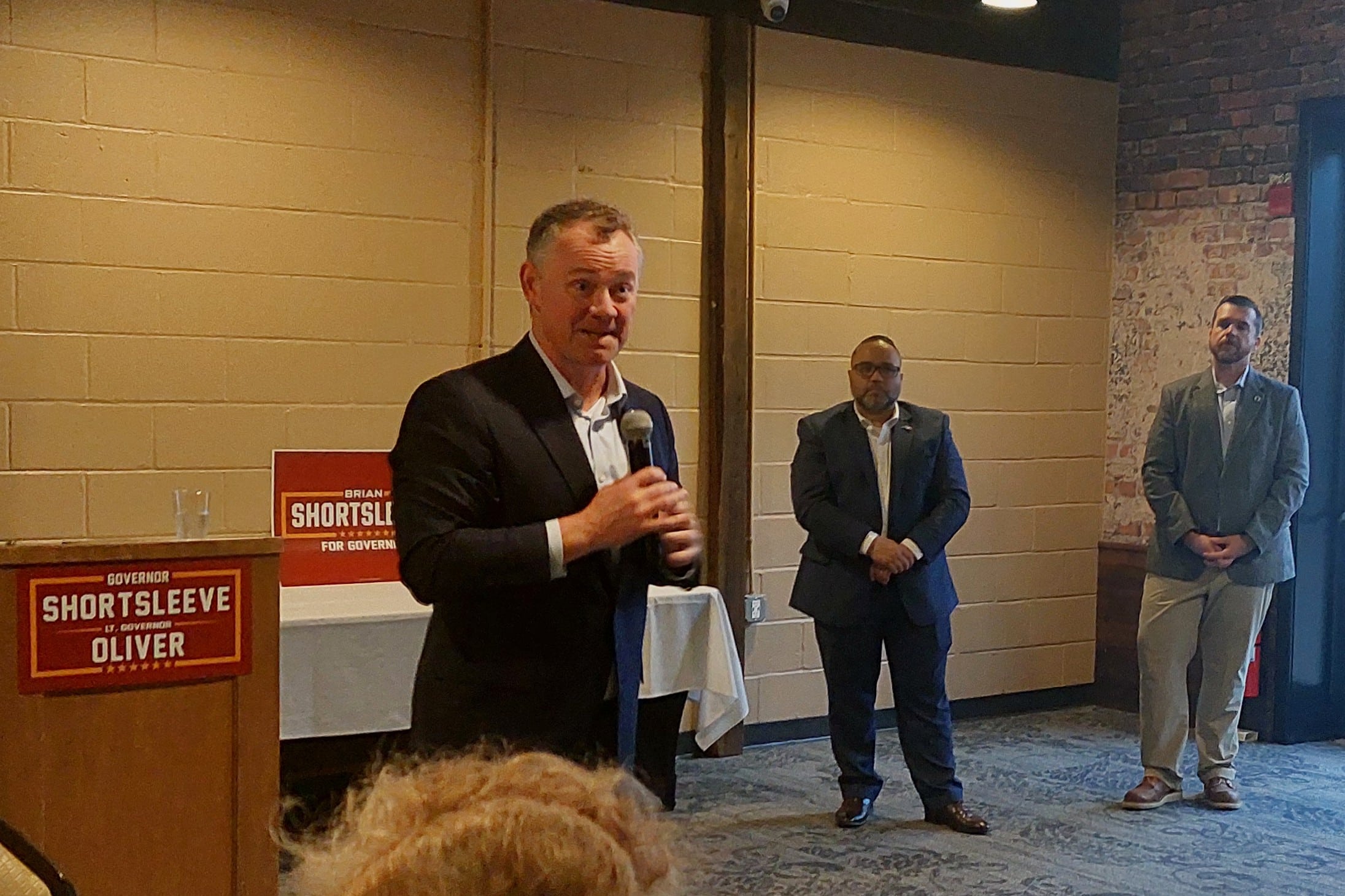
Brian Shortsleeve speaks to voters at Partner’s Restaurant in Agawam.
Reminder Publishing photo by Sarah Heinonen
AGAWAM — About 50 people milled around at Partner’s Restaurant on March 31, gathering in groups to nibble on hors d’oeuvres and talk politics.
Eventually, people settled at tables to listen to Brian Shortsleeve make his case for why he should be Massachusetts’s next governor.
State Rep. Nicholas Boldyga introduced Shortsleeve and his running mate, Shawn Oliver. Shortsleeve is one of three Republicans in the primary race. Boldyga said every Republican campaign for office in Massachusetts is difficult. To eschew concerns about the deep pockets of Shortsleeve’s primary opponent, former biotechnology executive Michael Minogue, he said now-Secretary of Education Linda McMahon had run for state Senate in Connecticut twice, and despite drastically outspending other opponents, failed to win the seat each time. He said a candidate can outspend their opponents and lose “if you’re not the right candidate for the job at the right time.”
Oliver, a New Bedford city councilor and corrections officer, took the mic, “You have to know criminals when you look them in the face every day; and there are a lot of criminals trying to run the state government.” Oliver said he and Shortsleeve would “fire” all members of the parole board and replace them with “common sense” board members.
Oliver urged the crowd to vote for Shortsleeve because, “He is one of us.”
Shortsleeve leaned heavily on his history as a U.S. Marine and as a business owner. He said the Marine Corps taught him about leadership.
“This state is in desperate need of new leadership,” he said. He also spoke at length about his time in former-Gov. Charlie Baker’s administration, managing the finances at the Massachusetts Bay Transportation Administration. Shortsleeve said he went “line by line” to find waste and found that the MBTA paid invoices without question and did not regularly examine where it could cut costs.
“We desperately need a governor in the corner office who knows how to balance budgets.” He said there was “enormous growth in state spending,” and noted the state budget was $48 billion in 2022 and is now $65 billion. He described it as “billions and billions of dollars blown.”
Without citing any sources, Shortsleeve estimated that $5 billion had been spent housing immigrants in temporary shelters. In late 2022, the number of people in the state’s emergency shelters drastically increased, largely due to an influx of immigrants. Because there is a right-to-shelter law in Massachusetts and the shelters were overflowing, many people and families were sheltered in hotels and other large-scale temporary housing, including Logan Airport. As the number of newly arrived people fell in 2024 and new restrictions, including six-month maximum stays and proof of residency requirements, the situation eased. As of August 2025, there were no immigrants sheltered in hotels.
Shortsleeve said he plans to cut waste, increase accountability and lower utility bills and taxes. The last two of these were talking points Shortsleeve returned to several times over the course of the event.
Shortsleeve said Massachusetts is losing population, business owners among them, because taxes are too high. Healey is not “in sync” with the factors impacting small business owners, he said. Shortsleeve’s plan included rolling back the income tax from 5% to 4%.
“We pay our taxes,” said one person in the audience. “I can’t go 14 feet without hitting a pothole.” Oliver said municipalities are “behind the eight-ball,” because not enough funding is coming back to them in local aid.
Pulling a National Grid bill out of his jacket, Shortsleeve said the average Massachusetts customer is paying $480 per month for electricity. As of January, the average electric bill in Massachusetts was $177.61. Shortsleeve also said 30% of electric bills are the result of state-mandated fees, which he described as taxes. There are several state-mandated charges on electric bills, including the energy efficiency charge, which funds electric energy efficiency programs, and the net metering recovery surcharge, which recovers net metering credits applied to customers with excess generation from on-site generation facilities. Most of these were put in place before Healey took office in 2023.
On “day one” of his administration, Shortsleeve said he would remove all mandated fees from utility bills. He also said he would tie the state to shale pipelines run by companies, including Algonquin Gas Transmission and Tennessee Gas.
Shortsleeve and Oliver both spoke in favor of auditing the state Legislature, which 72% of voters approved in a 2024 referendum. Since then, state House of Representatives Speaker Ronald Mariano and state Senate President Karen Spilka have blocked the audit, saying it violates the separation of powers under the state constitution. State Auditor Diana DiZoglio has since sued to force the audit.
In addition to allowing audits of the Legislature, Oliver said Shortsleeve would make sure all executive departments are audited. Under state law, all executive departments must be audited over the course of three years. DiZoglio completed those audits within the prescribed timeframe in 2025. Despite this, Oliver claimed such an audit would “find billions of dollars in waste.” He promised that the first billion would be returned directly to municipalities in local aid.
Reflecting local sentiment that spans the political spectrum, a man in the crowd said, “We have to fight for money in Western Mass., when Boston just gets money dumped on them.” Another person told Shortsleeve and Oliver, “I don’t want you to walk away after getting you elected and forget about us.” Oliver said that, like Western Massachusetts, Healey only visited New Bedford during campaign season. He promised Shortsleeve would not forget about the region.
Someone in the audience mentioned the “crazy policies” passed by the Massachusetts Association of School Committees. The organization does not pass binding policies but instead develops and provides model policies school committees can choose to use. Oliver opined that some districts were on an “ideological crusade.”
Shortsleeve lamented the achievement of students in the state. He described the state Department of Elementary and Secondary Education as “anti-choice, pro-politics,” and said he would fire and replace the entire board. He said parents should be able to log in online and see what their child learned in class that day. He also said the MCAS was removed as a graduation standard but not replaced with another metric, which he was in favor of, along with more vocational training options.
Shortsleeve also promoted the proposed federal Education Choice for Children Act, which would allow households earning up to 300% or their area’s median income and corporations to use up to $1,700 in tax credits to contribute to Scholarship Granting Organizations, which provide private school tuition vouchers.
When it comes to the need for housing statewide, Shortsleeve said, “To get prices down, we need to boost supply. There is an enormous amount of state-owned land.” To encourage builders, he would eliminate the stretch energy code and suspend the Massachusetts Environmental Policy Act, he said.
With Shortsleeve’s strong message of deregulation, Reminder Publishing asked the candidate what he would do to protect the people whom the regulations were designed to protect. He responded, “You protect people by acknowledging the policies have failed.”
, “You protect people by acknowledging the policies have failed.”
