
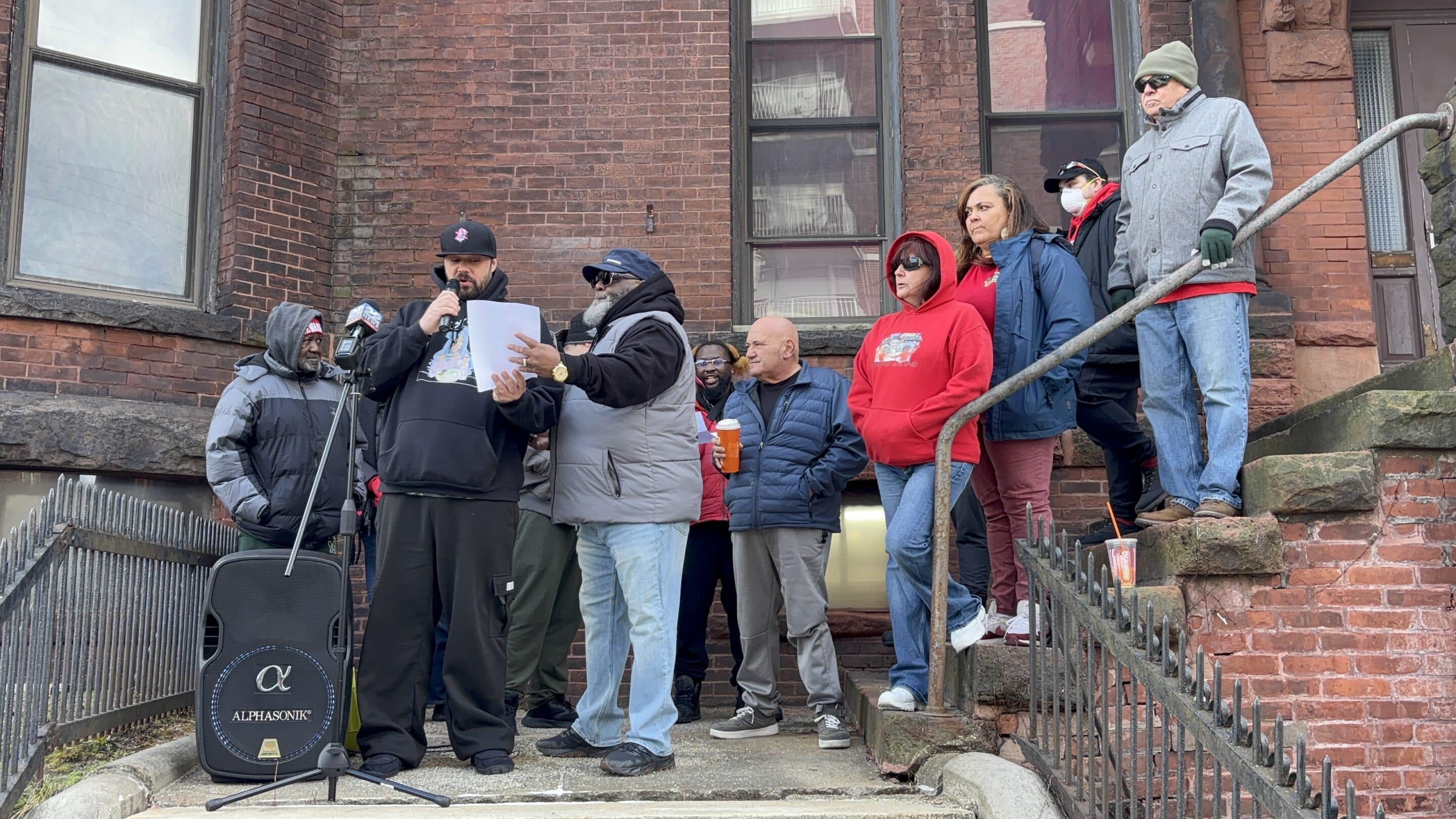
Providence Ministries sober living resident Wesley Pullen talks about his future housing concerns during a press conference on March 17.
Reminder Publishing photo by Tyler Garnet
HOLYOKE — Residents living atProvidence Ministries’ homes expressed their concerns during a press conference on March 17 after being told they would need to find new housing following an announcement of a revamped sober living program by the organization’s executive director.
After allegedly being told that they would have to transition out of the Broderick House and Loreto House, the men at all three Providence Ministries houses hosted a press conference to ask for the community’s support in finding their next home.
Providence Ministries for the Needy has been serving the Holyoke Community since 1980. The organization has three separate houses for men to support recovery from alcoholism and substance use disorder: the Broderick House, the Loreto House and McCleary Manor.
“The uncertainty of what is going on with my housing is creating anxiety I haven’t known in years. No one should have to deal with this level of uncertainty,” Broderick House resident Matt Martin stated.
Some of the men are disabled and don’t bring in enough to cover the cost of market-rate housing, according to the men. With move-in costs and the cost of market-rate housing, the men that do work can’t save enough to move either, organizers of the press conference said.
An organization that joined the residents’ side at the press conference was Springfield No One Leaves, a grassroots power-building organization that fights for housing justice across Western Massachusetts.
Springfield No One Leaves Organizing Director Katie Talbot said in a press release that Providence Ministries has a responsibility to these men and their mission to keep these men housed until sustainable, affordable long-term housing can be found for them.
“Recently, the men have been informed they needed to find new housing with no timeframe, no housing navigators and no conversations about next steps,” Talbot stated.
Wesley Pullen has been a resident and community member of Providence Ministries since 2022. He talked about how he grew up moving around the country and never really had a solid place to live or a supportive group around him to help him grow.
Since being a part of Providence Ministries, Pullen talked about the friends and mentors he has met and the volunteer work he’s done in the community. He said any threat of his Providence Ministry house closing has caused him anxiety.
“For the first time in my adult life, I’ve been able to work on myself and my mental health. The growth over the last few years would not have been possible if I didn’t have some housing,” Pullen stated. “All of that is being threatened. We have no idea what is going on with our housing. We’ve been told you need to be out within 30 and 90 days. Another staff person said it could be a year. That sense of uncertainty is creeping in. The thought of being homeless again and the thought of not being in secure housing is already impacting my mental health.”
Kenneth Wallace, who has lived at Loreto for just under two years, shared similar concerns to Pullen. Wallace said, “Last month, I was advised that Loreto House would be closing. No timeline was offered, no clarity about what [the] next steps would look like or the support that would be offered. My anxiety has increased, and I’ve been asking around about rooms or couches I could sleep on for a while. The last thing I want to do is have my stuff packed up for me because Loreto House has closed its doors. I’m not sure if these rooms or couches are as safe for me to go to. I don’t know what it would mean for my sobriety.”
Jeremiah Smith grew up in the Forest Park area in Springfield. He said he has experienced homelessness as a child and an early adult and knows how hard it is to get your life back on track when you don’t have secure housing.
“This isn’t my first time trying to get sober but having safe and secure housing has allowed me to be serious and successful in sobriety,” Smith stated.
Following concerns put forth by residents of the three homes, Providence Ministries Executive Director Pedro Rodriguez sent an email and press release to Reminder Publishing that attempted to mitigate some of the residents’ concerns.
He stated, “We want to be clear: our services are not closing. We are currently in a period of transition as we strengthen and revamp our sober living model to better serve men in recovery.”
The press release continued, “As part of the transition to the revitalized program at McCleary Manor, current residents have been offered placement options at Loreto House and Broderick House. Participants have been notified of upcoming program changes, though no final transition date has been set. All current residents will have the opportunity to apply for the revitalized program.”
The press release said that the revitalized program will serve a minimum of 50 men in early recovery. It also states that it is intended to be a “stepping stone toward independence — not permanent housing — helping residents develop the skills, confidence, and stability needed to transition to independent living.”
“The updated program encourages active participation, regular counseling engagement with outside providers, and collaborative planning for each resident’s transition to independent living,” the release states.
When Reminder Publishing followed up with Rodriguez about the situation, he once again stated that Providence Ministries is not closing the sober living homes, and instead, they are creating an updated model at McCleary that meets “NARR Level 2 standards and pursue MASH Certification, a nationally recognized standard for quality sober housing.”
“McCleary Manor program participants were given over 45 days’ notice and have been working directly with our staff to develop individualized transition plans,” he stated in an email to Reminder Publishing. “The intention was that completed plans were reviewed and agreed upon with leadership and include identifying barriers, exploring housing options, and connecting individuals with appropriate supports.”
He also disputed the notion that residents were given no timeframe, no housing navigators, or no conversations of next steps, saying that his team has provided support throughout this process since January.
“The number of individuals transitioning reflects those currently residing at McCleary Manor, and each is being supported on a case-by-case basis,” Rodriguez said. “Our priority is ensuring that no one is navigating this process alone.”