
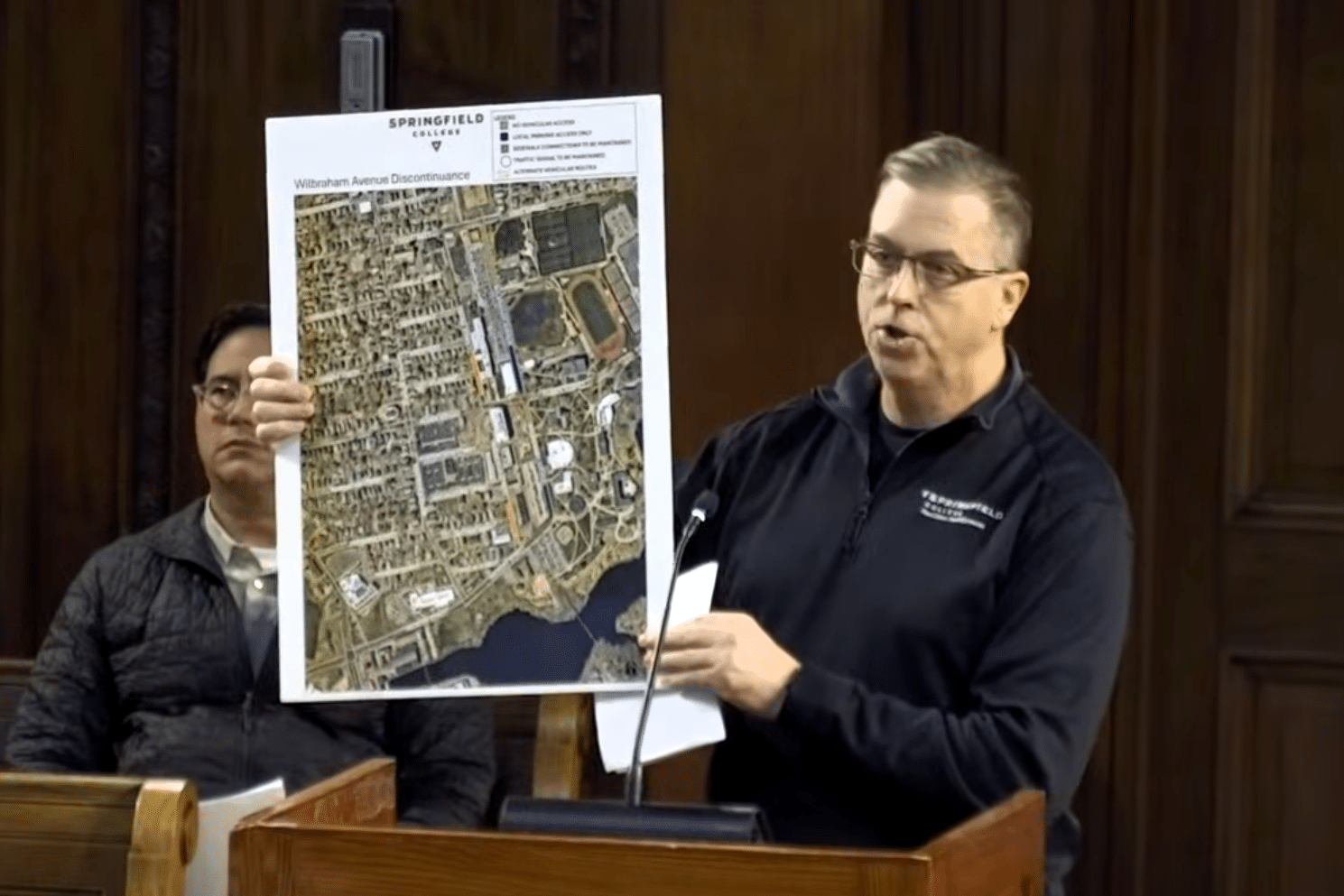
Springfield College Facilities Management Director Kevin Roy displays the area of Wilbraham Avenue the college wants to have closed.
Photo credit: Focus Springfield
SPRINGFIELD — Similar requests to discontinue the use of two Springfield streets resulted in very different discussions at the City Council’s Feb. 2 meeting.
Springfield College Facilities Management Director Kevin Roy presented a request to permanently close half a mile of Wilbraham Avenue, from King Street to Hickory Street. The expanse is bisected by Alden Street, which would remain a public street. Roy said one lane between Alden Street and King Street would also remain available for people who want to access the track or other public-facing college facilities.
The reason for the permanent closure is that Wilbraham Avenue is dangerous to cross, and eliminating the road will improve safety and traffic flow, Roy said. As proof, Springfield College President Mary-Beth A. Cooper offered to share with the council a video of a student being struck by a vehicle at one of the road’s eight crosswalks. The council declined to watch the clip.
The college first proposed the permanent closure of Wilbraham Road in 2023. Councilor Justin Hurst, who served on the body at that time, said the Mason Square neighborhood was “not excited” about the proposal at that time. Councilor Malo Brown went further, saying, “They were all going in an uproar.”
The last time the closure was before the council, it asked Springfield College to speak to its neighbors. Roy said the college had done so, hosting at least two public meetings for the Upper Hill neighborhood where the street is located. No one had spoken in opposition to the proposal, he said. Brown pointed out that those meetings took place two years ago, and City Council President Tracye Whitfield said he has never received a letter or head testimony either for or against shutting the road.
Brown said that the plan to close Wilbraham Avenue “seems like something the try to sneak in every couple of years.” Councilor Victor Davila agreed. “I am a little concerned with the constant quest to have this closed.” While he acknowledged the traffic issues, he said, “This is nothing new to us and we have said no because it’s part of the community.”
When asked by Davila, Hector Valez of the city’s Traffic Commission explained that when a public way is discontinued, the road is divided down the middle and the abutter on either side of the road absorbs their half of the road into their property. As the college owns the land on both sides of Wilbraham Avenue, it would take ownership of the street. Councilor Zaida Govan noted that colleges own a lot of land in Springfield and, due to pay-in-lieu-of-taxes agreements, the city does not receive as much revenue as it would from property taxes.
“We want to be good neighbors,” said Roy. He recalled that the college willingly gave up land for the construction of Samuel Golden Park.
The matter was referred to the council’s General Government Committee for a more detailed analysis.
A separate petition to discontinue a street was submitted for land at the end of Wallace Street, where it meets Wisteria Lane. There, Valdez explained, is a 600-square-foot “paper street,” a road that appears on maps but has never been built out. The petitioner, JETS Property Development founder Jelani Bland, owns property on one side of the street. As it stands, he said, the land is largely used for dumping.
Partway through the discussion, Councilor Michael Fenton inquired if City Council President Tracye Whitfield, who is Bland’s mother, intended to recuse herself. She said she had planned to and apologized for the delay, citing her relative inexperience as the new council president.
Bland explained that his company is building a duplex on an abutting property. The abutter on the opposite side is willing to sell the portion of the road they will own after it is discontinued, and Bland would like to either use the land as additional parking or build on it in the future.
Brown and Councilor Brian Santaniello praised Bland for taking the initiative to create land for housing, something the land-poor city needs. Likewise, Govan said it was putting the land to “good use” because the city would be able to collect taxes on it. Hurst said it would remedy a blighted piece of land.
Fenton, however, said he was uneasy about “giving away” land that could be developed. He said the discontinuance process is not typically used to facilitate personal gain and, if that is the intent, the land should be auctioned to provide the city with most economic benefit. This argument was not enough to sway many of Fenton’s colleagues, however, and when the vote was called, only he and Councilor Melvin Edwards voted not to eliminate the road.

- Sarah Heinonen
- Sarah Heinonen
- Sarah Heinonen
- Sarah Heinonen
- Sarah Heinonen
- Sarah Heinonen
- Sarah Heinonen
- Sarah Heinonen
- Sarah Heinonen
- Sarah Heinonen
- Sarah Heinonen
- Sarah Heinonen
- Sarah Heinonen
- Sarah Heinonen
- Sarah Heinonen
- Sarah Heinonen
- Sarah Heinonen
- Sarah Heinonen
- Sarah Heinonen
- Sarah Heinonen
- Sarah Heinonen
- Sarah Heinonen
- Sarah Heinonen
- Sarah Heinonen
- Sarah Heinonen
- Sarah Heinonen
- Sarah Heinonen
- Sarah Heinonen
- Sarah Heinonen
- Sarah Heinonen
- Sarah Heinonen
- Sarah Heinonen
- Sarah Heinonen
- Sarah Heinonen
- Sarah Heinonen
- Sarah Heinonen
- Sarah Heinonen
- Sarah Heinonen
- Sarah Heinonen
- Sarah Heinonen
- Sarah Heinonen
- Sarah Heinonen
- Sarah Heinonen
- Sarah Heinonen
- Sarah Heinonen
- Sarah Heinonen
- Sarah Heinonen
- Sarah Heinonen
- Sarah Heinonen
- Sarah Heinonen
- Sarah Heinonen
- Sarah Heinonen
- Sarah Heinonen
- Sarah Heinonen
- Sarah Heinonen
- Sarah Heinonen
- Sarah Heinonen
- Sarah Heinonen
- Sarah Heinonen
- Sarah Heinonen
- Sarah Heinonen
- Sarah Heinonen
- Sarah Heinonen
- Sarah Heinonen
- Sarah Heinonen
- Sarah Heinonen
- Sarah Heinonen
- Sarah Heinonen
- Sarah Heinonen
- Sarah Heinonen
- Sarah Heinonen
- Sarah Heinonen
- Sarah Heinonen
- Sarah Heinonen
- Sarah Heinonen
- Sarah Heinonen
- Sarah Heinonen
- Sarah Heinonen
- Sarah Heinonen
- Sarah Heinonen
- Sarah Heinonen
- Sarah Heinonen
- Sarah Heinonen
- Sarah Heinonen
- Sarah Heinonen
- Sarah Heinonen
- Sarah Heinonen
- Sarah Heinonen
- Sarah Heinonen
- Sarah Heinonen
- Sarah Heinonen
- Sarah Heinonen
- Sarah Heinonen
- Sarah Heinonen
- Sarah Heinonen
- Sarah Heinonen
- Sarah Heinonen
- Sarah Heinonen
- Sarah Heinonen
- Sarah Heinonen
- Sarah Heinonen
- Sarah Heinonen
- Sarah Heinonen
- Sarah Heinonen
- Sarah Heinonen
- Sarah Heinonen
- Sarah Heinonen
- Sarah Heinonen
- Sarah Heinonen
- Sarah Heinonen
- Sarah Heinonen
- Sarah Heinonen
- Sarah Heinonen
- Sarah Heinonen
- Sarah Heinonen
- Sarah Heinonen
- Sarah Heinonen
- Sarah Heinonen
- Sarah Heinonen
- Sarah Heinonen
- Sarah Heinonen
- Sarah Heinonen
- Sarah Heinonen
- Sarah Heinonen
- Sarah Heinonen
- Sarah Heinonen
- Sarah Heinonen
- Sarah Heinonen
- Sarah Heinonen
- Sarah Heinonen
- Sarah Heinonen
- Sarah Heinonen
- Sarah Heinonen
- Sarah Heinonen
- Sarah Heinonen
- Sarah Heinonen
- Sarah Heinonen
- Sarah Heinonen
- Sarah Heinonen
- Sarah Heinonen
- Sarah Heinonen
- Sarah Heinonen
- Sarah Heinonen
- Sarah Heinonen
- Sarah Heinonen
- Sarah Heinonen
- Sarah Heinonen
- Sarah Heinonen
- Sarah Heinonen
- Sarah Heinonen