
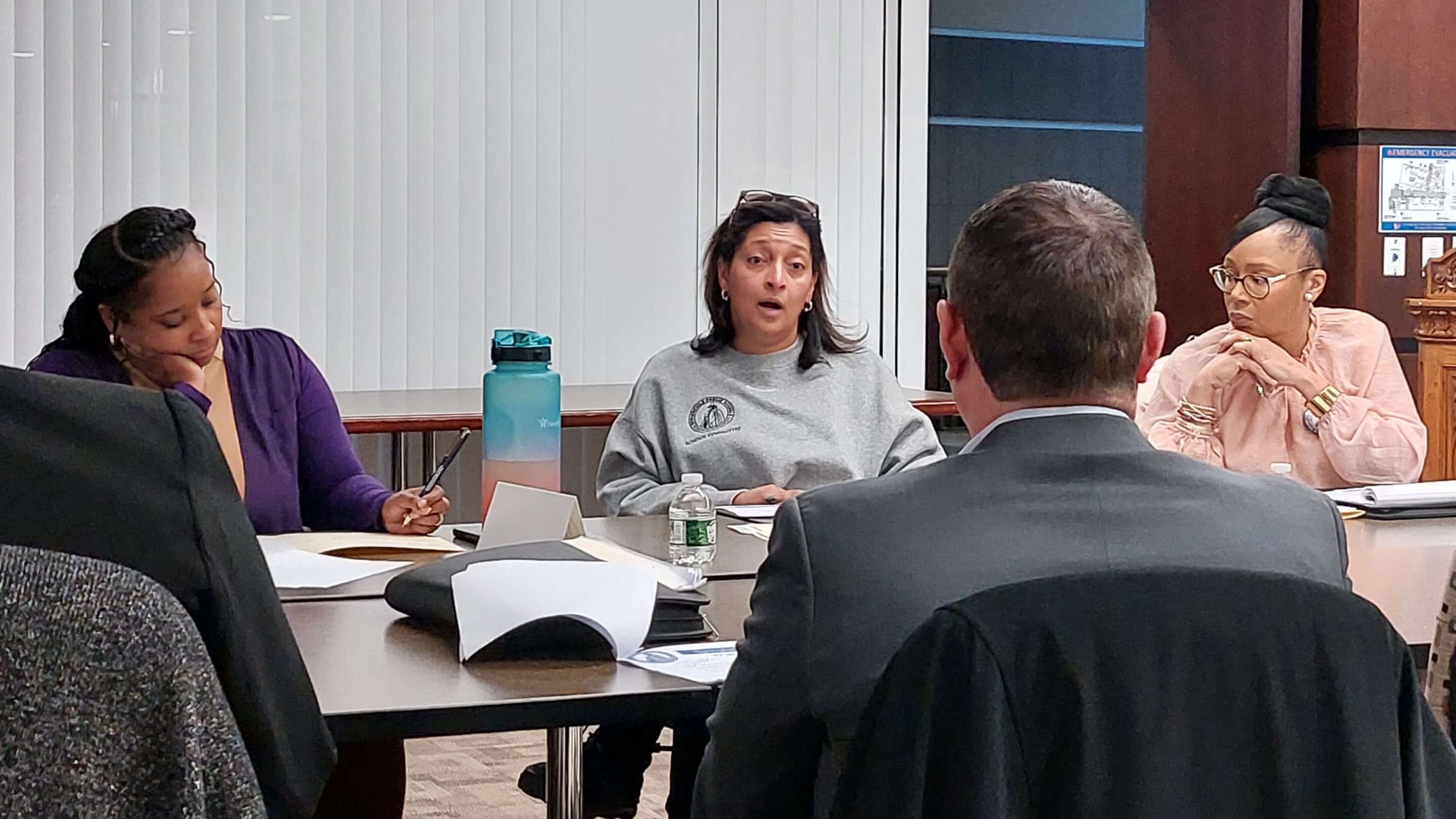
School Committee member Denise Hurst, flanked by colleagues LaTonia Monroe Naylor and Ayana Crawford, asks Chief Financial Officer Patrick Roach questions about the latest budget information at the March 4 Budget and Finance Subcommittee meeting.
Reminder Publishing photo by Sarah Heinonen
SPRINGFIELD — The Springfield School Committee’s Budget and Finance Subcommittee received an update from Superintendent Sonia Dinnall and Chief Financial Officer Patrick Roach and the news for this school year is disappointing, while the long-term outlook was grim.
Roach reminded the subcommittee, composed of School Committee members LaTonia Monroe Naylor, Denise Hurst and Ayana Crawford, that the budget projections are based on a preliminary proposal from Gov. Maura Healey’s administration. The budget still must go through the House and Senate appropriations processes before being reconciled and signed by the governor.
Dinnall said she had received word from Department of Elementary and Secondary Education Commissioner Pedro Martinez just before the meeting that districts could expect $3.9 million less in federal Title I funds than previously thought. Before the reduction, the budget was projected to be $708.6 million, more than $95,000 above the district’s expenses, and 5.8% more than the fiscal year 2026 budget. The reduction means there will be a $3 million deficit in the budget.
“It’s a rough calculation. Nothing is set in stone yet,” Dinnall later told Reminder Publishing, adding that the department will likely need to make cuts. “Whenever we make cuts, we cut as far away from the classroom as possible. There are some jobs that would be cut, but we try not to make the cuts that would have a negative impact on the classroom.”
Roach explained that the district’s foundational budget is up, in part, because this year includes the last installment of Student Opportunity Act funding, which prioritized Chapter 70 state aid for districts with high portions of low-income, special education and English language learner students. “We’re saved by year six of the Student Opportunity Act,” Roach said of this year’s funding.
That said, charter school costs are up 6.5%, while reimbursement is down 3.3%. Contractual salary increases have added $48 million to the budget, supplies and services are $8.1 million more than last year and insurance is up $7 million. Utilities have increased $2.3 million, 17.9% more than last year.
Hurst asked if the older, less efficient buildings were the cause of the utility increase. Roach explained that the newer buildings, which include air conditioning and state-of-the-art electrical systems, can actually bring the utility cost up. The ability to add solar power to schools has been hampered by the fact that private solar products cannot be added to a building that is being funded with a public bond.
Despite the $3 million projected shortfall, a half-dozen Springfield Public School educators spoke during the public comment period, asking the subcommittee to fund more paraprofessionals and provide them with stipends equal to those teachers receive.
Pre-K teacher Ariana Williams said that many of her students are not bathroom-trained, despite rules requiring it. This leaves teachers to take time away from instruction to diaper children. Classroom paraprofessionals or “floaters,” who help in whichever class has a need, would allow for more instructional time and a “better learning experience,” she said.
In substantially separate classrooms, “paraprofessionals are critical,” said educator Judy Kane. It is difficult to recruit and retain quality paraprofessionals at their current pay, particularly for special education classrooms. It is common for special education teachers and paraprofessionals to be injured by dysregulated students. While she said higher staff-to-student ratios would help prevent this, she acknowledged, “Would you work for low pay and a chance to be injured?”
Another special education teacher, Olivia Baker, pled with the subcommittee to provide more training for LINKS teachers. She said staff cannot put a student in a “hold” unless trained and not enough staff are. She also asked for two-way radios to call for assistance because staff cannot always get to the phone while also protecting students from a peer who is dysregulated.
Library educator Leslie Brower asked the subcommittee to create a line item specifically for books and materials and fund it at $5,000 per school with a library. It is not uncommon for books to be “coming apart or damaged,” she said. Additionally, books are lost by students and student interests change over time. Elementary school libraries have a supplies limit of $500, while high school libraries recently saw an increase to $1,000 for supplies. This is not enough funding to purchase new books and materials or replace damaged or lost old ones.
Next year, Roach cautioned, with the end of the Student Opportunity Act and declining enrollment, the School Department is facing a $20 million cliff. Roach said the department would need to make cuts. “If we manage tight this year,” he said the department may be able to roll over some funding to cushion the impact. He explained that municipal school departments are not legally allowed to operate a general reserve fund, and therefore, the department has been unable to set aside money for this eventuality.
“Twenty million dollars is a huge chunk of our budget,” Dinnall said. “It will hurt. We will feel it.”
Roach said, “We need to start advocating now for future budgets.” Monroe Naylor said it was not enough to speak only to the Western Massachusetts legislative delegation. “We need to show up,” she said.

- Sarah Heinonen
- Sarah Heinonen
- Sarah Heinonen
- Sarah Heinonen
- Sarah Heinonen
- Sarah Heinonen
- Sarah Heinonen
- Sarah Heinonen
- Sarah Heinonen
- Sarah Heinonen
- Sarah Heinonen
- Sarah Heinonen
- Sarah Heinonen
- Sarah Heinonen
- Sarah Heinonen
- Sarah Heinonen
- Sarah Heinonen
- Sarah Heinonen
- Sarah Heinonen
- Sarah Heinonen
- Sarah Heinonen
- Sarah Heinonen
- Sarah Heinonen
- Sarah Heinonen
- Sarah Heinonen
- Sarah Heinonen
- Sarah Heinonen
- Sarah Heinonen
- Sarah Heinonen
- Sarah Heinonen
- Sarah Heinonen
- Sarah Heinonen
- Sarah Heinonen
- Sarah Heinonen
- Sarah Heinonen
- Sarah Heinonen
- Sarah Heinonen
- Sarah Heinonen
- Sarah Heinonen
- Sarah Heinonen
- Sarah Heinonen
- Sarah Heinonen
- Sarah Heinonen
- Sarah Heinonen
- Sarah Heinonen
- Sarah Heinonen
- Sarah Heinonen
- Sarah Heinonen
- Sarah Heinonen
- Sarah Heinonen
- Sarah Heinonen
- Sarah Heinonen
- Sarah Heinonen
- Sarah Heinonen
- Sarah Heinonen
- Sarah Heinonen
- Sarah Heinonen
- Sarah Heinonen
- Sarah Heinonen
- Sarah Heinonen
- Sarah Heinonen
- Sarah Heinonen
- Sarah Heinonen
- Sarah Heinonen
- Sarah Heinonen
- Sarah Heinonen
- Sarah Heinonen
- Sarah Heinonen
- Sarah Heinonen
- Sarah Heinonen
- Sarah Heinonen
- Sarah Heinonen
- Sarah Heinonen
- Sarah Heinonen
- Sarah Heinonen
- Sarah Heinonen
- Sarah Heinonen
- Sarah Heinonen
- Sarah Heinonen
- Sarah Heinonen
- Sarah Heinonen
- Sarah Heinonen
- Sarah Heinonen
- Sarah Heinonen
- Sarah Heinonen
- Sarah Heinonen
- Sarah Heinonen
- Sarah Heinonen
- Sarah Heinonen
- Sarah Heinonen
- Sarah Heinonen
- Sarah Heinonen
- Sarah Heinonen
- Sarah Heinonen
- Sarah Heinonen
- Sarah Heinonen
- Sarah Heinonen
- Sarah Heinonen
- Sarah Heinonen
- Sarah Heinonen
- Sarah Heinonen
- Sarah Heinonen
- Sarah Heinonen
- Sarah Heinonen
- Sarah Heinonen
- Sarah Heinonen
- Sarah Heinonen
- Sarah Heinonen
- Sarah Heinonen
- Sarah Heinonen
- Sarah Heinonen
- Sarah Heinonen
- Sarah Heinonen
- Sarah Heinonen
- Sarah Heinonen
- Sarah Heinonen
- Sarah Heinonen
- Sarah Heinonen
- Sarah Heinonen
- Sarah Heinonen
- Sarah Heinonen
- Sarah Heinonen
- Sarah Heinonen
- Sarah Heinonen
- Sarah Heinonen
- Sarah Heinonen
- Sarah Heinonen
- Sarah Heinonen
- Sarah Heinonen
- Sarah Heinonen
- Sarah Heinonen
- Sarah Heinonen
- Sarah Heinonen
- Sarah Heinonen
- Sarah Heinonen
- Sarah Heinonen
- Sarah Heinonen
- Sarah Heinonen
- Sarah Heinonen
- Sarah Heinonen
- Sarah Heinonen
- Sarah Heinonen
- Sarah Heinonen
- Sarah Heinonen
- Sarah Heinonen
- Sarah Heinonen
- Sarah Heinonen
- Sarah Heinonen