
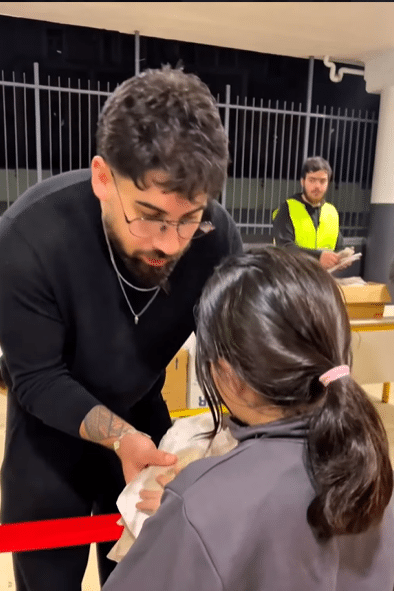
Hassan Mourad hands food to a child whose family is sheltering at a school.
Photo credit: Hassan Mourad
BEIRUT, LEBANON — It is hard to be away from home for extended periods. Harder still when one is in a war zone.
Hassan Mourad, a Springfield resident who traveled to Lebanon on business in late February, became stranded in the country amid the Iran War. However, he has turned his circumstances into action, working to help displaced people however he can.
On March 17, Reminder Publishing reached out to Mourad via Zoom. He stood in front of a wall of windows. In the background, the setting sun cast a warm, hazy glow over the skyline of Beirut. The haze, he explained, was from the plumes of smoke that rise from the hourly air strikes in Douha, Lebanon, a couple miles south of Beirut. Throughout the course of the interview, Mourad repeatedly looked behind him into the distance as the sound of air raids carried across the city.
Mourad, a first-generation Lebanese American, is a 33-year-old business owner and father of two who was born and raised in Springfield. He went to Lebanon to strike distributing deals for his uncle’s line of hair care products. Less than 48 hours later, the United States and Israel launched surprise attacks against Iran. After Iran’s Supreme Leader Ayatollah Ali Khamenei was killed in the first wave of attacks, Hezbollah, a Lebanese political party and banned paramilitary group, launched missiles at its neighbor and long-time adversary, Israel. Israel responded by stepping up its attacks against Lebanon and launching a ground invasion.
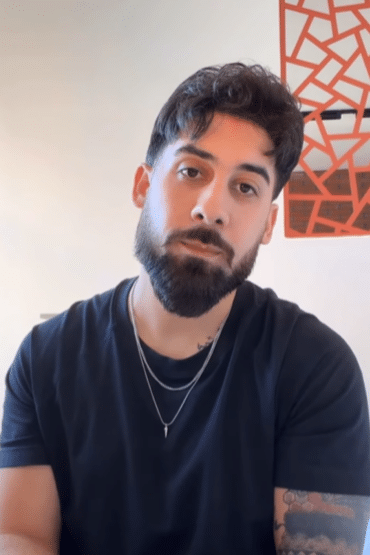
Photo credit: Hassan Mourad
Many Americans left Lebanon immediately after the war began, Mourad said, but a few days later when the American embassy closed, commercial flights largely stopped. The only flights available now are through Beirut-based Middle East Airlines. He had booked a flight to Turkey, but it was canceled. He said if he were able to successfully catch a flight, it would likely take him to Cyprus or Egypt, and he would need to make his way to the Unted States from there.
Mourad is less concerned with fleeing the country, though, and more focused on helping people in Lebanon, much to the dismay of his family. He said his parents are worried, particularly when they hear reports of aid workers killed in air strikes. His mother calls him every day asking him to come home. “I tell her, ‘I have to help our people,’” he said.
Mourad’s children also fear for their father. While he tries to assure them that he is safe but said they are old enough to understand news reports. “They tell me, ‘No one is safe. Look at what happened in Gaza.’ Once I feel like my mission here is complete, I’ll be more focused on getting home.”
When asked how he is faring, Mourad said, “I’m still alive, so that’s good. It’s a surreal experience for me.” He admitted, “It takes a lot of courage to be out here.”
This is not Mourad’s first time in Lebanon while the country is at war. Israel crossed into Lebanon in October 2024, and despite a ceasefire signed roughly two months later, there have been consistent air strikes since. Mourad’s parents left Lebanon to escape war with Israel, which has been recurring since 1978.
“In 2024, I was very unhappy with the situation in the Middle East. It bothered me to pay taxes and have that money go to weapons used to kill people here in the Middle East,” Mourad said of Israel’s use of American-made arms to strike Lebanon. He began a GoFundMe campaign to raise money and then distributed food, diapers and baby formula to the people who were displaced by the fighting.
“Maybe it’s God’s plan putting me back here,” Mourad wondered aloud, and not for the first time.
Mourad said the current air strikes have once again displaced the same people who fled their homes in 2024. Given just 30 minutes of warning, many did not have time to gather possessions, Mourad said. Pushed north to the Litani River, up to 35 miles from their homes near Lebanon’s border with Israel, an estimated 1 million people — 19% of the country’s population — are displaced, sheltering in schools, sleeping in cars and camping in tents.
“In winter in Lebanon, it rains,” Mourad explained. The few belongings of people living in tents along the side of the road are often washed away in rainstorms. That is why Mourad has focused on providing people with blankets and pillows. “My parents raised us to give to the poor,” he said.
He is also focusing on making and delivering meals to people, as it is the Islamic holy month of Ramadhan. During Ramadhan, observant Muslims fast from sunrise to sunset. Each evening, Mourad distributes the meal to break the fast, called Iftar. He also hands out food for Suhoor, the meal that is eaten before the fast begins again at sun-up.
“It’s the month when you recalibrate. You might get off the path of God, but in Ramadhan, you are with family, you celebrate and you get back to God,” Mourad said, tearing up. After a moment, he collected himself and said, “They turned what was supposed to be one of the best times of the year for Muslims into hell, honestly.”
Mourad has been working with local social media influencers to help share the situation on the ground in Lebanon. He has also worked alongside organizations, including Amity Foundation, Banin Charity Association and Wish Foundation, to help provide displaced people with necessities.

Photo credit: Hassan Mourad
While the current fighting has led to the displacement, Mourad said the people he sees have grown used to the danger they have faced over the past few years. “I just feel like everybody’s numb here. They’re just waiting to die,” Mourad said. As the father of an 11-year-old and 7-year-old, he said it is “heartbreaking” to watch fathers try to comfort their young children.
Mourad said the narratives he hears from United States politicians and pundits about people in Lebanon hating Americans is not true. “That doesn’t exist, and it upsets me,” he said. Referring to people who spread such narratives, he said, “I don’t think they know who we are, how the Lebanese people are. They love us, to be honest.” He said that he walks around wearing a shirt emblazoned with “USA” and has never faced any negativity around it. “People don’t hate Americans. They hate American foreign policy. I think Americans hate American foreign policy, too. I have friends in the Army. I don’t want to see them die in Iran.”
Mourad insisted that the issue is not a partisan one. “I voted for Trump. All I cared about — that he sold me on — was stopping wars. Now, we’re seeing the opposite of what we voted for. Why do we not, as Americans, extend compassion to other people? We’re very more similar than different.” He added, “I just want people to live in peace here.”
People can follow Mourad’s humanitarian efforts and see updates from Lebanon on Instagram at @hassan.mourad. Donations to Mourad’s crowdfunding campaign can be made at tinyurl.com/lebanese-aid-alliance-2026. As of press time, he has raised $8,794.

- Sarah Heinonen
- Sarah Heinonen
- Sarah Heinonen
- Sarah Heinonen
- Sarah Heinonen
- Sarah Heinonen
- Sarah Heinonen
- Sarah Heinonen
- Sarah Heinonen
- Sarah Heinonen
- Sarah Heinonen
- Sarah Heinonen
- Sarah Heinonen
- Sarah Heinonen
- Sarah Heinonen
- Sarah Heinonen
- Sarah Heinonen
- Sarah Heinonen
- Sarah Heinonen
- Sarah Heinonen
- Sarah Heinonen
- Sarah Heinonen
- Sarah Heinonen
- Sarah Heinonen
- Sarah Heinonen
- Sarah Heinonen
- Sarah Heinonen
- Sarah Heinonen
- Sarah Heinonen
- Sarah Heinonen
- Sarah Heinonen
- Sarah Heinonen
- Sarah Heinonen
- Sarah Heinonen
- Sarah Heinonen
- Sarah Heinonen
- Sarah Heinonen
- Sarah Heinonen
- Sarah Heinonen
- Sarah Heinonen
- Sarah Heinonen
- Sarah Heinonen
- Sarah Heinonen
- Sarah Heinonen
- Sarah Heinonen
- Sarah Heinonen
- Sarah Heinonen
- Sarah Heinonen
- Sarah Heinonen
- Sarah Heinonen
- Sarah Heinonen
- Sarah Heinonen
- Sarah Heinonen
- Sarah Heinonen
- Sarah Heinonen
- Sarah Heinonen
- Sarah Heinonen
- Sarah Heinonen
- Sarah Heinonen
- Sarah Heinonen
- Sarah Heinonen
- Sarah Heinonen
- Sarah Heinonen
- Sarah Heinonen
- Sarah Heinonen
- Sarah Heinonen
- Sarah Heinonen
- Sarah Heinonen
- Sarah Heinonen
- Sarah Heinonen
- Sarah Heinonen
- Sarah Heinonen
- Sarah Heinonen
- Sarah Heinonen
- Sarah Heinonen
- Sarah Heinonen
- Sarah Heinonen
- Sarah Heinonen
- Sarah Heinonen
- Sarah Heinonen
- Sarah Heinonen
- Sarah Heinonen
- Sarah Heinonen
- Sarah Heinonen
- Sarah Heinonen
- Sarah Heinonen
- Sarah Heinonen
- Sarah Heinonen
- Sarah Heinonen
- Sarah Heinonen
- Sarah Heinonen
- Sarah Heinonen
- Sarah Heinonen
- Sarah Heinonen
- Sarah Heinonen
- Sarah Heinonen
- Sarah Heinonen
- Sarah Heinonen
- Sarah Heinonen
- Sarah Heinonen
- Sarah Heinonen
- Sarah Heinonen
- Sarah Heinonen
- Sarah Heinonen
- Sarah Heinonen
- Sarah Heinonen
- Sarah Heinonen
- Sarah Heinonen
- Sarah Heinonen
- Sarah Heinonen
- Sarah Heinonen
- Sarah Heinonen
- Sarah Heinonen
- Sarah Heinonen
- Sarah Heinonen
- Sarah Heinonen
- Sarah Heinonen
- Sarah Heinonen
- Sarah Heinonen
- Sarah Heinonen
- Sarah Heinonen
- Sarah Heinonen
- Sarah Heinonen
- Sarah Heinonen
- Sarah Heinonen
- Sarah Heinonen
- Sarah Heinonen
- Sarah Heinonen
- Sarah Heinonen
- Sarah Heinonen
- Sarah Heinonen
- Sarah Heinonen
- Sarah Heinonen
- Sarah Heinonen
- Sarah Heinonen
- Sarah Heinonen
- Sarah Heinonen
- Sarah Heinonen
- Sarah Heinonen
- Sarah Heinonen
- Sarah Heinonen
- Sarah Heinonen
- Sarah Heinonen
- Sarah Heinonen
- Sarah Heinonen
- Sarah Heinonen
- Sarah Heinonen
- Sarah Heinonen
- Sarah Heinonen
- Sarah Heinonen
You must be logged in to post a comment.