
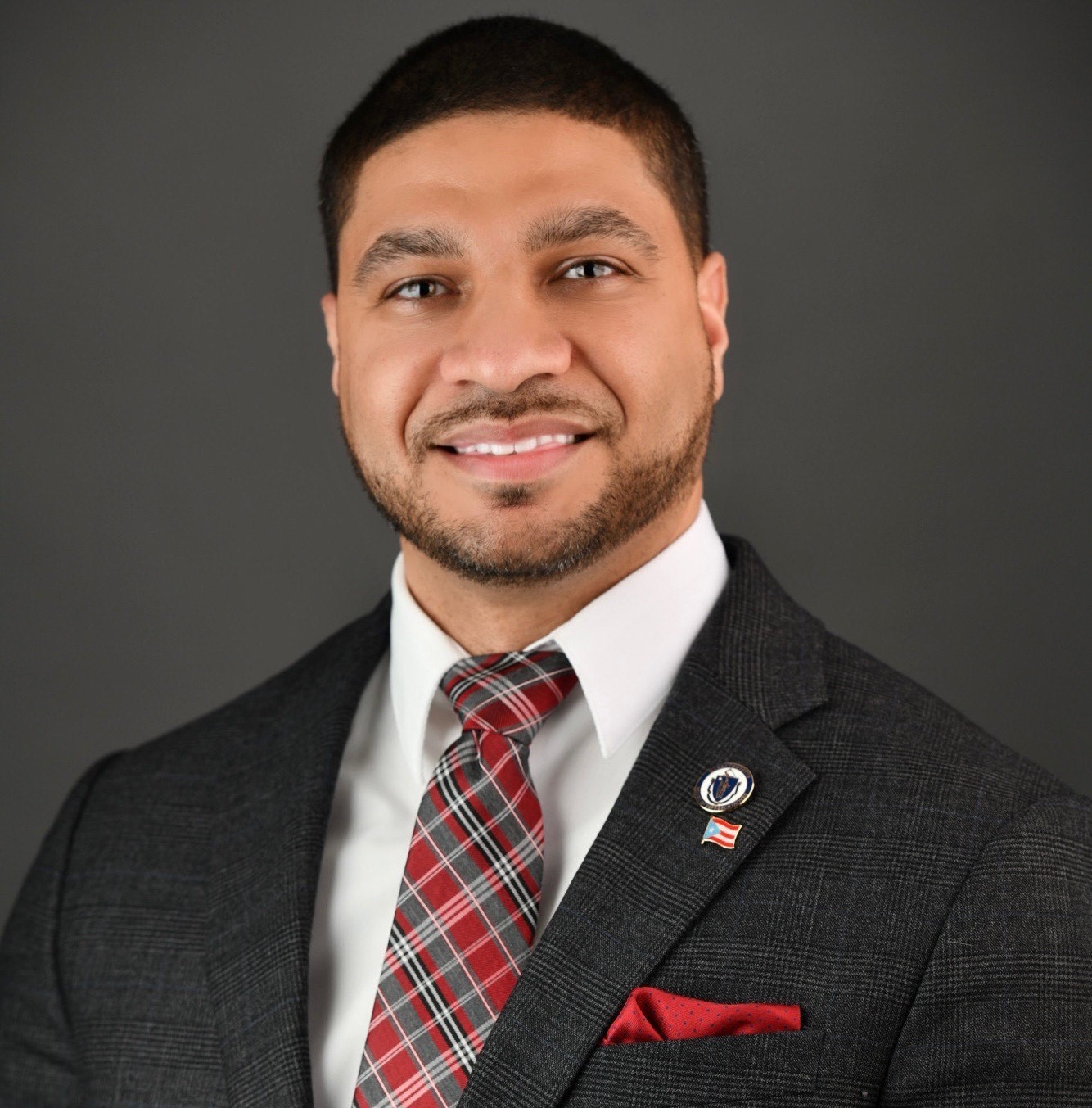
State Rep. Orlando Ramos represents the state House of Representatives 9th Hampden District, encompassing neighborhoods of Indian Orchard, East Springfield, Liberty Heights and parts of Boston Road and Pine Point.
Reminder Publishing file photo
SPRINGFIELD — January 2026 marks the midway point of the current session in the state Legislature and state Rep. Orlando Ramos said he is continuing to make progress on some of his main goals, despite the challenges that exist.
Since Ramos was first elected in 2021, he has worked to pass a bill that would codify the recommendations of a 2020 study on the use of biometric surveillance technology, including facial recognition in law enforcement.
The bill would prohibit law enforcement from acquiring, possessing, accessing, using, assisting or developing the technology.
Biometric surveillance has been on Ramos’s radar for several years. In early 2020, when he served as a Springfield city councilor, the council voted to place a moratorium on the use of facial recognition software by city law enforcement until it could be regulated by the state. At the time, it was only the fifth governmental body in the country to curb use of the technology.
In a previous legislative session, the bill was passed in the state House of Representatives but failed in the Senate. Ramos attributed that, in part, to concerns that then-Gov. Charlie Baker would vetoed the bill. Now, however, Ramos said the conditions are more favorable.
“I think we’re in a better position,” Ramos said. “It’s been made a priority of the Black and Latino Caucus.”
Another piece of legislation filed by Ramos in this session would establish a Puerto Rico Trade Commission. Massachusetts has the fifth-largest Puerto Rican population in the diaspora. Ramos said both Massachusetts and Puerto Rico are leaders in education, pharmaceuticals and manufacturing, and it would benefit both commonwealths to create “a partnership that we don’t need to go outside the country for trade.”
Notably, a similar commission was recommended at the federal level by U.S. Rep. Pablo Hernandez, the resident commissioner of Puerto Rico, who holds a non-voting seat in the House. Ramos said Massachusetts has partnered with Puerto Rico around education in the past, particularly after Hurricane Maria decimated large areas of the island in 2017.
Ramos acknowledged that the year ahead would have its challenges, particularly as the federal government has cut funding to certain states, including Massachusetts.
“They’re unprecedented,” Ramos said of the funding cuts. “We’ve never seen this sort of attack from the federal government.” He called cuts and claw backs of congressionally allocated funding “unethical” and said that Massachusetts residents and the state pay taxes to the federal government and in exchange, funding should be returned to the state.
“It’s hurting us from every angle,” he said, adding that all industries have been affected. Because “there is no rhyme or reason” to which funding pools are being cut, he said it makes it difficult to create a budget and plan for the future. “We have to try to do the best with what we have,” said Ramos.
Ramos understands that people are skeptical of the state government’s transparency, “I think because, at the federal level, people have a distrust and distaste for the government.” But Ramos said the state government operates differently. “We’re an open checkbook,” he said of how the state spends its finances, adding that people can review how money is spent “down to the dollar.” Of his colleagues, Ramos said, “We have a chamber full of people who care and go to work everyday to do our best for the people who sent us there.”

- Sarah Heinonen
- Sarah Heinonen
- Sarah Heinonen
- Sarah Heinonen
- Sarah Heinonen
- Sarah Heinonen
- Sarah Heinonen
- Sarah Heinonen
- Sarah Heinonen
- Sarah Heinonen
- Sarah Heinonen
- Sarah Heinonen
- Sarah Heinonen
- Sarah Heinonen
- Sarah Heinonen
- Sarah Heinonen
- Sarah Heinonen
- Sarah Heinonen
- Sarah Heinonen
- Sarah Heinonen
- Sarah Heinonen
- Sarah Heinonen
- Sarah Heinonen
- Sarah Heinonen
- Sarah Heinonen
- Sarah Heinonen
- Sarah Heinonen
- Sarah Heinonen
- Sarah Heinonen
- Sarah Heinonen
- Sarah Heinonen
- Sarah Heinonen
- Sarah Heinonen
- Sarah Heinonen
- Sarah Heinonen
- Sarah Heinonen
- Sarah Heinonen
- Sarah Heinonen
- Sarah Heinonen
- Sarah Heinonen
- Sarah Heinonen
- Sarah Heinonen
- Sarah Heinonen
- Sarah Heinonen
- Sarah Heinonen
- Sarah Heinonen
- Sarah Heinonen
- Sarah Heinonen
- Sarah Heinonen
- Sarah Heinonen
- Sarah Heinonen
- Sarah Heinonen
- Sarah Heinonen
- Sarah Heinonen
- Sarah Heinonen
- Sarah Heinonen
- Sarah Heinonen
- Sarah Heinonen
- Sarah Heinonen
- Sarah Heinonen
- Sarah Heinonen
- Sarah Heinonen
- Sarah Heinonen
- Sarah Heinonen
- Sarah Heinonen
- Sarah Heinonen
- Sarah Heinonen
- Sarah Heinonen
- Sarah Heinonen
- Sarah Heinonen
- Sarah Heinonen
- Sarah Heinonen
- Sarah Heinonen
- Sarah Heinonen
- Sarah Heinonen
- Sarah Heinonen
- Sarah Heinonen
- Sarah Heinonen
- Sarah Heinonen
- Sarah Heinonen
- Sarah Heinonen
- Sarah Heinonen
- Sarah Heinonen
- Sarah Heinonen
- Sarah Heinonen
- Sarah Heinonen
- Sarah Heinonen
- Sarah Heinonen
- Sarah Heinonen
- Sarah Heinonen
- Sarah Heinonen
- Sarah Heinonen
- Sarah Heinonen
- Sarah Heinonen
- Sarah Heinonen
- Sarah Heinonen
- Sarah Heinonen
- Sarah Heinonen
- Sarah Heinonen
- Sarah Heinonen
- Sarah Heinonen
- Sarah Heinonen
- Sarah Heinonen
- Sarah Heinonen
- Sarah Heinonen
- Sarah Heinonen
- Sarah Heinonen
- Sarah Heinonen
- Sarah Heinonen
- Sarah Heinonen
- Sarah Heinonen
- Sarah Heinonen
- Sarah Heinonen
- Sarah Heinonen
- Sarah Heinonen
- Sarah Heinonen
- Sarah Heinonen
- Sarah Heinonen
- Sarah Heinonen
- Sarah Heinonen
- Sarah Heinonen
- Sarah Heinonen
- Sarah Heinonen
- Sarah Heinonen
- Sarah Heinonen
- Sarah Heinonen
- Sarah Heinonen
- Sarah Heinonen
- Sarah Heinonen
- Sarah Heinonen
- Sarah Heinonen
- Sarah Heinonen
- Sarah Heinonen
- Sarah Heinonen
- Sarah Heinonen
- Sarah Heinonen
- Sarah Heinonen
- Sarah Heinonen
- Sarah Heinonen
- Sarah Heinonen
- Sarah Heinonen
- Sarah Heinonen
- Sarah Heinonen
- Sarah Heinonen
- Sarah Heinonen
- Sarah Heinonen
- Sarah Heinonen
- Sarah Heinonen
- Sarah Heinonen
- Sarah Heinonen
- Sarah Heinonen
- Sarah Heinonen
- Sarah Heinonen
- Sarah Heinonen