
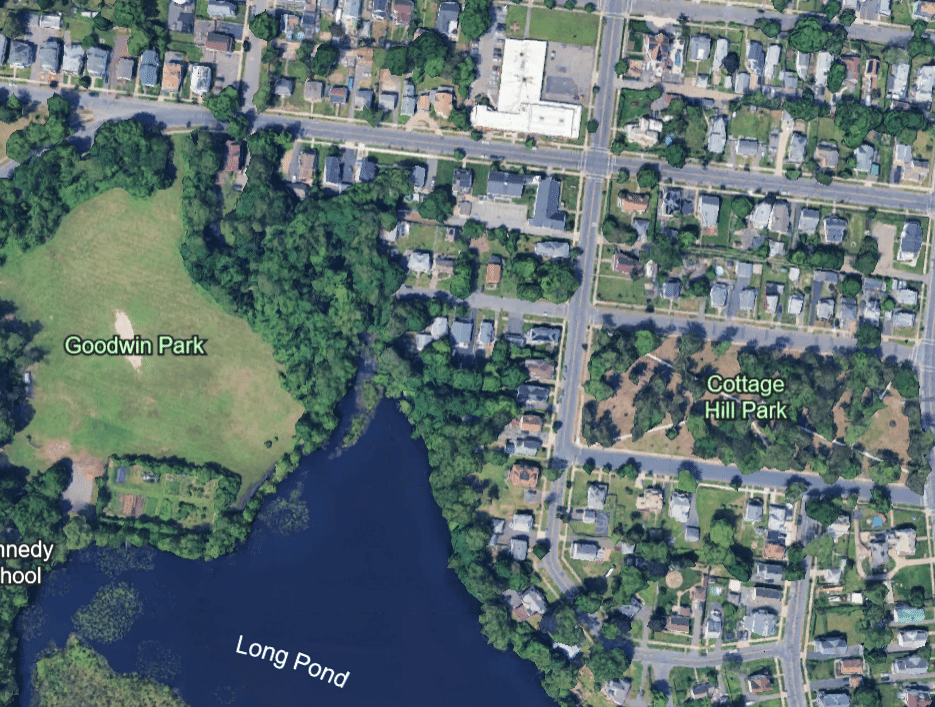
A 1.21-acre parcel on Hampshire Street abutting Long Pond and Goodwin Park was purchased with the intent of building four two-family homes.
Photo credit: Google Earth
SPRINGFIELD — A proposal for a zone change that would allow a developer to turn a wooded area of Indian Orchard into multifamily housing met opposition from a group of neighbors at the Springfield City Council meeting on March 23.
A 1.21-acre parcel on Hampshire Street abutting Long Pond and Goodwin Park was purchased with the intent of building four two-family homes.
To do so, the property must be changed from Residence B to Residence C, which allows for a higher density of units.
Petitioner James Ferrera said the zone change is only the first step in the process. If the zone change is approved, the Planning Board would need to approve a site plan or special permit, and the Conservation Commission would have to review the project before the project could be built. Ferrera said his team is working with the Indian Orchard Neighborhood Council and is “hopeful” that he can continue to work with “neighborhood groups.”
“We look forward to bringing some much more needed housing to the city of Springfield,” Ferrera said.
A group of four residents attended the meeting to oppose the development and express concerns that the land is too steep, and wet to be buildable. They were largely concerned with environmental issues. Residents Barbara Footman and Denise Hudson insisted the site was a wetland.
However, Deputy Director of Planning Philip Dromey explained that nearby Long Pond is the wetland and that there is a 200-foot buffer around it. As the plan was presented, the Conservation Commission would decide whether to approve the developer to build within the buffer. Ferrera said his team is willing to work on any environmental issues with the Conservation Commission.
The opponents were not persuaded. Hudson noted that the lot was heavily wooded, and the project would cut down the trees. “There’s no place for the birds. There’s no place for nature anymore,” she said. Mike Pietras of Engineering and Land Solutions, the engineer on the project, countered that the plan covers less than 24% of the site, leaving 76% “open and green.”
Pietras said the site has sandy soil and is buildable. He refuted comments from Footman that the basements of the homes would flood, noting that the footing for the homes would be 8 feet above the water level. He quipped, “We’d have bigger problems than these basements flooding if it was rising eight feet.”
Dromey addressed comments by the abutters that the land “used to be” unbuildable, but now it is buildable. He explained that the lot had been labeled with an assessors’ code used for unbuildable lots. “Just because the assessors assess it as unbuildable, does not mean it is unbuildable,” he said.
Hudson said Indian Orchard home prices are depreciating and worried that higher density housing would add to that trend. She gave the councilors copies of a petition signed by neighbors who opposed the development.
Ferrera assured the council that he was willing to work with abutters to address their concerns. He and the lawyer for the project, Rachel Fancy, had already spoken to the abutters several times regarding their apprehension. He said many of their concerns would be addressed in the Planning Board’s and Conservation Commission’s processes.
Hudson expressed frustration that Ward 8 Councilor Zaida Govan, who represents Indian Orchard, was absent from the meeting, but Ward 7 Councilor Gerry Martin defended his colleague as “a woman of extreme integrity” who “is always responding to her constituents.”
Ward 6 Councilor Victor Davila questioned whether the road would be continued. Dromey explained that the public way of Hampshire Street would stop at the property line, and the developer would need to continue it into the parcel. He confirmed that the DPW would require that it meet public way standards so it can be plowed. The driveways would branch off of the private portion of the road.
Because only nine councilors were present — the minimum number needed to approve a zone change — the council, Dromey and City Attorney Kenneth Shea discussed a relevant state law under which a failed vote would prohibit the zone change from being resubmitted within two years. Considering that, the petitioner said he would prefer the full committee to decide the matter. The council voted to continue the item to the April 27 hearings meeting.

- Sarah Heinonen
- Sarah Heinonen
- Sarah Heinonen
- Sarah Heinonen
- Sarah Heinonen
- Sarah Heinonen
- Sarah Heinonen
- Sarah Heinonen
- Sarah Heinonen
- Sarah Heinonen
- Sarah Heinonen
- Sarah Heinonen
- Sarah Heinonen
- Sarah Heinonen
- Sarah Heinonen
- Sarah Heinonen
- Sarah Heinonen
- Sarah Heinonen
- Sarah Heinonen
- Sarah Heinonen
- Sarah Heinonen
- Sarah Heinonen
- Sarah Heinonen
- Sarah Heinonen
- Sarah Heinonen
- Sarah Heinonen
- Sarah Heinonen
- Sarah Heinonen
- Sarah Heinonen
- Sarah Heinonen
- Sarah Heinonen
- Sarah Heinonen
- Sarah Heinonen
- Sarah Heinonen
- Sarah Heinonen
- Sarah Heinonen
- Sarah Heinonen
- Sarah Heinonen
- Sarah Heinonen
- Sarah Heinonen
- Sarah Heinonen
- Sarah Heinonen
- Sarah Heinonen
- Sarah Heinonen
- Sarah Heinonen
- Sarah Heinonen
- Sarah Heinonen
- Sarah Heinonen
- Sarah Heinonen
- Sarah Heinonen
- Sarah Heinonen
- Sarah Heinonen
- Sarah Heinonen
- Sarah Heinonen
- Sarah Heinonen
- Sarah Heinonen
- Sarah Heinonen
- Sarah Heinonen
- Sarah Heinonen
- Sarah Heinonen
- Sarah Heinonen
- Sarah Heinonen
- Sarah Heinonen
- Sarah Heinonen
- Sarah Heinonen
- Sarah Heinonen
- Sarah Heinonen
- Sarah Heinonen
- Sarah Heinonen
- Sarah Heinonen
- Sarah Heinonen
- Sarah Heinonen
- Sarah Heinonen
- Sarah Heinonen
- Sarah Heinonen
- Sarah Heinonen
- Sarah Heinonen
- Sarah Heinonen
- Sarah Heinonen
- Sarah Heinonen
- Sarah Heinonen
- Sarah Heinonen
- Sarah Heinonen
- Sarah Heinonen
- Sarah Heinonen
- Sarah Heinonen
- Sarah Heinonen
- Sarah Heinonen
- Sarah Heinonen
- Sarah Heinonen
- Sarah Heinonen
- Sarah Heinonen
- Sarah Heinonen
- Sarah Heinonen
- Sarah Heinonen
- Sarah Heinonen
- Sarah Heinonen
- Sarah Heinonen
- Sarah Heinonen
- Sarah Heinonen
- Sarah Heinonen
- Sarah Heinonen
- Sarah Heinonen
- Sarah Heinonen
- Sarah Heinonen
- Sarah Heinonen
- Sarah Heinonen
- Sarah Heinonen
- Sarah Heinonen
- Sarah Heinonen
- Sarah Heinonen
- Sarah Heinonen
- Sarah Heinonen
- Sarah Heinonen
- Sarah Heinonen
- Sarah Heinonen
- Sarah Heinonen
- Sarah Heinonen
- Sarah Heinonen
- Sarah Heinonen
- Sarah Heinonen
- Sarah Heinonen
- Sarah Heinonen
- Sarah Heinonen
- Sarah Heinonen
- Sarah Heinonen
- Sarah Heinonen
- Sarah Heinonen
- Sarah Heinonen
- Sarah Heinonen
- Sarah Heinonen
- Sarah Heinonen
- Sarah Heinonen
- Sarah Heinonen
- Sarah Heinonen
- Sarah Heinonen
- Sarah Heinonen
- Sarah Heinonen
- Sarah Heinonen
- Sarah Heinonen
- Sarah Heinonen
- Sarah Heinonen
- Sarah Heinonen
- Sarah Heinonen
- Sarah Heinonen
- Sarah Heinonen
- Sarah Heinonen
- Sarah Heinonen
- Sarah Heinonen