
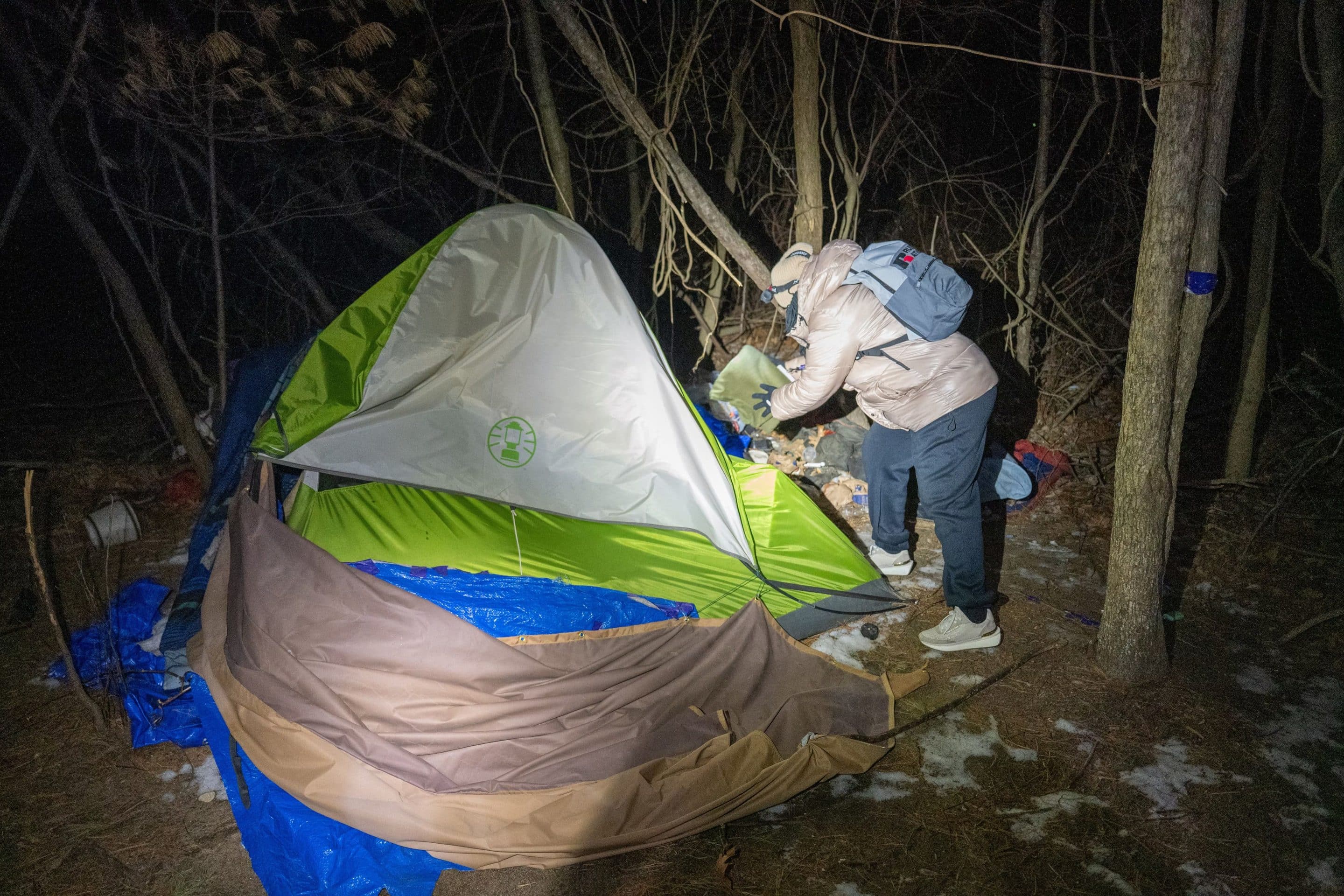
Ivelisse Burgos delivers a care package and a wool blanket to a homeless encampment in Springfield on Jan. 29, 2025.
Republican file photo
SPRINGFIELD — Springfield is among hundreds of cities around the country struggling with the issue of homelessness.
While the problem is more acute in many places, an annual point-in-time count in January 2025 found 2,683 individuals and families, 1.7% of the city’s population, were unhoused.
If a funding cut proposed by the federal Department of Housing and Urban Development takes effect, hundreds more Springfield residents will be without a place to call home.
HUD funds the $3.5 billion Continuum of Care program, the purpose of which is to “promote a community-wide commitment to the goal of ending homelessness,” according to the department’s website.
Currently, 87% of the funding from the Continuum of Care program is devoted to permanent supportive housing, units secured for people with a history of long-term homelessness, those disabilities or unhoused families. On Nov. 13, 2025, HUD sent out notice detailing plans to limit the amount of funding for permanent supportive housing to 30% of the program’s funding. This cut would abruptly leave more than 170,000 nationwide without housing, according to the National Alliance to End Homelessness. On Dec. 8, 2025, HUD withdrew its notice of intent and stated the department would review the possible changes.
In the Jan. 1 issue of The Reminder, Reminder Publishing explored some of the effects this change might have on the shelter system in Springfield. This week, we reached out to law enforcement to discuss how cuts to this program may impact the city.
According to Gerry McCafferty, Springfield’s Director of Housing and administrator of the Springfield-Hampden County Continuum of Care, there are 304 permanent supportive housing units in Springfield. The people currently living in those apartments would find themselves facing homelessness again should this funding change occur, McCafferty said in a press release.
Ryan Walsh, the public information officer and media relations specialist for the Springfield Police Department, said the unhoused people that the police most often have contact with are those who are completely unsheltered, known as sleeping rough.
Walsh said, “If you start reducing permanent housing, we could anticipate seeing more encampments, and with encampments comes wellness checks.” The Police Department often checks in on people who are unsheltered, and the Metro Center Unit knows most of the unsheltered people by name, he said. There is a smaller group of unsheltered people along Boston Road and in some of the city’s wooded areas, Walsh said, but most of them live downtown along the Main Street corridor, near services and the bus lines.
“In terms of crimes and arrests for the homeless population, the vast majority is about quality of life — panhandling, loitering, trespassing,” said Walsh, adding that relatively few incidents of theft or shoplifting are committed by people who are unhoused. More troubling is the opportunity for people who sell drugs to frequent encampments where people with substance abuse disorder may live. He added, “There are issues at times, if you’re purchasing drugs, someone might try to rob you.”
Walsh said the Police Department works with the state Department of Public Health and the city to regularly offer unsheltered people resources, “for when they are ready. A lot of them never are,” he said.
“Housing stability is public safety,” said Rob Rizzuto, senior public information officer for the Hampden County Sheriff’s Department. “Vouchers reduce the strain on public services. Housing is essential to medical and behavioral health, socio-economic programs.”
Rizzuto said, “In substance abuse facilities or jail, we see a lot of addiction-related challenges that have gone unaddressed in the community.” He added that the Sheriff’s Department works to address the whole person while they are incarcerated and often connects them to resources and sober programs in preparation for their release. “When homelessness is at the root of this, it makes everything else exponentially more challenging,” he said.
“There are crises and there are manufactured crises,” Rizzuto said. “Removing these supports seems like it would be counterproductive. Cuts to federal housing assistance doesn’t eliminate the costs; it just pushes it onto cities and counties. Jails and emergency rooms are among the least effective and most expensive housing, but this is where unhoused people end up.” Rizzuto said the loss of housing assistance would affect the community and its people “for decades.”
If you are experiencing homelessness, call 211 for a directory of housing, food and crisis services, or visit mass.gov/help-for-homeless-people.

- Sarah Heinonen
- Sarah Heinonen
- Sarah Heinonen
- Sarah Heinonen
- Sarah Heinonen
- Sarah Heinonen
- Sarah Heinonen
- Sarah Heinonen
- Sarah Heinonen
- Sarah Heinonen
- Sarah Heinonen
- Sarah Heinonen
- Sarah Heinonen
- Sarah Heinonen
- Sarah Heinonen
- Sarah Heinonen
- Sarah Heinonen
- Sarah Heinonen
- Sarah Heinonen
- Sarah Heinonen
- Sarah Heinonen
- Sarah Heinonen
- Sarah Heinonen
- Sarah Heinonen
- Sarah Heinonen
- Sarah Heinonen
- Sarah Heinonen
- Sarah Heinonen
- Sarah Heinonen
- Sarah Heinonen
- Sarah Heinonen
- Sarah Heinonen
- Sarah Heinonen
- Sarah Heinonen
- Sarah Heinonen
- Sarah Heinonen
- Sarah Heinonen
- Sarah Heinonen
- Sarah Heinonen
- Sarah Heinonen
- Sarah Heinonen
- Sarah Heinonen
- Sarah Heinonen
- Sarah Heinonen
- Sarah Heinonen
- Sarah Heinonen
- Sarah Heinonen
- Sarah Heinonen
- Sarah Heinonen
- Sarah Heinonen
- Sarah Heinonen
- Sarah Heinonen
- Sarah Heinonen
- Sarah Heinonen
- Sarah Heinonen
- Sarah Heinonen
- Sarah Heinonen
- Sarah Heinonen
- Sarah Heinonen
- Sarah Heinonen
- Sarah Heinonen
- Sarah Heinonen
- Sarah Heinonen
- Sarah Heinonen
- Sarah Heinonen
- Sarah Heinonen
- Sarah Heinonen
- Sarah Heinonen
- Sarah Heinonen
- Sarah Heinonen
- Sarah Heinonen
- Sarah Heinonen
- Sarah Heinonen
- Sarah Heinonen
- Sarah Heinonen
- Sarah Heinonen
- Sarah Heinonen
- Sarah Heinonen
- Sarah Heinonen
- Sarah Heinonen
- Sarah Heinonen
- Sarah Heinonen
- Sarah Heinonen
- Sarah Heinonen
- Sarah Heinonen
- Sarah Heinonen
- Sarah Heinonen
- Sarah Heinonen
- Sarah Heinonen
- Sarah Heinonen
- Sarah Heinonen
- Sarah Heinonen
- Sarah Heinonen
- Sarah Heinonen
- Sarah Heinonen
- Sarah Heinonen
- Sarah Heinonen
- Sarah Heinonen
- Sarah Heinonen
- Sarah Heinonen
- Sarah Heinonen
- Sarah Heinonen
- Sarah Heinonen
- Sarah Heinonen
- Sarah Heinonen
- Sarah Heinonen
- Sarah Heinonen
- Sarah Heinonen
- Sarah Heinonen
- Sarah Heinonen
- Sarah Heinonen
- Sarah Heinonen
- Sarah Heinonen
- Sarah Heinonen
- Sarah Heinonen
- Sarah Heinonen
- Sarah Heinonen
- Sarah Heinonen
- Sarah Heinonen
- Sarah Heinonen
- Sarah Heinonen
- Sarah Heinonen
- Sarah Heinonen
- Sarah Heinonen
- Sarah Heinonen
- Sarah Heinonen
- Sarah Heinonen
- Sarah Heinonen
- Sarah Heinonen
- Sarah Heinonen
- Sarah Heinonen
- Sarah Heinonen
- Sarah Heinonen
- Sarah Heinonen
- Sarah Heinonen
- Sarah Heinonen
- Sarah Heinonen
- Sarah Heinonen
- Sarah Heinonen
- Sarah Heinonen
- Sarah Heinonen
- Sarah Heinonen
- Sarah Heinonen
- Sarah Heinonen
- Sarah Heinonen
- Sarah Heinonen
- Sarah Heinonen
- Sarah Heinonen
- Sarah Heinonen
- Sarah Heinonen
- Sarah Heinonen
- Sarah Heinonen
- Sarah Heinonen
- Sarah Heinonen