
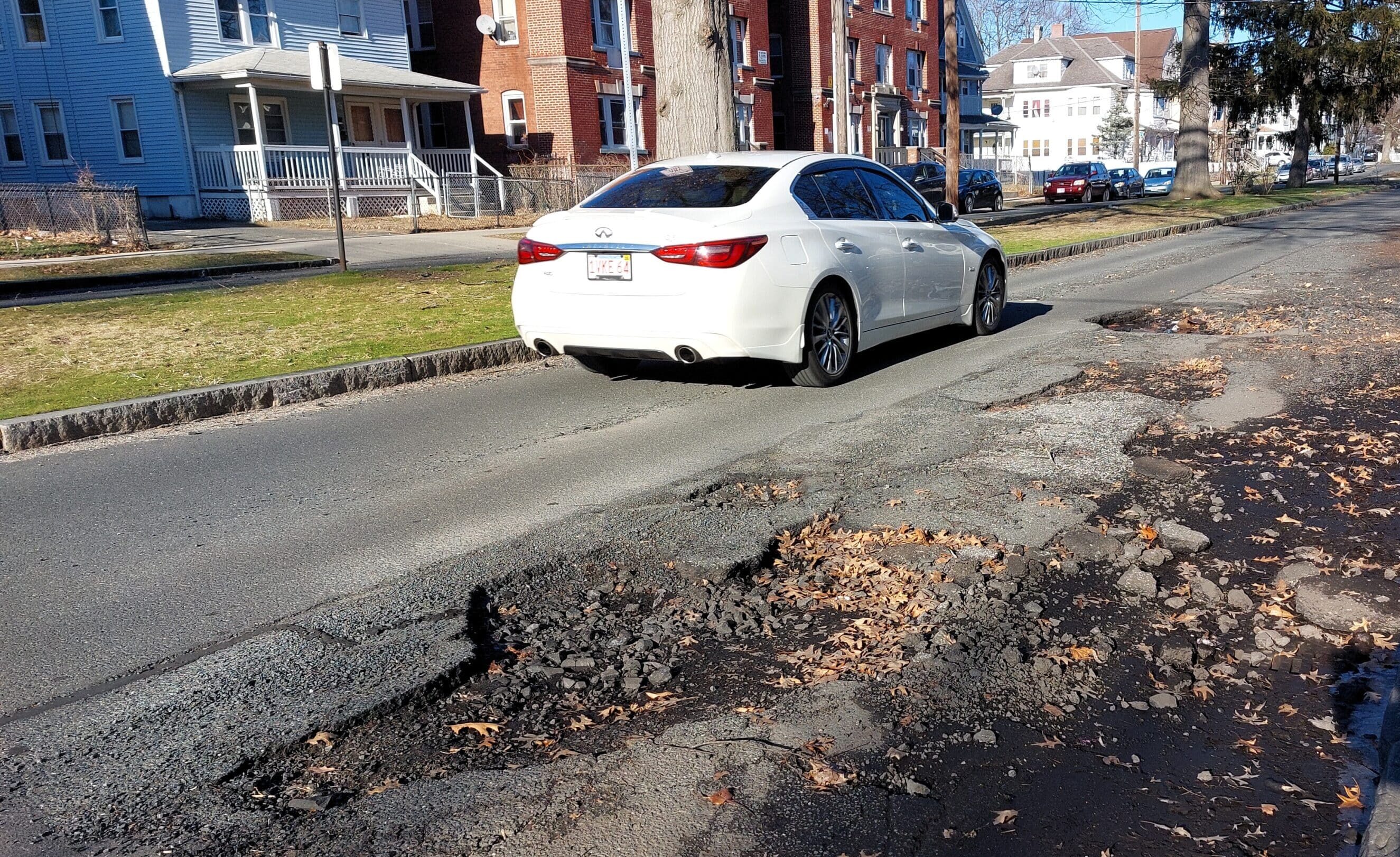
A vehicle drives past large potholes at the intersection of Grenada Terrace and Ventura Street.
Reminder Publishing photo by Sarah Heinonen
SPRINGFIELD — Spring in New England is pothole season and this year the roadway nuisance has been particularly egregious.
At the City Councilor’s March 17 Sustainability and Environment Committee meeting, Chair and Ward 6 Councilor Victor Davila made the case that potholes are more than a nuisance, affecting not only driving conditions but the environment.
He said potholes cause drivers to swerve, brake suddenly and repeatedly slow down and speed up, leading to higher fuel consumption and emissions. The water in potholes collects oil, heavy metals and other fluids from automobiles, as well as road salt, which seep into the ground. Additionally, he said, “You have people honking their horns,” vibrations and noise from vehicles that hit potholes negatively impacting neighborhoods’ quality of life.
Even repairing potholes has environmental impacts. More roadway material must be manufactured, transported and laid down, generating fossil fuels and consuming energy at each step.
Davila listed a few streets in his ward surrounding Forest Park that have pothole damage, including Cliffwood, Orange, Lenox and Tiffany streets and Pineywoods Ave. Grenada Terrace “looks like a war zone,” Davila said, “like somebody dropped grenades.”
DPW Director Christopher Cignoli explained that a perfect storm of conditions this year has led to potholes that are excessive in number and severe in size. He said many roads in Springfield are older with cracks that allowed water from the heavy amounts of snow the city received to seep in. Extreme cold the locked frost below ground level.
Potholes occur throughout the year but are particularly a problem in the spring. Once temperatures begin to rise during the daytime, the frost and ice melt, but harden again as temperatures dip below freezing at night. This freeze-thaw cycle causes the asphalt to expand and contract, damaging it and resulting in potholes.
Because there was so much snow this winter, Cignoli said the parking ban was left in effect longer than usual. The Springfield Police Department towed three times the number of vehicles as usual over the winter. Cignoli said it is important to keep vehicles off the streets, not just so plow crews can clear them, but also because they block sunlight from hitting the asphalt and slows the time it takes snow to melt.
Davila asked Cignoli to about how the DPW is combating the pothole problem. Cignoli explained that three crews, one more than normal for this time of year, had been filling potholes with “cold patch,” which is essentially a gravel and asphalt mix that is designed to temporarily cover the holes. Until the weather is consistently above freezing, he said, permanent asphalt material cannot be manufactured or adhered to road surfaces. Cignoli expected hot patch to be available within a week. Pothole repair is largely tackled based on the order in which they are reported, but major potholes may be prioritized, he said.
Davila brought Cignoli’s attention to the X, a busy intersection in the Forest Park neighborhood. Cignoli explained that responsibility for those potholes falls to the Massachusetts Department of Transportation, which is partway through construction on a multi-year redesign of the area.
Returning to the environmental impacts of potholes and winter road maintenance, Davila asked about the quality of road salt used by the DPW and if there were more environmentally friendly alternatives. Cignoli did not address alternative options but explained that the city buys raw salt and treats it with varying portions of liquid calcium depending on road conditions and the type of precipitation expected. It takes DPW crews about 12 hours to pre-treat Springfield’s arterial roads. Cignoli said his department does not have the resources to treat the residential streets, except for dangerous hills.
Council President Tracye Whitfield, who joined the meeting remotely, along with At Large Councilor Justin Hurst and Ward 2 Councilor Michael Fenton, asked if there had been a moratorium on digging this winter as there had been previous years. Cignoli confirmed that the only digging or trenching needed for emergency utility work had been allowed. The moratorium is due to be lifted on March 23.
Cignoli urged residents to report potholes to the city’s 311 system using a nearby address so crews can easily locate them. If a vehicle is damaged by a pothole that has been reported to 311 but not fixed, Cignoli said people can file a claim with the city for repair costs. Cignoli agreed to Davila’s request that the City Council be provided with a weekly “progress report” on which potholes have been addressed.
To report a pothole, call 413-736-3111 or email 311@springfieldcityhall.com. Davila also said people can reach out to him at councilorvictordavila@gmail.con if the pothole goes unaddressed.

- Sarah Heinonen
- Sarah Heinonen
- Sarah Heinonen
- Sarah Heinonen
- Sarah Heinonen
- Sarah Heinonen
- Sarah Heinonen
- Sarah Heinonen
- Sarah Heinonen
- Sarah Heinonen
- Sarah Heinonen
- Sarah Heinonen
- Sarah Heinonen
- Sarah Heinonen
- Sarah Heinonen
- Sarah Heinonen
- Sarah Heinonen
- Sarah Heinonen
- Sarah Heinonen
- Sarah Heinonen
- Sarah Heinonen
- Sarah Heinonen
- Sarah Heinonen
- Sarah Heinonen
- Sarah Heinonen
- Sarah Heinonen
- Sarah Heinonen
- Sarah Heinonen
- Sarah Heinonen
- Sarah Heinonen
- Sarah Heinonen
- Sarah Heinonen
- Sarah Heinonen
- Sarah Heinonen
- Sarah Heinonen
- Sarah Heinonen
- Sarah Heinonen
- Sarah Heinonen
- Sarah Heinonen
- Sarah Heinonen
- Sarah Heinonen
- Sarah Heinonen
- Sarah Heinonen
- Sarah Heinonen
- Sarah Heinonen
- Sarah Heinonen
- Sarah Heinonen
- Sarah Heinonen
- Sarah Heinonen
- Sarah Heinonen
- Sarah Heinonen
- Sarah Heinonen
- Sarah Heinonen
- Sarah Heinonen
- Sarah Heinonen
- Sarah Heinonen
- Sarah Heinonen
- Sarah Heinonen
- Sarah Heinonen
- Sarah Heinonen
- Sarah Heinonen
- Sarah Heinonen
- Sarah Heinonen
- Sarah Heinonen
- Sarah Heinonen
- Sarah Heinonen
- Sarah Heinonen
- Sarah Heinonen
- Sarah Heinonen
- Sarah Heinonen
- Sarah Heinonen
- Sarah Heinonen
- Sarah Heinonen
- Sarah Heinonen
- Sarah Heinonen
- Sarah Heinonen
- Sarah Heinonen
- Sarah Heinonen
- Sarah Heinonen
- Sarah Heinonen
- Sarah Heinonen
- Sarah Heinonen
- Sarah Heinonen
- Sarah Heinonen
- Sarah Heinonen
- Sarah Heinonen
- Sarah Heinonen
- Sarah Heinonen
- Sarah Heinonen
- Sarah Heinonen
- Sarah Heinonen
- Sarah Heinonen
- Sarah Heinonen
- Sarah Heinonen
- Sarah Heinonen
- Sarah Heinonen
- Sarah Heinonen
- Sarah Heinonen
- Sarah Heinonen
- Sarah Heinonen
- Sarah Heinonen
- Sarah Heinonen
- Sarah Heinonen
- Sarah Heinonen
- Sarah Heinonen
- Sarah Heinonen
- Sarah Heinonen
- Sarah Heinonen
- Sarah Heinonen
- Sarah Heinonen
- Sarah Heinonen
- Sarah Heinonen
- Sarah Heinonen
- Sarah Heinonen
- Sarah Heinonen
- Sarah Heinonen
- Sarah Heinonen
- Sarah Heinonen
- Sarah Heinonen
- Sarah Heinonen
- Sarah Heinonen
- Sarah Heinonen
- Sarah Heinonen
- Sarah Heinonen
- Sarah Heinonen
- Sarah Heinonen
- Sarah Heinonen
- Sarah Heinonen
- Sarah Heinonen
- Sarah Heinonen
- Sarah Heinonen
- Sarah Heinonen
- Sarah Heinonen
- Sarah Heinonen
- Sarah Heinonen
- Sarah Heinonen
- Sarah Heinonen
- Sarah Heinonen
- Sarah Heinonen
- Sarah Heinonen
- Sarah Heinonen
- Sarah Heinonen
- Sarah Heinonen
- Sarah Heinonen
- Sarah Heinonen
- Sarah Heinonen
- Sarah Heinonen
- Sarah Heinonen
- Sarah Heinonen
- Sarah Heinonen