
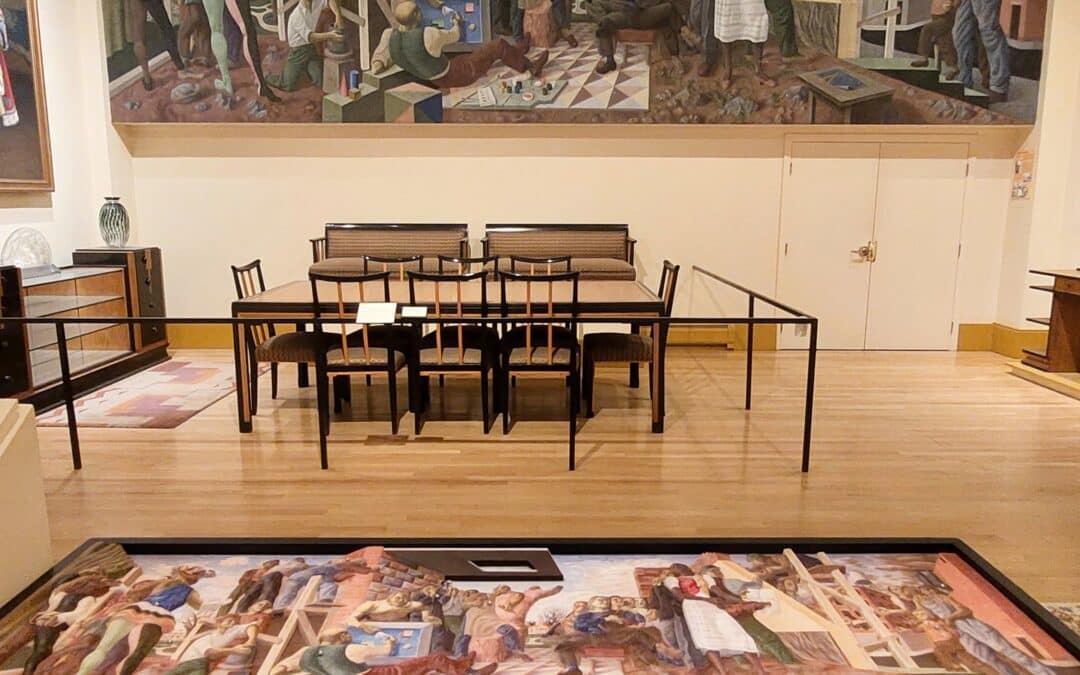
The interactive layered relief of Sante Graziani’s painting, with the mural in the background.
Reminder Publishing photo by Sarah Heinonen
SPRINGFIELD — An exhibit at the Springfield Museums allows people to explore an old painting in a brand-new way — with their hands.
The name of exhibit, “Please Touch! A Tactile Exploration of Sante Graziani’s Mural,” a play on signs reading “Do Not Touch” that are commonly found in museums.
An interactive exhibit, it allows people to physically explore a three-dimensional recreation of an artwork that is usually only experienced through the eyes.
The mural, an enormous 25-foot by 7-foot plaster fresco, came about when the Museum of Fine Arts in Springfield, now the Michele and Donald D’Amour Museum of Fine Arts, hosted an international mural contest in 1943. At the time, mural art was popular in the United States, spurred on by works commissioned by the federal Works Progress Administration during the Great Depression. More than 80 artists from the United States, Mexico and Canada submitted designs to the contest that celebrated culture and art, but Graziani’s vision was unanimously chosen by the jury of judges. The fresco was painted in 1947.
Reminder Publishing photo by Sarah Heinonen
The figures depicted in the work represent the arts scene of Springfield in the 1940s, highlighting painters, sculptors, photographers, architects, musicians, actors and dancers. Many of the individuals in the mural are not simply generic artists, but rather, are based on Graziani’s contemporaries and friends. These include sculptor Leonard Baskin, who was Graziani’s college roommate, and Springfield’s own soprano vocalist Adele Addison. Also included in the crowd were then-museum director Frederick Robinson and a depiction of the artist himself, as a child.
Meanwhile, in the mural, two walls are being erected, reflecting the growing, evolving nature of the museum. The walls visually divide the painting into three sections. In the background of the painting, there are well known Springfield buildings, including Old First Church and the Alexander House. The Van Norman Tool Company, which sponsored the mural contest, is seen on the right side of the mural.
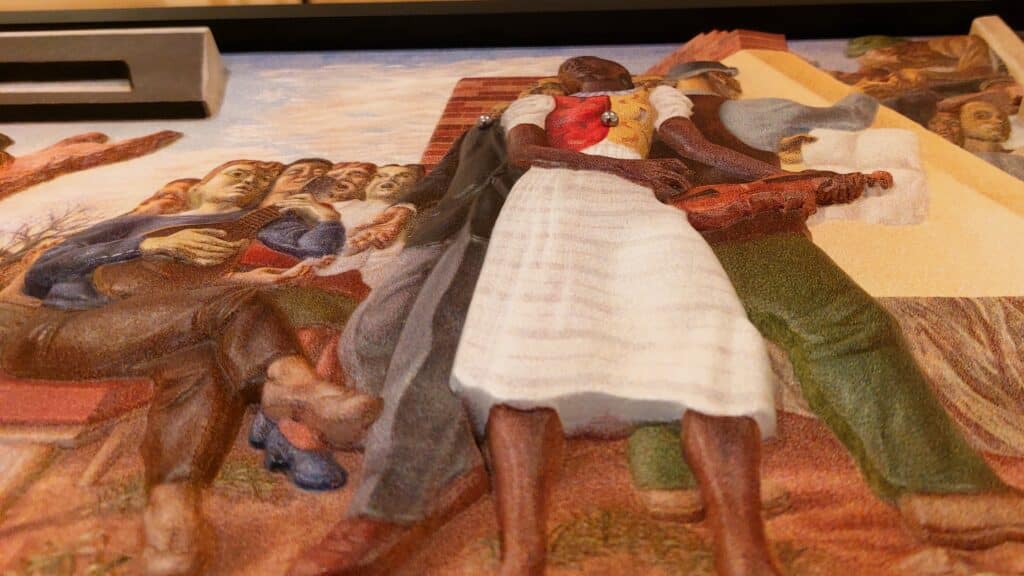
The interactive exhibit presents museum goers with a three-dimensional recreation of the artwork laid flat on a table in front of the mural. The layered relief adds a realistic quality to the art. Every bumpy rock, sharp-edged stair and rippled fabric is brought to life, making it feel as though the viewer just interrupted the movement of the scene’s subjects.
Beyond giving the mural more depth, the exhibit allows people with limited vision to experience the artwork, allowing fingertips to explore the people and their contributions to the arts. Buttons are set into the tactile recreation. When one runs their hands over a figure or object, it triggers an audio commentary about the painting, the art forms depicted, the mural competition and the artist.
The exhibit was made possible with support from FedEx, the National Federation of the Blind, MassCultural Council and Tactile Images, an organization that creates three-dimensional art to allow people living with limited sight to expand their enjoyment of art.
“Please Touch! A Tactile Exploration of Sante Graziani’s Mural” is on display in the Michele and Donald D’Amour Museum of Fine Arts through July 26.

- Sarah Heinonen
- Sarah Heinonen
- Sarah Heinonen
- Sarah Heinonen
- Sarah Heinonen
- Sarah Heinonen
- Sarah Heinonen
- Sarah Heinonen
- Sarah Heinonen
- Sarah Heinonen
- Sarah Heinonen
- Sarah Heinonen
- Sarah Heinonen
- Sarah Heinonen
- Sarah Heinonen
- Sarah Heinonen
- Sarah Heinonen
- Sarah Heinonen
- Sarah Heinonen
- Sarah Heinonen
- Sarah Heinonen
- Sarah Heinonen
- Sarah Heinonen
- Sarah Heinonen
- Sarah Heinonen
- Sarah Heinonen
- Sarah Heinonen
- Sarah Heinonen
- Sarah Heinonen
- Sarah Heinonen
- Sarah Heinonen
- Sarah Heinonen
- Sarah Heinonen
- Sarah Heinonen
- Sarah Heinonen
- Sarah Heinonen
- Sarah Heinonen
- Sarah Heinonen
- Sarah Heinonen
- Sarah Heinonen
- Sarah Heinonen
- Sarah Heinonen
- Sarah Heinonen
- Sarah Heinonen
- Sarah Heinonen
- Sarah Heinonen
- Sarah Heinonen
- Sarah Heinonen
- Sarah Heinonen
- Sarah Heinonen
- Sarah Heinonen
- Sarah Heinonen
- Sarah Heinonen
- Sarah Heinonen
- Sarah Heinonen
- Sarah Heinonen
- Sarah Heinonen
- Sarah Heinonen
- Sarah Heinonen
- Sarah Heinonen
- Sarah Heinonen
- Sarah Heinonen
- Sarah Heinonen
- Sarah Heinonen
- Sarah Heinonen
- Sarah Heinonen
- Sarah Heinonen
- Sarah Heinonen
- Sarah Heinonen
- Sarah Heinonen
- Sarah Heinonen
- Sarah Heinonen
- Sarah Heinonen
- Sarah Heinonen
- Sarah Heinonen
- Sarah Heinonen
- Sarah Heinonen
- Sarah Heinonen
- Sarah Heinonen
- Sarah Heinonen
- Sarah Heinonen
- Sarah Heinonen
- Sarah Heinonen
- Sarah Heinonen
- Sarah Heinonen
- Sarah Heinonen
- Sarah Heinonen
- Sarah Heinonen
- Sarah Heinonen
- Sarah Heinonen
- Sarah Heinonen
- Sarah Heinonen
- Sarah Heinonen
- Sarah Heinonen
- Sarah Heinonen
- Sarah Heinonen
- Sarah Heinonen
- Sarah Heinonen
- Sarah Heinonen
- Sarah Heinonen
- Sarah Heinonen
- Sarah Heinonen
- Sarah Heinonen
- Sarah Heinonen
- Sarah Heinonen
- Sarah Heinonen
- Sarah Heinonen
- Sarah Heinonen
- Sarah Heinonen
- Sarah Heinonen
- Sarah Heinonen
- Sarah Heinonen
- Sarah Heinonen
- Sarah Heinonen
- Sarah Heinonen
- Sarah Heinonen
- Sarah Heinonen
- Sarah Heinonen
- Sarah Heinonen
- Sarah Heinonen
- Sarah Heinonen
- Sarah Heinonen
- Sarah Heinonen
- Sarah Heinonen
- Sarah Heinonen
- Sarah Heinonen
- Sarah Heinonen
- Sarah Heinonen
- Sarah Heinonen
- Sarah Heinonen
- Sarah Heinonen
- Sarah Heinonen
- Sarah Heinonen
- Sarah Heinonen
- Sarah Heinonen
- Sarah Heinonen
- Sarah Heinonen
- Sarah Heinonen
- Sarah Heinonen
- Sarah Heinonen
- Sarah Heinonen
- Sarah Heinonen
- Sarah Heinonen
- Sarah Heinonen
- Sarah Heinonen
- Sarah Heinonen
- Sarah Heinonen
You must be logged in to post a comment.