
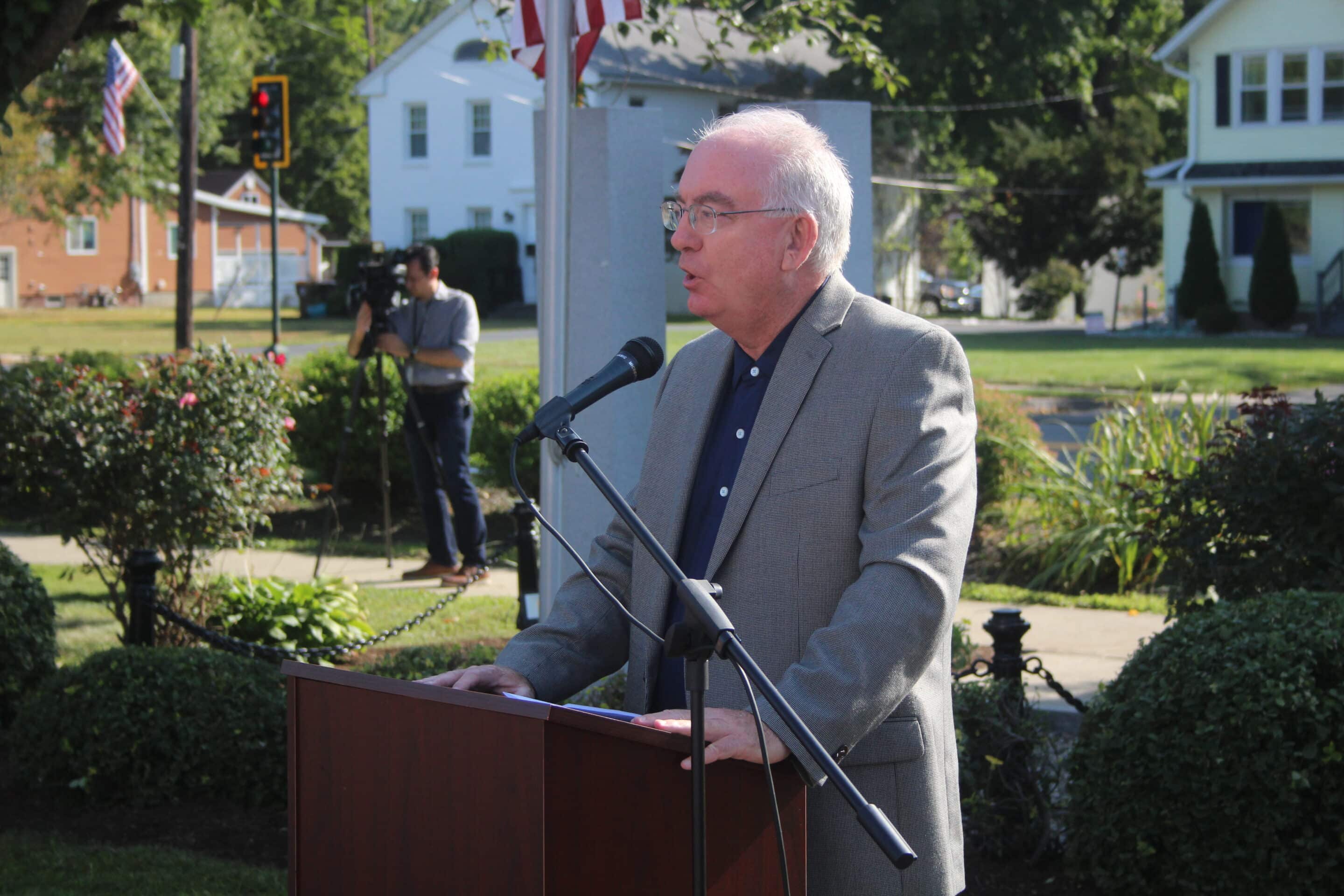
Mayor Christopher Johnson, pictured in this file photo, explained that stormwater infrastructure is the “linchpin” of the downtown revitalization planned for Walnut Street Extension.
Reminder Publishing file photo
AGAWAM — Municipalities do not usually receive funding directly from the federal government. Often, it is received by states, which then distribute it to cities and towns.
One exception to this is an earmark, a sum of money that legislators request for specific projects in their district. Agawam recently received a $1.97 million earmark to improve its stormwater infrastructure.
Mayor Christopher Johnson explained that stormwater infrastructure is the “linchpin” of the downtown revitalization planned for Walnut Street Extension. As it stands, he said, the low-lying area around Walnut Street Extension and Ramah Circle flood during storms. He said there is “virtually no capacity” in the stormwater system to manage large volumes of rainwater.
“People don’t realize how much these projects cost,” Johnson said. He pointed to a recent culvert replacement with a price tag of $3 million. “God forbid we suffer a catastrophic failure,” Johnson said, estimating that emergency repairs would cost three times the cost of planned work.
Johnson said he was “extremely grateful” to U.S. Sens. Ed Markey and Elizabeth Warren, and U.S. Rep. Richard Neal for the funding. “Without funds like this, it would be difficult to do projects like this,” he said. He remarked that the project was nearly funded at the beginning of 2025, but it fell through “with the change in the White House.” Johnson predicted that it would be harder to secure such funding in the years ahead.
Agawam will certainly need more funding, too. “We, like every community, have aging stormwater infrastructure,” Johnson said. Most of the pipes were laid between 60 and 70 years ago. He said that a survey of Agawam’s stormwater system that was performed a few years ago found that 13 smaller culverts under main roads are in immediate need of attention.
“You drive down that road; you don’t even realize that they’re there,” Johnson said. He said stormwater infrastructure goes unnoticed by the public unless something goes wrong. He also said that a failure in one part of the system affects everyone. “Everything in Agawam goes west to east, and into the Connecticut River, Johnson said. “Blocked up culverts will cause flooding upstream.”
