
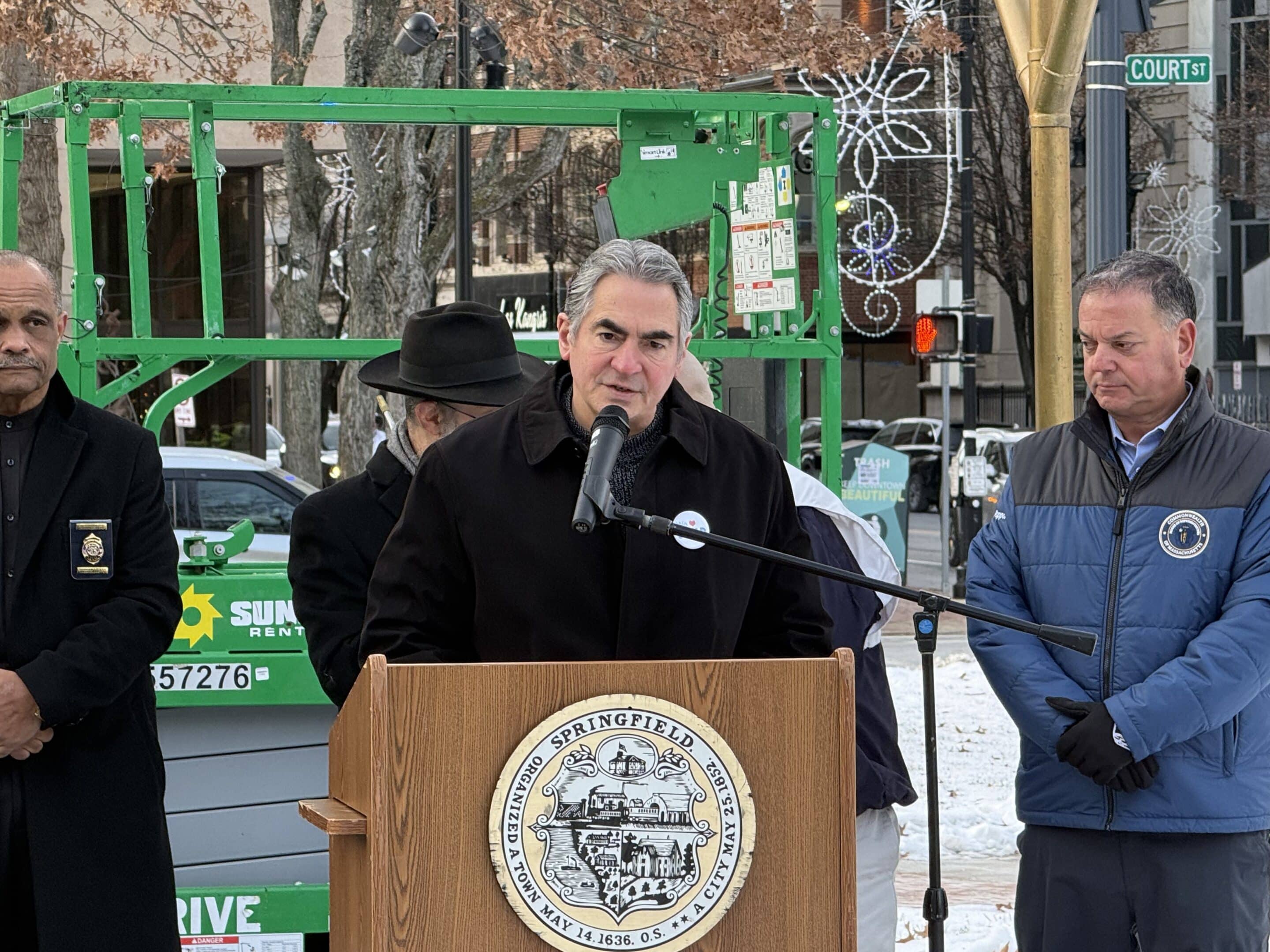
Mayor Domenic Sarno speaks at the city’s menorah lighting in December 2025.
Reminder Publishing file photo
SPRINGFIELD — Springfield Mayor Domenic Sarno and Chief Development Officer Timothy Sheehan sat down recently with Reminder Publishing to discuss the opportunities and challenges that lie ahead for the city in 2026.
The city has seen much economic development in recent years.
Sarno said there has been $5 billion of investment in downtown Springfield over the past decade, including $1 billion from MGM Springfield. Touting another development, Sarno said, “What was Eastfield Mall, now Springfield Crossing, is the job they said would never get done.”
Springfield has many more opportunities for development in the near future. Among them, the city is in talks with Durra Panel, an Australian company that makes building materials from wheat waste product. The company will soon be touring potential sites for manufacturing.
The city is preparing for construction of a new district courthouse. Over the past couple of years, there has been significant uncertainty over where the courthouse will be built. While the Division of Capital Asset Management and Maintenance had considered moving the courthouse out of the city, Sarno said he emphatically advocated to keep it in downtown Springfield.
In 2025, developer Peter Picknelly purchased land along the riverfront with a proposal to site the courthouse there, along with housing and a marina. Sarno said he favored that location, but there are also proposals to site the courthouse on Main, State, Liberty, Chestnut, Dwight and Maple streets. DCAMM is expected to decide on a location this year.
Once the new courthouse is built, the site of the existing Springfield District Courthouse will offer another opportunity for redevelopment.
“That’s prime property,” Sarno said. Sheehan said he is working on a master plan for that property, the juvenile court building at 80 State St. and Old First Church at 50 Elm St.
Sheehan said Gov. Maura Healey recently declared Western Massachusetts to be a “quantum computing hub.” Quantum computing has the ability to process vast amounts of data in relatively short periods of time, taking hours to compute what would normally take months. Springfield Technical Community College was awarded a $1 million grant to study what will be needed to create a quantum computing center and how much it will cost.
While the technology is exciting to some, Sarno said, “All I want to hear about is jobs.”
Jobs are also on Sarno’s mind when it comes to CRRC, the Springfield-based affiliate of Chinese a railcar manufacturer that is experiencing difficulties importing its materials. Sarno explained that the materials and parts are imported from China and have been seized by U.S. Customs and Border Patrol.
In March, the company is expected to lay off 161 employees. “These are good paying jobs, good American manufacturing jobs. Doesn’t this defeat the purpose? Wasn’t it supposed to support jobs here?” Sarno said of President Donald Trump’s tariff policies.
Another federal issue that is impacting Springfield is Congress’s struggle to agree on Medicare and Medicaid subsidies. The programs are an integral part of hospital funding and are expected to add to market pressures felt by Mercy Medical Center and Baystate Health. Mercy suspended its maternity and newborn services in November 2025 due to staffing constraints. Meanwhile, Baystate, the largest employer in Western Massachusetts, announced it was seeking voluntary separations for some of its 13,000 employees.
Noting that Baystate offers the only level one trauma center in the Pioneer Valley, Sarno said he has been working with the state to “keep Baystate moving forward and thriving.”
While large companies like Baystate are important, Sarno said the small businesses that make up the fabric of downtown Springfield are vital. “People got to come back to work,” he said. “It’s hurting the ecosystem of downtown.” Many companies embraced remote work or downsized during the coronavirus pandemic. Despite the crisis having passed, remote employment has become the new normal for many. Sheehan predicted it will take 20 to 25 years for office real estate to fully recover from the impacts of COVID-19.
In the meantime, Sheehan said, the small businesses that rely on foot traffic are suffering. “It’s the coffee shop, the lunch counter,” he said. Retail shops also experience the loss.
That said, Sheehan estimated that the city’s small businesses are 80% recovered. He said Springfield is an easy city to access for commuters and there has been an “incremental, steady comeback.”
Housing is a major priority for the city. Sarno said MGM Springfield has yet to make good on its promise to build housing at 101 State St. He said he recently voiced his displeasure at a meeting with the owners. “Lots of work was done to make MGM happen. Now, they have to hold up their end of the bargain,” he said.
Sarno pointed to 31 Elm St. as an example of successful housing development in the city. He said there was much skepticism when first proposed, but the market-rate units are completely full. Likewise, Sheehan said developments in downtown Springfield have yielded more return than expected.
Another location for potential housing is the shuttered Vibra Hospital at 1400 State St. Abutting blunt Park and Roger Putnam Vocational Technical Academy, the 17-acre site would be a prime location for housing development. The city had tried to acquire the property, but there is a $10 million lien on it, and the owners have allowed it to fall into disrepair. The city has since sued the owners of the property.
Sarno said a private developer is interested in the property and would be willing to preserve the historic part of the building that was once Springfield City Hospital’s tuberculosis isolation ward. However, the property owners have refused to engage with the developer, as it had refused to respond to the city during its negotiations. “We don’t want it to become a zombie property,” Sarno said.
“Housing development for all income levels is critically important,” Sheehan said. Setting aside the tax revenue it creates, it draws more people into Springfield. Sarno explained that the city has a population of about 155,000. If it drops below 150,000, the city is eligible for a lower tier of Community Development Block Grant funding from the state.
With housing comes the need for schools. There are plans to renovate several of Springfield’s schools, including Gerena Community, and White and Washington street schools. “We’ve done the most rehabbed schools in Massachusetts,” Sarno said.
