
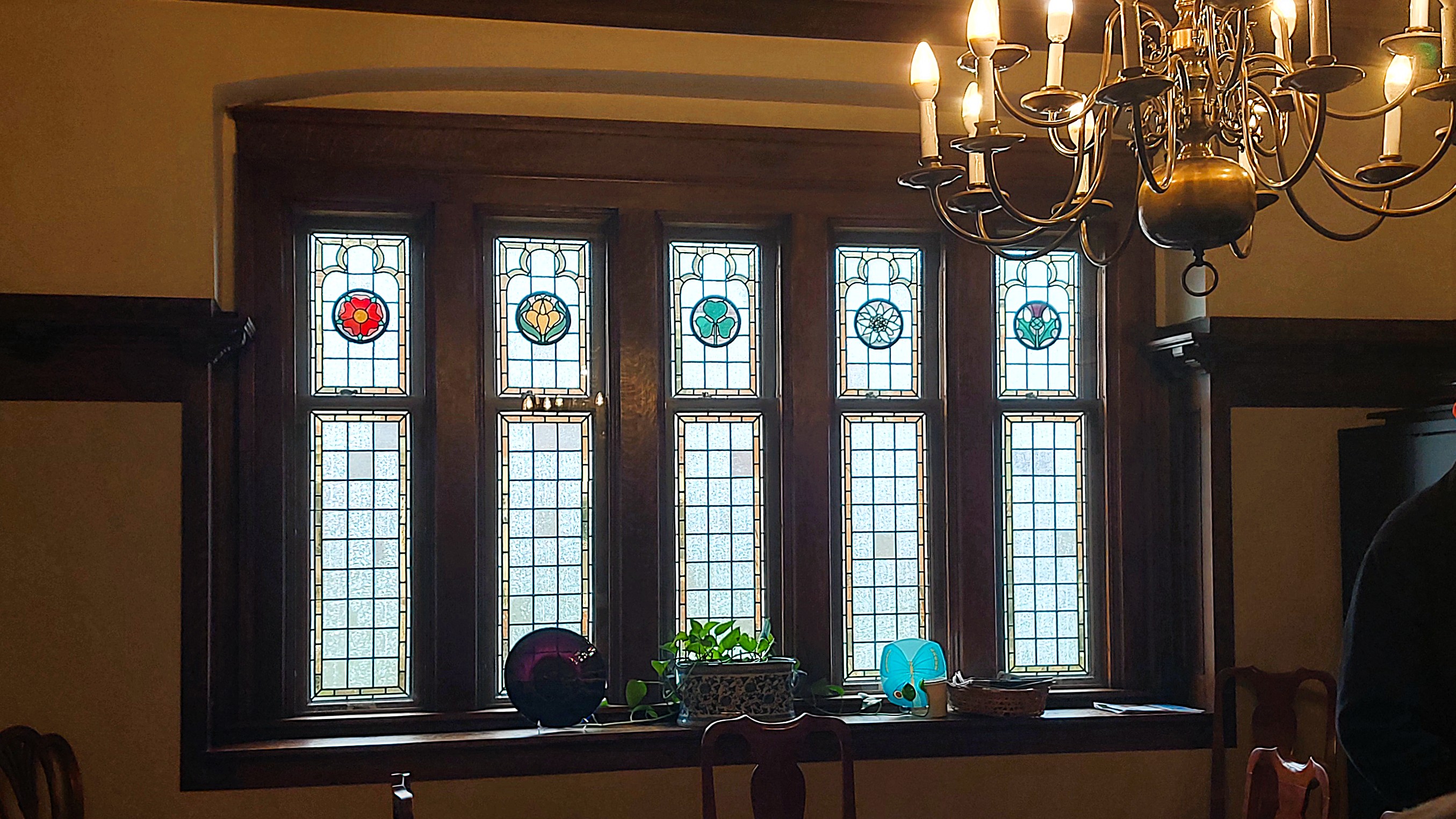
The dining room windows in the Kilroy House feature ornate stained-glass details.
Reminder Publishing photo by Sarah Heinonen
SPRINGFIELD — Springfield is “The City of Homes” and one of those historic homes received a new lease on life with help from the city’s Community Preservation Committee.
The Philip Kilroy House at 63 Chestnut St. was constructed in 1905. Built to be Kilroy’s home and medical office, the building cost $11,000 to erect, $404,970 in today’s money.
As an example of Mission Revival architecture, rare in New England, the house features a terracotta-tiled roof, arches along the rear porch and a stucco facade. The leaded stained-glass windows are the highlight of the house’s exterior, particularly the five panels in the dining room, each of which includes a medallion representing places Kilroy visited, including Wales, Scandinavia and his native Ireland.
Mayor Domenic Sarno described Kilroy, a renowned neurologist, dermatologist and psychiatrist, then known as an alienist, as a “renaissance man.” He said it is “always important when we can preserve our history.”
Four years after Kilroy’s death in 1932, the building was bought by Springfield radio station WSPR and served as its home until 1981, after which it was purchased by the Springfield Museums. The building serves as the administrative offices for the Springfield Museums.
After 115 years, the house needed costly repairs. The $800,000, five-year restoration project was partially funded with $586,213 in Community Preservation money, a pot of funding sourced from a 1.5% surcharge on the city’s property taxes. The house, which is on the National Register of Historic Places, was restored in phases. The first step was tackling the roof to maintain the structure’s envelope. Next, the asbestos in the stucco was remediated and the facade was refinished.
The work that went into restoring the windows is an example of the painstaking efforts that were taken in the building’s restoration.
Christopher Albrecht of Chris’s Carpentry said it took more than a year for his company to restore the building’s windows, many of which feature unique stained-glass details. He explained that he had to use steam to soften the outside putty before gently removing the leaded glass panes. Otherwise, he said, the stress could easily have shattered the fragile glass.
The panes were labeled to ensure they returned to the same locations. Because of the age and historical nature of the windows, Abrecht used infrared heaters to clean the frames, which were then coated in a micro-crystalline wax polisher, which will allow them to develop a natural patina over the years ahead.
Springfield Museums President and CEO Kay Simpson said the restoration was “not an easy undertaking.” She thanked architect Steve Jablonski for “bringing this historic structure back to life for years to come.”
State Sen. Jake Oliviera said Springfield voters made a conscious choice in “preserving history and understanding” in 2018 when they adopted the state’s Community Preservation Act. Similarly, state Rep. Brian Ashe said the Kilroy House is a “prime example” of the “gorgeous architecture” throughout Springfield that needs preservation.
At one point Chestnut Street was lined with grand houses like this,” said Community Preservation Committee Chair Robert McCarroll recognized the mission of the Springfield Museums and said it was “a wonderful steward” of the city’s history.

- Sarah Heinonen
- Sarah Heinonen
- Sarah Heinonen
- Sarah Heinonen
- Sarah Heinonen
- Sarah Heinonen
- Sarah Heinonen
- Sarah Heinonen
- Sarah Heinonen
- Sarah Heinonen
- Sarah Heinonen
- Sarah Heinonen
- Sarah Heinonen
- Sarah Heinonen
- Sarah Heinonen
- Sarah Heinonen
- Sarah Heinonen
- Sarah Heinonen
- Sarah Heinonen
- Sarah Heinonen
- Sarah Heinonen
- Sarah Heinonen
- Sarah Heinonen
- Sarah Heinonen
- Sarah Heinonen
- Sarah Heinonen
- Sarah Heinonen
- Sarah Heinonen
- Sarah Heinonen
- Sarah Heinonen
- Sarah Heinonen
- Sarah Heinonen
- Sarah Heinonen
- Sarah Heinonen
- Sarah Heinonen
- Sarah Heinonen
- Sarah Heinonen
- Sarah Heinonen
- Sarah Heinonen
- Sarah Heinonen
- Sarah Heinonen
- Sarah Heinonen
- Sarah Heinonen
- Sarah Heinonen
- Sarah Heinonen
- Sarah Heinonen
- Sarah Heinonen
- Sarah Heinonen
- Sarah Heinonen
- Sarah Heinonen
- Sarah Heinonen
- Sarah Heinonen
- Sarah Heinonen
- Sarah Heinonen
- Sarah Heinonen
- Sarah Heinonen
- Sarah Heinonen
- Sarah Heinonen
- Sarah Heinonen
- Sarah Heinonen
- Sarah Heinonen
- Sarah Heinonen
- Sarah Heinonen
- Sarah Heinonen
- Sarah Heinonen
- Sarah Heinonen
- Sarah Heinonen
- Sarah Heinonen
- Sarah Heinonen
- Sarah Heinonen
- Sarah Heinonen
- Sarah Heinonen
- Sarah Heinonen
- Sarah Heinonen
- Sarah Heinonen
- Sarah Heinonen
- Sarah Heinonen
- Sarah Heinonen
- Sarah Heinonen
- Sarah Heinonen
- Sarah Heinonen
- Sarah Heinonen
- Sarah Heinonen
- Sarah Heinonen
- Sarah Heinonen
- Sarah Heinonen
- Sarah Heinonen
- Sarah Heinonen
- Sarah Heinonen
- Sarah Heinonen
- Sarah Heinonen
- Sarah Heinonen
- Sarah Heinonen
- Sarah Heinonen
- Sarah Heinonen
- Sarah Heinonen
- Sarah Heinonen
- Sarah Heinonen
- Sarah Heinonen
- Sarah Heinonen
- Sarah Heinonen
- Sarah Heinonen
- Sarah Heinonen
- Sarah Heinonen
- Sarah Heinonen
- Sarah Heinonen
- Sarah Heinonen
- Sarah Heinonen
- Sarah Heinonen
- Sarah Heinonen
- Sarah Heinonen
- Sarah Heinonen
- Sarah Heinonen
- Sarah Heinonen
- Sarah Heinonen
- Sarah Heinonen
- Sarah Heinonen
- Sarah Heinonen
- Sarah Heinonen
- Sarah Heinonen
- Sarah Heinonen
- Sarah Heinonen
- Sarah Heinonen
- Sarah Heinonen
- Sarah Heinonen
- Sarah Heinonen
- Sarah Heinonen
- Sarah Heinonen
- Sarah Heinonen
- Sarah Heinonen
- Sarah Heinonen
- Sarah Heinonen
- Sarah Heinonen
- Sarah Heinonen
- Sarah Heinonen
- Sarah Heinonen
- Sarah Heinonen
- Sarah Heinonen
- Sarah Heinonen
- Sarah Heinonen
- Sarah Heinonen
- Sarah Heinonen
- Sarah Heinonen
- Sarah Heinonen
- Sarah Heinonen
- Sarah Heinonen
- Sarah Heinonen
- Sarah Heinonen