
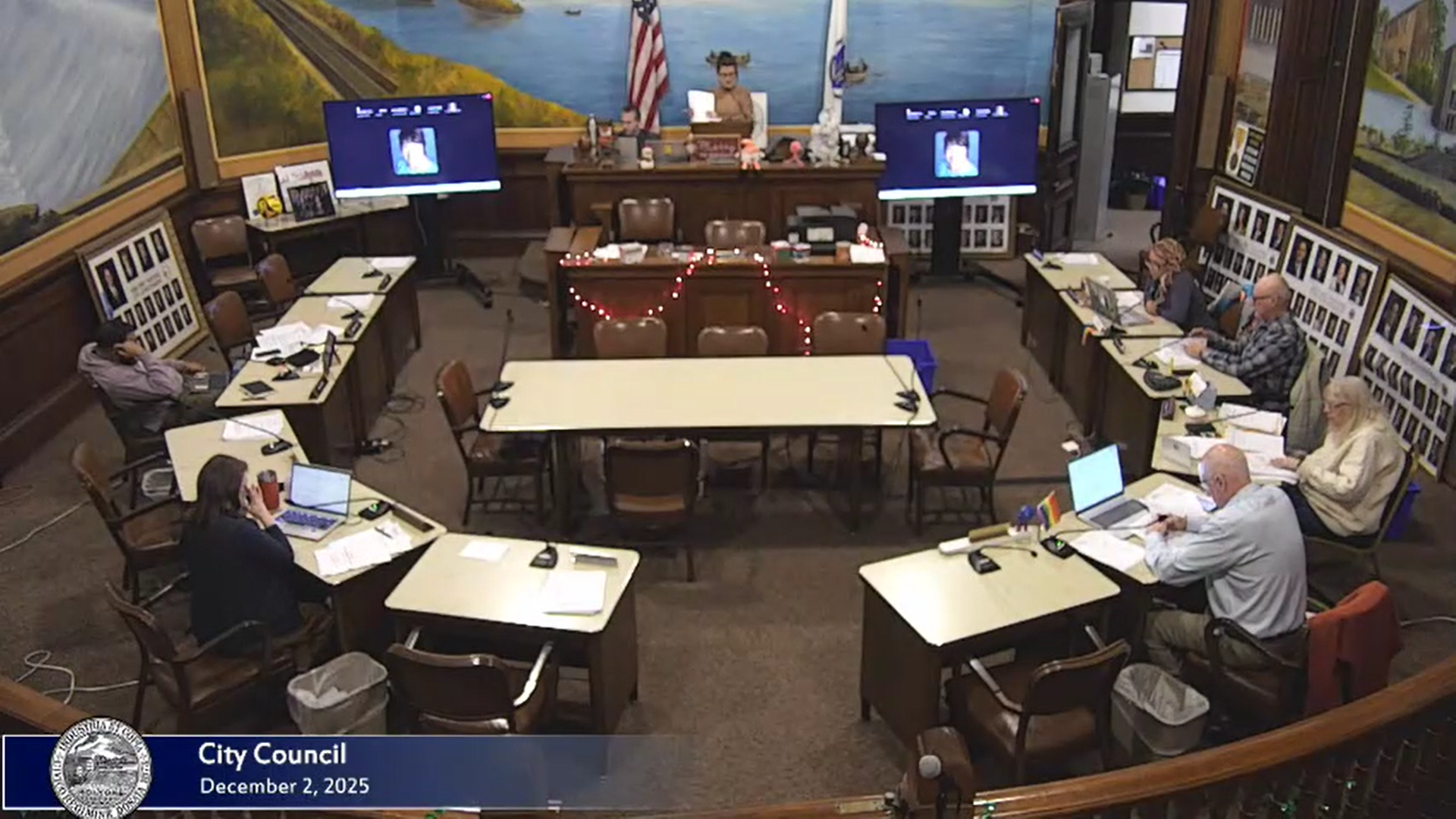
The City Council discusses and approves a new tax shift at its Dec. 2 meeting.
Photo credit: Holyoke Media
HOLYOKE — Although the City Council voted 10-2 to decrease the tax rate for residential and commercial, residents can still expect to see an average tax bill increase by $352 for the year, or $29 per month.
The City Council met on Dec. 2, and after a long discussion, they approved a tax shift of 1.75%, which set a new residential tax rate of $17.43 per $1,000 and a commercial tax rate of $38.16 per $1,000.
Last year, the tax rate for residential was $17.46 and the tax rate for commercial was $38.54.
City Council President Tessa Murphy-Romboletti explained that once the City Council hosts the tax classification, they can vote on the percentage of the tax burden that they wish to shift from residential to commercial.
Holyoke hosted a tax classification hearing on Nov. 6.
The tax levy also increased by $3.16 million, which is why taxes are set to increase by 7%. The fiscal year 2025 levy was approximately $67 million, while the FY26 levy is approximately $70 million.
City Councilor Kevin Jourdain proposed the 1.75 tax shift and talked about his decision.
“A 7% tax increase is just absolutely unheard of. To have a shift of 1.75 is already going to be, I think, catastrophic to the average resident,” Jourdain said. “This is just mind-numbing, these type of increases year over year. We’ve raised the taxes, this city, 19%, I haven’t been voting for those increases but the majority has, and 19% in the last four years and this adds on to that.”
City Councilor Linda Vacon said she was in favor of the 1.75 tax shift because “it is the most that we can do and as it is, it’s only making a difference of three cents, so pretty much whatever your value went up on your house, that percentage will be how much your tax bill will increase.”
She also recognized that, “Right now we are taxing our citizens that are on a fixed [income] … I just don’t think it’s the right thing to do.”
City Councilor Kocayne Givner also supported the 1.75 tax shift but further explained, “I think it makes the most sense right now, but I feel like we always talk about the needs of the taxpayers, which is absolutely the most important thing offsetting the tax burden. But as I often do, I like to remind us all that there was a 10-year period where we either kept the taxes at no increase or we minimized the taxes, or increased it by very little.”
Givner continued, “Unfortunately, I think we’re spending some time now having to deal with incredibly high inflation and the fact that we didn’t increase taxes when we could.”
Givner said it’s important to reduce taxes and acknowledged that there are city costs and capital improvements that they must pay for.
Mayor Joshua Garcia, who also recommended a 1.75 tax shift, provided some information as to why he believes there is a need for another tax increase.
He highlighted that although the city has built enough excess capacity, which is money on the table to the levy limit, untouched, the current sewer deficit absorbed it right to the limit.
The deficit stands at about $1.2 million.
Garcia said without an updated sewer rate, this deficit is likely to persist annually.
He stated, “Every year, the City Council expresses a clear preference to avoid resolving the deficit through taxation. I fully agree. But this year, without an appropriate sewer rate, I have no other responsible option but to address this year’s shortfall by raising and appropriating. There is an option to subsidize using reserves, but it isn’t an ideal practice. By raising and appropriating, we protect our bond rating and preserve our stabilization account. In other words, this path allows us to clear the deficit responsibly while ensuring fiscal stability.”
The increase is also primarily driven by rising residential property values, coupled with higher costs for insurance, schools, transportation, contractual obligations and subsidizing the sewer rate.
Additionally, Holyoke’s long-standing commitment to fully funding the retirement system by 2032 requires allocating approximately $8 million annually beyond the standard retirement budget.
For education, the city’s required local contribution to the public schools will rise by 5.87%.
Transportation costs continue to escalate, increasing by 10.32% or $1.1 million.
Health insurance premiums went up by 9%, or $661,859, totaling $13,746,739.
Garcia concluded, “We will continue to keep up with services within our limits and keep preparing and planning for mitigating what I often refer to as “the sea of icebergs” to limit impacts as much as possible. One way or another, there will be impacts, but I am committed to continuing to explore strategies to alleviate taxpayer burdens. How hard of an impact will be up to how well I, as mayor, and the City Council can work together to implement different strategies that can strengthen our position as a city, reduce liability and protect local resources.”

- Tyler Garnet
- Tyler Garnet
- Tyler Garnet
- Tyler Garnet
- Tyler Garnet
- Tyler Garnet
- Tyler Garnet
- Tyler Garnet
- Tyler Garnet
- Tyler Garnet
- Tyler Garnet
- Tyler Garnet
- Tyler Garnet
- Tyler Garnet
- Tyler Garnet
- Tyler Garnet
- Tyler Garnet
- Tyler Garnet
- Tyler Garnet
- Tyler Garnet
- Tyler Garnet
- Tyler Garnet
- Tyler Garnet
- Tyler Garnet
- Tyler Garnet
- Tyler Garnet
- Tyler Garnet
- Tyler Garnet
- Tyler Garnet
- Tyler Garnet
- Tyler Garnet
- Tyler Garnet
- Tyler Garnet
- Tyler Garnet
- Tyler Garnet
- Tyler Garnet
- Tyler Garnet
- Tyler Garnet
- Tyler Garnet
- Tyler Garnet
- Tyler Garnet
- Tyler Garnet
- Tyler Garnet
- Tyler Garnet
- Tyler Garnet
- Tyler Garnet
- Tyler Garnet
- Tyler Garnet
- Tyler Garnet
- Tyler Garnet
- Tyler Garnet
- Tyler Garnet
- Tyler Garnet
- Tyler Garnet
- Tyler Garnet
- Tyler Garnet
- Tyler Garnet
- Tyler Garnet
- Tyler Garnet
- Tyler Garnet
- Tyler Garnet
- Tyler Garnet
- Tyler Garnet
- Tyler Garnet
- Tyler Garnet
- Tyler Garnet
- Tyler Garnet
- Tyler Garnet
- Tyler Garnet
- Tyler Garnet
- Tyler Garnet
- Tyler Garnet
- Tyler Garnet
- Tyler Garnet
- Tyler Garnet
- Tyler Garnet
- Tyler Garnet
- Tyler Garnet
- Tyler Garnet
- Tyler Garnet
- Tyler Garnet
- Tyler Garnet
- Tyler Garnet
- Tyler Garnet