
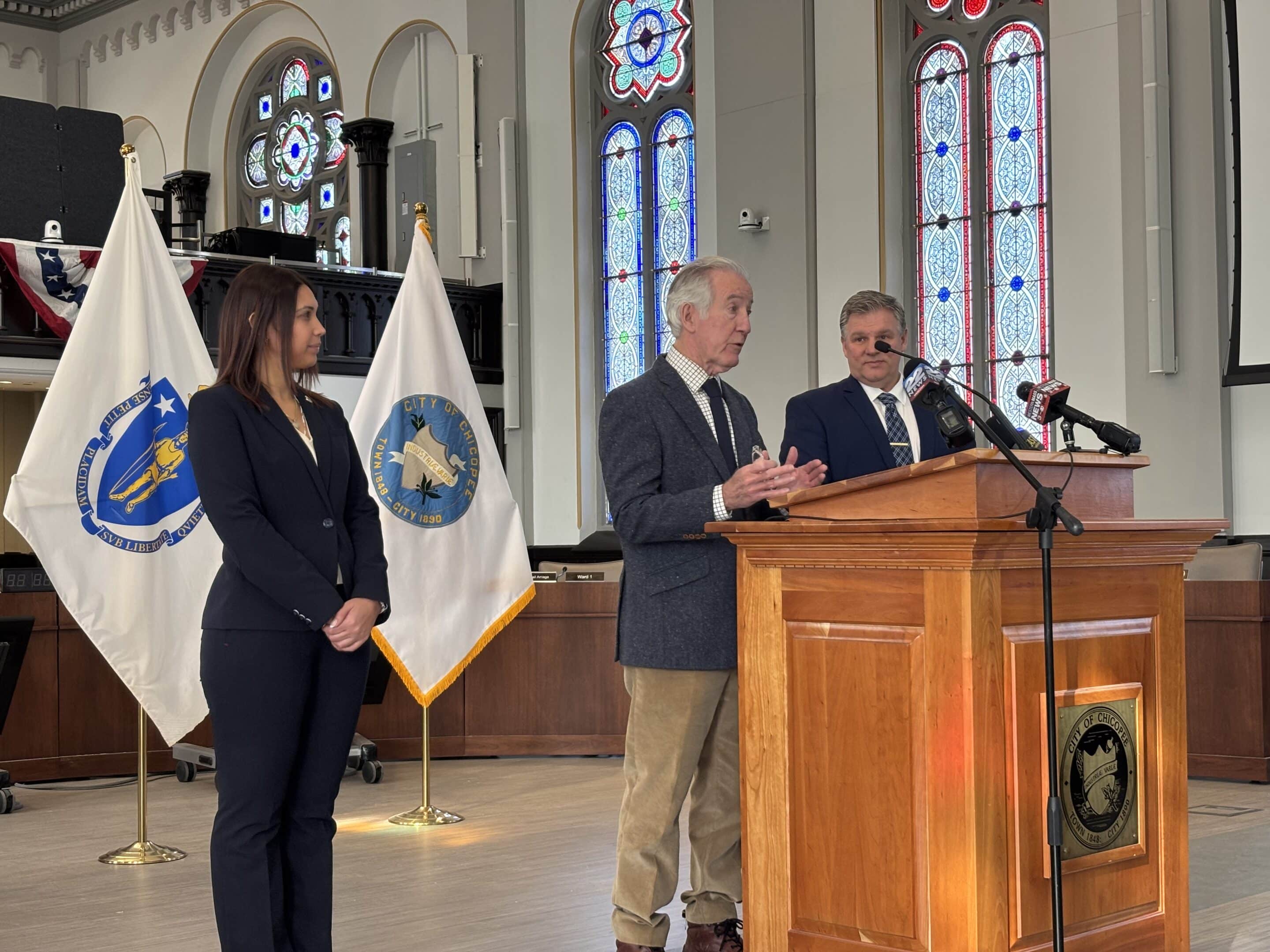
Congressman Richard Neal talks about the federal funding he helped secure for Chicopee’s wastewater treatment plant.
Reminder Publishing photo by Tyler Garnet
CHICOPEE — U.S. Rep. Richard Neal visited Chicopee on Jan. 28 to announce funding he helped secure to support phase two of the city’s nitrogen removal project at the wastewater treatment plant.
The funding is made available through the Massachusetts Clean Water State Revolving Fund and will be administered by the Massachusetts Department of Environmental Protection.
Neal joined Chicopee Mayor John Vieau and other city stakeholders to discuss the important funding for the project. “I am pleased to join with Mayor Vieau to announce this critical investment in Chicopee’s wastewater infrastructure,” Neal stated. “As a former mayor, I know just how important these projects are and what they mean to a community. This announcement will represent a significant step in protecting public health and the local environment.”
Neal explained that the total federal contribution to Chicopee’s wastewater treatment plant, with its over $1 million earmark, is almost $12 million. Chicopee has also invested in upgrading its wastewater plant through direct sewer fees, American Rescue Plan Act funds and other grants.
“America’s infrastructure is aging, but thanks to funding from the Bipartisan Infrastructure Law, coupled with congressionally directed investments like the one we will highlight in Chicopee, we are making terrific strides in modernizing essential systems across the country, including right here in western and central Massachusetts,” Neal said. The funding is supported by the fiscal year 2026 Interior and Environment appropriations process and will help advance ongoing efforts to reduce nitrogen discharges, improve water quality in the Connecticut River, and provide downstream environmental benefits to communities throughout Western Massachusetts and beyond.
The environmental impact extends beyond Chicopee, affecting downstream communities including West Springfield, Agawam, Springfield and Longmeadow. Addressing nitrogen pollution at its source will help reduce downstream impacts and provide long-term regional environmental benefits throughout Western Massachusetts, according to Neal and the city.
State Rep. Shirley Arriaga said she is currently working at the state level with her colleagues to address the commonwealth’s wastewater plants and the municipalities’ effect on the Connecticut River.
“This issue, as terrible as it is, is not unique to Chicopee,” Arriaga stated. “There’s a lot of folks across the commonwealth of Massachusetts dealing with this. One of the things that I’m fighting for at Beacon Hill is, ‘how can we address this?’ We’re not the only one, but we need to come together.”
The Chicopee Wastewater Pollution Control Facility was not originally designed to meet modern nitrogen removal standards and is now subject to federally required discharge limits issued by the U.S. Environmental Protection Agency and MassDEP.
Compliance with these limits is necessary to maintain the city’s discharge permit and protect water quality in the Connecticut River and downstream waters. Federal and state investment through the Clean Water State Revolving Fund allows Chicopee to meet these requirements while minimizing the financial burden on local ratepayers.
Each summer, elevated levels of nitrogen enter the Connecticut River, which flows downstream to Long Island Sound. Excess nitrogen, which originates from wastewater, contributes to a process known as eutrophication. Eutrophication occurs when excess nutrients stimulate excessive algae growth. As algae break down, bacteria consume oxygen in the water, leading to hypoxia, a condition that can displace or kill essential aquatic species such as fish and crustaceans.
The project, which hopes to prevent this from occurring, is being implemented in three phases. Phase one, completed in 2022, focused on upgrading biological reactors, improving liquid treatment systems and enhancing solids processing.
Phase two, supported by this newly awarded funding, represents the primary nitrogen reduction component of the project. Phase three will include comprehensive upgrades and repairs to the water pollution control plant.
Vieau shared his gratitude for the federal funding that will help with phase two of the project.
“We are extremely grateful for the continued partnership and advocacy brought forth by Congressman Neal,” Vieau said. “Without his support and the assistance of MassDEP and the EPA, these improvements would not be financially feasible for the city. As a fisherman and avid nature lover, I am especially excited about phase two and its role in reducing nitrogen levels, helping protect our wildlife, and ensuring the Connecticut River remains enjoyable for residents and visitors alike.”

- Tyler Garnet
- Tyler Garnet
- Tyler Garnet
- Tyler Garnet
- Tyler Garnet
- Tyler Garnet
- Tyler Garnet
- Tyler Garnet
- Tyler Garnet
- Tyler Garnet
- Tyler Garnet
- Tyler Garnet
- Tyler Garnet
- Tyler Garnet
- Tyler Garnet
- Tyler Garnet
- Tyler Garnet
- Tyler Garnet
- Tyler Garnet
- Tyler Garnet
- Tyler Garnet
- Tyler Garnet
- Tyler Garnet
- Tyler Garnet
- Tyler Garnet
- Tyler Garnet
- Tyler Garnet
- Tyler Garnet
- Tyler Garnet
- Tyler Garnet
- Tyler Garnet
- Tyler Garnet
- Tyler Garnet
- Tyler Garnet
- Tyler Garnet
- Tyler Garnet
- Tyler Garnet
- Tyler Garnet
- Tyler Garnet
- Tyler Garnet
- Tyler Garnet
- Tyler Garnet
- Tyler Garnet
- Tyler Garnet
- Tyler Garnet
- Tyler Garnet
- Tyler Garnet
- Tyler Garnet
- Tyler Garnet
- Tyler Garnet
- Tyler Garnet
- Tyler Garnet
- Tyler Garnet
- Tyler Garnet
- Tyler Garnet
- Tyler Garnet
- Tyler Garnet
- Tyler Garnet
- Tyler Garnet
- Tyler Garnet
- Tyler Garnet
- Tyler Garnet
- Tyler Garnet
- Tyler Garnet
- Tyler Garnet
- Tyler Garnet
- Tyler Garnet
- Tyler Garnet
- Tyler Garnet
- Tyler Garnet
- Tyler Garnet
- Tyler Garnet
- Tyler Garnet
- Tyler Garnet
- Tyler Garnet
- Tyler Garnet
- Tyler Garnet
- Tyler Garnet
- Tyler Garnet
- Tyler Garnet
- Tyler Garnet
- Tyler Garnet
- Tyler Garnet
- Tyler Garnet