
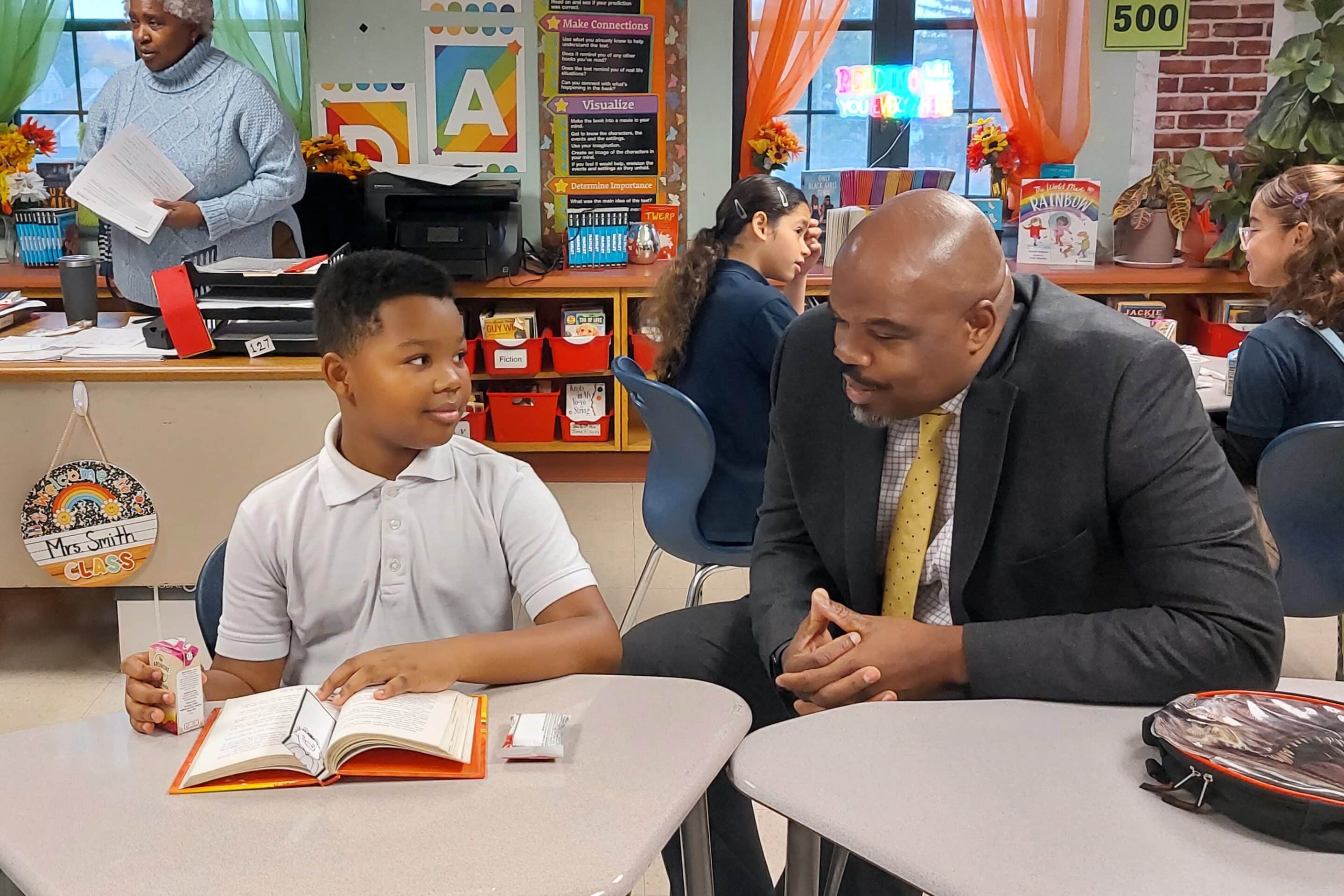
Massachusetts Education Secretary Patrick Tutwiler talks with Kameron Hillman while he has breakfast and reads a book.
Reminder Publishing file photo
The Eos Foundation recently released its study, Ending Hunger in Our Classrooms with Breakfast in the Classroom, which explores the state of breakfast at Massachusetts’ high-poverty schools and urges schools to implement the Breakfast in the Classroom program.
The Eos Foundation is a private family trust that focuses on combating hunger, poverty, gender and racial equality.
Since 2013, the Eos Foundation has provided grants to schools to launch After the Bell Breakfast programs, focusing primarily on Breakfast in the Classroom.
The report highlights how Massachusetts schools could feed 303,000 more students breakfast each day with universal free school meals and bring in an extra $73 million in federal dollars.
The comprehensive statewide analysis revealed an opportunity for Massachusetts to end hunger in K-12 public schools by instituting Breakfast in the Classroom. The Eos Foundation calls for this urgent expansion as hunger continues to spike across the state.
The reports finds that while 595,000 Massachusetts students participate in school lunch each day, only 292,000 eat breakfast, leaving a “breakfast gap” of 303,000 students.
In 2023, Massachusetts passed legislation, School Meals for All, guaranteeing free school meals for all K-12 students. This presents an opportunity to reduce childhood hunger, according to Eos Foundation President Andrea Silbert.
Silbert said the organization is trying to help schools in the state follow the example of Springfield.
For the last 10 years, Springfield Public Schools has incorporated Breakfast in the Classroom districtwide, including in high schools. Breakfast participation soared from 44% in 2015 to 84% in 2025. With the highest breakfast participation in the state, Springfield uses increased federal reimbursements to fund its 62,000 square-foot Culinary Center.
The center serves over 19,000 breakfasts each day, more than any other district, and over 60% of meals are scratch cooked.
Another aspect of the Breakfast in the Classroom initiative that Silbert finds important is the schools’ collaboration with local farms and businesses.
For example, Springfield Public Schools purchases 25% of its food from local food companies and farms.
“A lot of them are in Western Massachusetts. It’s bigger than just feeding kids, it’s about buying fresh, local food and supporting local companies,” Silbert stated.
Massachusetts Secretary of Education Patrick Tutwiler talked about the example Springfield Public Schools are setting, stating, “It was wonderful to be in Springfield to see the impact of Breakfast in the Classroom firsthand. Springfield is a model for meeting children where they are, sustaining high breakfast participation, and incorporating local products with meals made from scratch. Every child I met with that day was happy, engaged and enjoyed their meal. We will continue to work to ensure every student across Massachusetts has an opportunity to begin their days nourished and ready to learn.”
Looking at other Massachusetts school districts, Chicopee breakfast participation decreased from 77% to 57.3% over the last year, ranking 16th statewide among high-poverty schools.
Hitting the 80% benchmark would mean feeding 2,066 additional students every day and bringing in $1.05 million more in USDA reimbursement revenue.
Silbert explained that those federal dollars, currently left on the table, could be reinvested directly into student support. Based on the report, high poverty schools are leaving $73 million in federal funds on the table. If every high-poverty school reached 80% breakfast participation, a threshold many met in prior years, the state would draw down an estimated $73 million more annually in federal USDA reimbursements.
At a time when districts face soaring food and labor costs, this revenue is currently “forfeited” by low participation, the report notes.
The report highlights Breakfast in the Classroom as the most effective strategy to close the breakfast gap. When served in the cafeteria before the bell, only 36% of students eat breakfast; served in the classroom after the bell, participation jumps to 71%.
To accelerate progress, Eos is offering up to $20,000 per school to transition from cafeteria breakfast to Breakfast in the Classroom.
The report also lays out steps for superintendents, principals, teachers, and legislators to help their specific district implement a plan to ulitlize the program.
To view each school’s performance or see the full report, readers can visit eosfoundation.org.

- Tyler Garnet
- Tyler Garnet
- Tyler Garnet
- Tyler Garnet
- Tyler Garnet
- Tyler Garnet
- Tyler Garnet
- Tyler Garnet
- Tyler Garnet
- Tyler Garnet
- Tyler Garnet
- Tyler Garnet
- Tyler Garnet
- Tyler Garnet
- Tyler Garnet
- Tyler Garnet
- Tyler Garnet
- Tyler Garnet
- Tyler Garnet
- Tyler Garnet
- Tyler Garnet
- Tyler Garnet
- Tyler Garnet
- Tyler Garnet
- Tyler Garnet
- Tyler Garnet
- Tyler Garnet
- Tyler Garnet
- Tyler Garnet
- Tyler Garnet
- Tyler Garnet
- Tyler Garnet
- Tyler Garnet
- Tyler Garnet
- Tyler Garnet
- Tyler Garnet
- Tyler Garnet
- Tyler Garnet
- Tyler Garnet
- Tyler Garnet
- Tyler Garnet
- Tyler Garnet
- Tyler Garnet
- Tyler Garnet
- Tyler Garnet
- Tyler Garnet
- Tyler Garnet
- Tyler Garnet
- Tyler Garnet
- Tyler Garnet
- Tyler Garnet
- Tyler Garnet
- Tyler Garnet
- Tyler Garnet
- Tyler Garnet
- Tyler Garnet
- Tyler Garnet
- Tyler Garnet
- Tyler Garnet
- Tyler Garnet
- Tyler Garnet
- Tyler Garnet
- Tyler Garnet
- Tyler Garnet
- Tyler Garnet
- Tyler Garnet
- Tyler Garnet
- Tyler Garnet
- Tyler Garnet
- Tyler Garnet
- Tyler Garnet
- Tyler Garnet
- Tyler Garnet
- Tyler Garnet
- Tyler Garnet
- Tyler Garnet
- Tyler Garnet
- Tyler Garnet
- Tyler Garnet
- Tyler Garnet
- Tyler Garnet
- Tyler Garnet
- Tyler Garnet
- Tyler Garnet