
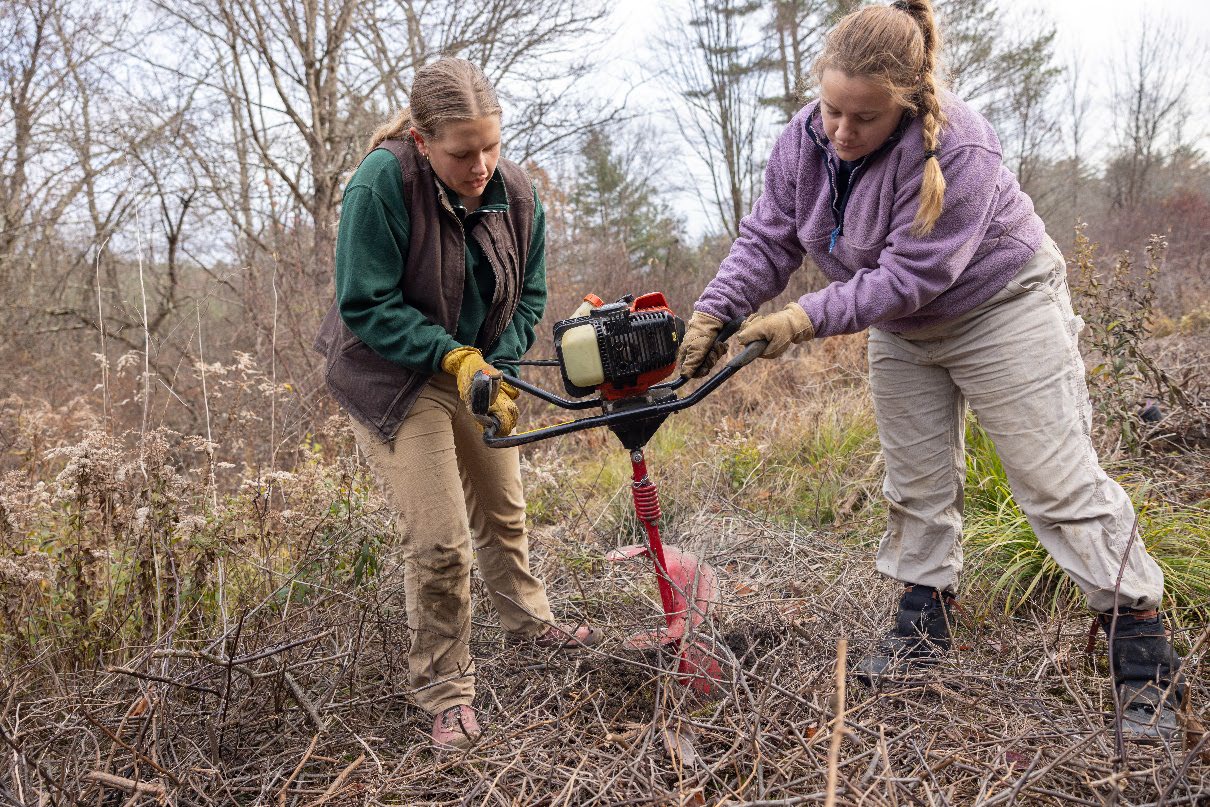
Smith College students on the project help install the hibernaculum to help protect the endangered eastern rat snake.
Photo credit: National Wildlife Federation
NORTHAMPTON — As part of a recent grant, students at Smith College have completed a project focused on helping the endangered Eastern rat snake, Massachusetts’ only tree snake.
The habitat-restoration project at the college’s MacLeish Field Station will help keep endangered snakes warm in the winter after the installation of a hibernaculum, or a winter shelter, designed to help the species survive the elements and stay protected from predators.
The project is part of a partnership between the National Wildlife Federation and Mutual of Ohama’s Wild Kingdom to support higher education institutions focused on conserving endangered or at-risk species and habitat. Smith’s Center for Environment, Ecological Design and Sustainability, or CEEDS, were supported by an $8,500 grant.
“I really love this program because we are able to provide grants to support those efforts on campus. With Smith College, one of the things that stood out was they were focusing on an endangered species, a reptile in Massachusetts. They also put a lot of emphasis on their proposal and in the project over the last several months on engaging students. Students are participating in this project, learning about the species, and also learning with hands-on skills,” National Wildlife Federation Wildlife and Nature Director Kristy Jones told Reminder Publishing.
Jones has been with the NWF for 20 years, mostly working with colleges and universities on conservation and sustainability projects, anything from habitat restoration to energy conservation.
The eastern rat snake has become an endangered species in the state primarily due to habitat degradation and fragmentation. In Massachusetts, the rat snake is severely imperiled and unlikely to be observed except at a handful of mountainous locations in central and Western Mass. Adult rat snakes in Massachusetts are large, muscular, shiny black and is non-venomous.
As explained by MacLeish Field Station manager Paul Wetzel, the newly installed hidden hibernaculum is a place where snakes, both the endangered rat snake and other snake species, can comfortably spend cold days when they go through brumation, a state of dormancy where they are not fully asleep but metabolically slowed down. This allows snakes to conserve energy until the winter months return.
Wetzel said the history of the 250-acre property at the MacLeish Field station is tied to its current ecological makeup today. The property was first purchased by the school in the 1960s to build the field station and it included a pasture for about 30 to 40 acres that was mowed or grazed consistently before the college purchased it. As time went on, Wetzel said the college wasn’t really doing much with the property outside the addition of the observatory until about 15 years ago, a concerted effort was made to take advantage of the nature available, as well as conserve the space.
“They eventually decided we should do more with this. Let’s develop this as an educational resource for experiential learning. Let’s put a stake in the ground. It’s 12 miles from campus and could be something that is a real asset for students,” said Wetzel.
Wetzel said now the MacLeish Field Station is the home for scientific research for students at Smith, art and nature projects, and recreational opportunities on the property. Overall, the outdoor educational opportunities have made for unique work from students and opened the door for this project around the eastern rat snake.
Wetzel said if the property’s fields had been abandoned generations ago, the space would have gone through the traditional plant succession. The composition of the forest might change over 150 years, but in essence, a forest would return.
“That didn’t happen because the abandonment occurred in the ’60s and ’70s, and by that time there were invasive species in the ecosystem,” added Wetzel.
With this already in mind, Wetzel began conservation efforts on the property starting several years ago to try and control the invasives that had made their way on the property. Wetzel explained the four main invasive species seen on the property included multiflora rose, round leaf bittersweet vines, autumn olive trees and Japanese barberry bushes. All of these species produce red berries that are then eaten by songbirds who end up dispersing seeds around the area through their droppings.
For example, the bittersweet vines end up growing and strangling other plants. Some of the multiflora rose bushes end up growing around 8 feet tall and are so dense that virtually nothing else can grow up against them. These invasives have only spread during the last 60 years or so, leading to other impacts to the ecosystem like the endangering of the eastern rat snake.
“It can happen pretty fast, but it’s been 60 years where no one has done anything so there’s 30 acres of that property or so that is just sort of stagnant in a plant ecosystem that doesn’t allow trees to grow very well and much less anything else. It’s a pretty low diversity area,” said Wetzel. “I need to get rid of the seed source, especially for the bittersweet. It’s this huge seed source and if it grows up these trees, you’ve seen it, it’s just a waterfall of vines and every fall it produces thousands of seeds that get carried away and spread all over,” said Wetzel.
Wetzel said while it is difficult to actually get rid of the invasives, they can still be controlled through these efforts. In this process of doing this work and getting students involved as well, Wetzel was eventually made aware of the National Wildlife Federation’s grant funding for universities and colleges to improve the habitat of threatened and endangered species on campus, which he soon then applied for.
“I came to an area [on the property] that had a bunch of wetlands in it and so I had to delineate the wetland. When I did that, I found out that part of the property is designated by Natural Heritage, the state wildlife organization, as being a space where you would find eastern rat snakes,” said Wetzel.
Wetzel said after securing the funding he got more students involved in the work and hired junior student Alex Blaszcyk as the student leader on the project, a student who has been closely involved with the general conservation work as well. He also credited Blaszcyk for her efforts in crafting a snake reporting form to identify and monitor populations.
Starting over the summer the work to control invasives expanded with students involved. The complicated work had students out there working on different areas related to this work, including planting plants and identifying areas of invasives.
The hibernaculum was established through digging a hole about 5 and a half feet deep, and is 10-feet-by-6-feet, and then adding rocks and logs in there to create cavities. There are three ways of accessing the hibernaculum through little tunnels around the area. This hibernaculum is now permanently in place on the property and will be monitored for years to come.
“Will they use it? I have no idea. I’ve still never even seen a rat snake,” Wetzel said with a laugh. “It was good because it gave students a chance to learn firsthand. It’s sort of like building a bird house. Birds need one, but maybe they don’t. But what you’re doing is you’re saying, if for whatever reason the habitat isn’t there, here’s the possibility of using this as a substitute. And so, you have to start thinking about how is this animal going to interact with the environment. What are its needs. And that’s actually a really good exercise for any student when they are interested in wildlife biology or wildlife habitat restoration. It was good example or surrogate for just the through processes when thinking about wildlife restoration.”
Jones said projects such as this are important for students as well as adults in helping better understand their environment and wildlife in the community.
“I think it’s really important for individuals, citizens, whether it’s a kid or an adult, to really understand what species in their community are vulnerable and learn how they can help. Because I see endangered species as kind of an alarm. It’s a warning for folks that something isn’t healthy in the environment and ecosystem, and most of the time if it’s not healthy for wildlife, animals and plants, it’s not going to be healthy for humans as well,” added Jones.
Wetzel said as for the overall conservation work on the property, about 15 acres are in conversion but there are still about 15 more acres to keep working at and this will continue to be ongoing work. As for his students and their experience through the installation the hibernaculum or general conservation, he hopes their takeaways stay with them as they continue to grow and enter professional careers.
“I don’t know if I can speak for students but I’m hoping they’re getting this talking about a takeaway. One of the reasons I’m doing this is if you read the newspaper or listen to the news or start searching the internet, there’s a lot of things going on in the world that could make you sit down and cry. And you could get very discouraged. And the thing is that in terms of ecological restoration, we know what needs to happen by and large. It’s hard work and it takes resources, but we know enough about what needs to happen.
Wetzel continued, “So at least for me, and I think this translates to students as well, if they can do even just for three hours plant trees, it 1. Get’s them outside, 2. They get to learn about how to plant trees, and 3. They can say they planted trees and there’s this hope they will grow and be something beautiful in part of the landscape. That is what restoration ecology does for me and that’s what I think it does for a lot of people who volunteer. It’s a positive thing they can do instead of just like, oh the world is going to hell in a handbasket. What are we going to do?’ Well, here’s something positive you can do and we’re helping the world a little bit.