
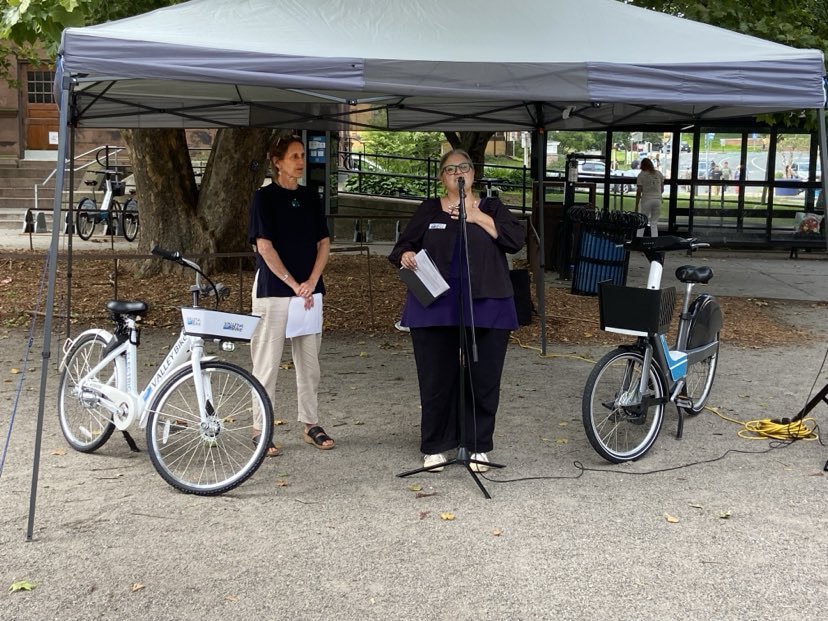
Northampton Mayor Gina-Louise Sciarra and Director of Planning and Sustainability Carolyn Misch previously spoke about the benefits of the return of ValleyBike to the region during an August 2024 event.
Reminder Publishing file photo
NORTHAMPTON — As part of a $10 million statewide investment from the Healey-Driscoll administration, the city of Northampton was awarded $1.5 million for ValleyBike Share efforts.
According to Gov. Maura Healey’s announcement, nine programs were awarded through the state’s Microtransit and Last-Mile Transit Grant Program.
The funding will support regional transit authorities, municipalities, and a Regional Planning Agency in expanding flexible, technology-enabled transit options that improve access to jobs, housing, education and essential services across the state, according to the press release.
Northampton Director of Planning and Sustainability Carolyn Misch told Reminder Publishing that the city is thrilled to be receiving this latest funding for the ValleyBike electric bikeshare system, which serves 10 communities. She said it was a competitive application process due to the existing demand for equitable transportation options.
She said the $1.5 million award will support the regional ValleyBike electric bikeshare system, helping expand operations, modernize the fleet and replace bike docks. The program plays a key role in connecting residents to transit hubs, jobs, housing and other essential destinations throughout the Pioneer Valley, according to Misch.
“We were grateful that our application for the region was successful, but I think it also shows how much demand there is for multiple types of transit that isn’t the traditional mass transit. Also, I think that points to the fact that in lower-density communities outside the Boston metro region, the other types of transit, microtransit, micromobility, are viable and feasible, and reach more people than what would be required for mass transit,” said Misch, who added that the investment in ValleyBike Share is just one part of finding the solution to more accessible mobility.
“You have to reach certain densities to have mass transit be viable, so it doesn’t extend into these communities that are slightly lower density than a Boston suburb or something like that. I think it’s really important that MassDOT recognize that we need to be looking at all the different types of transit options in order to achieve net neutral carbon impact goals that we have as a commonwealth and also that individual communities have as well,” she said.
The state funding is specifically supporting projects that use microtransit, on-demand shared-ride services, and last-mile connections that link riders to transit hubs and key destinations. Award recipients will use the funding to expand rural access, improve mobility for people who lack transit options, and support communities advancing sustainable housing and transportation planning.
“Through MassDOT’s new Microtransit and Last Mile Transit Grant Program, MassDOT is empowering municipalities, RTAs, and Regional Planning Agencies to deliver innovative transportation solutions that focus on connectivity between transit hubs and destinations. These programs will connect riders to the jobs, housing, education and destinations they depend on, while improving quality of life across the commonwealth,” said Interim MassDOT Secretary and MBTA General Manager Phil Eng.
Three awards, including Northampton’s, will fund regional bikeshare initiatives that strengthen first and last mile connections, while six awards will support microtransit services.
“On behalf of the City of Northampton, I am thrilled to accept a Last Mile grant from MassDOT for ValleyBike for operations and fleet modernization for this critical piece of the Pioneer Valley’s transportation puzzle,” said Northampton Mayor Gina-Louise Sciarra. “As is the case with all modes of travel, this 24/7 last-mile transit is only feasible with public investment through partnerships between local communities and the commonwealth. This is an important next step toward a more equitable transportation system that prioritizes all modes and all users.”
She continued, “This funding enables ValleyBike share to continue to provide transportation for residents throughout the valley to connect to regional bus transit and other destinations where transit does not currently exist. My entire team here in Northampton is deeply grateful to our state legislative delegation for funding this important work and for their tireless advocacy for transit alternatives. We are proud to partner with MassDOT to operate this critical program.”
The modernization of the bike fleet continues the work of ValleyBike Share’s effort of upgrading the region’s bikes. These E-assist bikes provide smoother rides, are lighter than the previous model and also include swappable batteries that don’t need to charge at a docking station, according to the release.
“It makes it more flexible to also lock up anywhere so you can just lock to a regular bike rack, and you create stations more easily that way because you don’t have to bring power necessarily to the station,” added Misch.
When ValleyBike restarted in 2024, Springfield transitioned to the modernized fleet immediately. Eventually, the modernized fleet expanded to Westfield through initial MassCEC grants that were awarded.
Misch explained that state Sen. Jo Comerford secured a one-time allocation last year to transition the fleets at the University of Massachusetts Amherst and in the town of Amherst to these new bikes. She said that the latest funding will help Northampton, Easthampton and South Hadley upgrade to the new bikes.
Northampton’s Office of Planning and Sustainability is in charge of overseeing the ValleyBike Share system for the entire region, which means they hold the contract for Drop Mobility, the group that runs the day-to-day operations and maintenance of the bikes.
Misch explained that the more flexible bikes will help address desertion issues throughout the communities.
“We still have a station-based system, and we’ve always had a station-based system to one, address people just leaving their bikes in random location, but the other reason we started out with a station-based system is for equity purposes. We wanted to make sure there were stations located where people really needed them. They might not necessarily make the most amount of money for an operator, but we wanted to make sure we’re serving all the members of our community,” said Misch. “And even though there’s more flexibility with locking these bikes, what I mean by that is you can quickly establish a station with just basic bike racks, as opposed to the other system where you have to have a whole docking infrastructure with power and key and a locking dock that only fits that bike.”
Misch said that she hopes the state can find a way to utilize subsidies for the program moving forward and that this can be the start of continued investment toward the bikeshare system.
“This grant is incredible, we’re excited about it, and I hope it’s the start of a continued investment by MassDOT because bike share, just like transit, really needs to have larger public subsidies, because it can’t run on fees alone, just like buses can’t, and even the road network,” Misch said. “Cars and the gasoline tax don’t pay for all the infrastructure required to allow cars to drive on highways, and so, there’s public subsidies that go into support cars, and so we need that same thing, I think, continuously for bike share, and I hope this is the start of that long relationship.”