
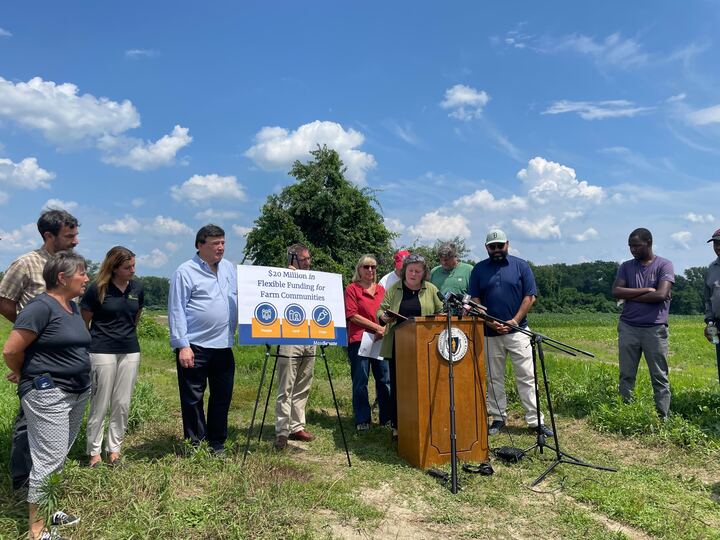
State Sen. Jo Comerford speaks at a press conference at a Hatfield farm in 2023 after extreme weather events. She filed the FARM Bill that recently passed the state Senate. The legislation will now go in front of the state’s House of Representatives.
Reminder Publishing file photo
The state is now one step closer to giving farmers what they need to better thrive in their respective environments.
The Massachusetts Senate recently passed the FARM Bill, which is agricultural legislation aimed at supporting Massachusetts’s 7,000 farms, making it easier for families to buy fresh and nutritious food, and protecting the state’s food supply for the future.
The bill will now head to the House of Representatives for consideration before it reaches Gov. Maura Healey’s desk.
Formally known as S.3029, An Act Fostering Agricultural Resilience in Massachusetts, this legislation is a step forward in supporting Massachusetts farmers and growing the state’s agricultural economy. The bill builds on a recent special commission report focused on making the state’s agricultural operations sustainable for the 21st century.
“Today, the Senate advanced urgently-needed legislation to support the farms, producers, and fisheries that are the foundation of our local and regional food systems. In Western and north central Massachusetts, where agriculture is core to our economy and identity, we know that when we lose farmland, we lose far more than fields — we lose livelihoods, food security and community. This legislation reflects the recommendations of the Special Commission on Agriculture in the 21st Century — a body that I was proud to co-chair,” said state Sen. Jo Comerford, who filed the bill. “With the FARM Bill, Massachusetts is stepping up — investing in the next generation of farms and fisheries while ensuring more local, nutritious food reaches Massachusetts families.”
The Northampton Democrat told Reminder Publishing it was a seismic moment for her to see this legislation pass, as many of the policies have been incubated and advocated for over the last seven years by her and other State House colleagues. She added that while everyone wishes the process could move more quickly, she is grateful that so many policies have moved forward all at once.
“I represent more than 400 farmers in this district. It’s a very agriculture-centered place in the world, and when I got into the legislature, not only did I begin meeting and visiting farmers, growers, producers, I also heard from their advocates. From researchers. From entities like UMass Extension, which is really central to farms’ well-being. I talked with agency folks, like at [Massachusetts Department of Agricultural Resources], and so we began to file a series of farm bills, some of which have already passed in the Legislature,” said Comerford. “We began to file different kinds of bills, everything from helping the next generation of farmers to the bill that was ultimately passed, which is really dedicated to helping farms stay in operation, given the economic pressures of farming, which are pretty acute, honestly. So, it’s really from the bottom up; it’s the roots of my district and farms. This is a way for me to do my job in representing people, by really filing something that is both being called for, but also would be useful to the well-being of the folks I work for.”
The FARM Bill will help owners of small farms grow their businesses by removing hurdles and making agritourism ventures possible, such as corn mazes and “pick your own” berry and fruit operations. Comerford explained that many farmers rely on additional agritourism ventures as other ways of collecting additional revenue for their main operations.
“This year, we said you can do agritourism on protected land, and that was a recognition about the fact that many farms have microbusinesses to survive. Nobody is surviving just by selling their produce or their eggs or milk. They’re surviving because they have a corn maze or sell value-added products, or they have a store, and this is just trying to break down the barriers to that,” she said.
The bill also makes it easier for residents to access healthy food, making permanent the Health Incentives Program to help families afford fresh produce, and the Farm to School program — which brings local ingredients into schools. By codifying these programs, the Senate is continuing its reaction to federal actions that threaten food access as a part of the Senate’s Response 2025 initiative.
A further Response 2025 priority requires that state emergency planning efforts prioritize the security of the local food supply chain, given federal cuts to emergency planning.
“It’s important to codify these in law because it says these are serious endeavors and we’re going to have language in that is now statutory language. It makes them much more central in the budgeting process, and we also tweaked some of the language, so it helps in the implementation and regulatory process,” said Comerford. “By putting HIP into the bill, we hope that it won’t be a question of how we fund it going forward.”
She added, “Similarly, the Farm to School program is really critical for districts. It’s reaching this education of the land, it’s teaching nutrition education to students. All these things are really, really, really important, and this is an opportunity for us to enshrine that into law.”
The FARM Bill additionally requires regular reporting about the distribution of local produce through food banks, universal school meals, Meals on Wheels, the Massachusetts Emergency Food Assistance Program and other food assistance programs. This data will help assess the damage from federal actions such as the elimination of the USDA Local Food Purchase Assistance Cooperative Agreement Program, which purchased food from historically underserved Massachusetts farmers and provided it to underserved communities.
The legislation includes key provisions to help farmers remain viable and expand their operations. New farm buildings and structures would receive a five-year property tax exemption under a local option program added to the bill. The bill also expands opportunities for farmers to participate in agritourism, makes the Food Security Infrastructure Grant program permanent and eases the water permitting process for cranberry growers.
“Farming is an impossible business in Massachusetts, which is why I do believe the state has a role to play,” said Comerford. “The dominant reason why farmland stops being farmland has to do with the economics of it. Families sell land because they can’t make a living on the land often, or they’ve had an opportunity to really recoup some losses from previous years. I call that the downward economic pressure of farming.”
Comerford added that the state Legislature is set to pass another provision in the bill, a food donation tax credit, where farmers can receive up to $5,000 through a refundable tax credit for donating produce to a nonprofit entity.
“This is at the intersection of food insecurity and farming, trying to make farming viable economically and trying to get more fresh local produce into the hands of people who need it,” added Comerford. “It’s responding to federal cuts to food security programs, and it’s responding to the need for farms to stay farming.”
Overall, Comerford described this bill as a four-pronged approach that focuses on closing the margins faced by farmers, getting MDAR and UMass Extension to have a more robust ability to assist in the preservation of farmland in the state, helping the next generation of farmers be in a position to succeed and having the state become more focused on preservation of farmland.
“Between 2017 and 2022, we lost in Massachusetts 27,000 acres of farmland, twice the national rate. It should be a red alert signal for every one of us who cares about both maintaining farms for food security, or maintaining farms for economic development reasons, or maintaining farms for climate reasons. You name it, farms do it,” added Comerford. “No bill does everything that should be done, and that’s really important to say. This isn’t the first, and it won’t be the last FARM bill that I file, or my colleagues file.”