
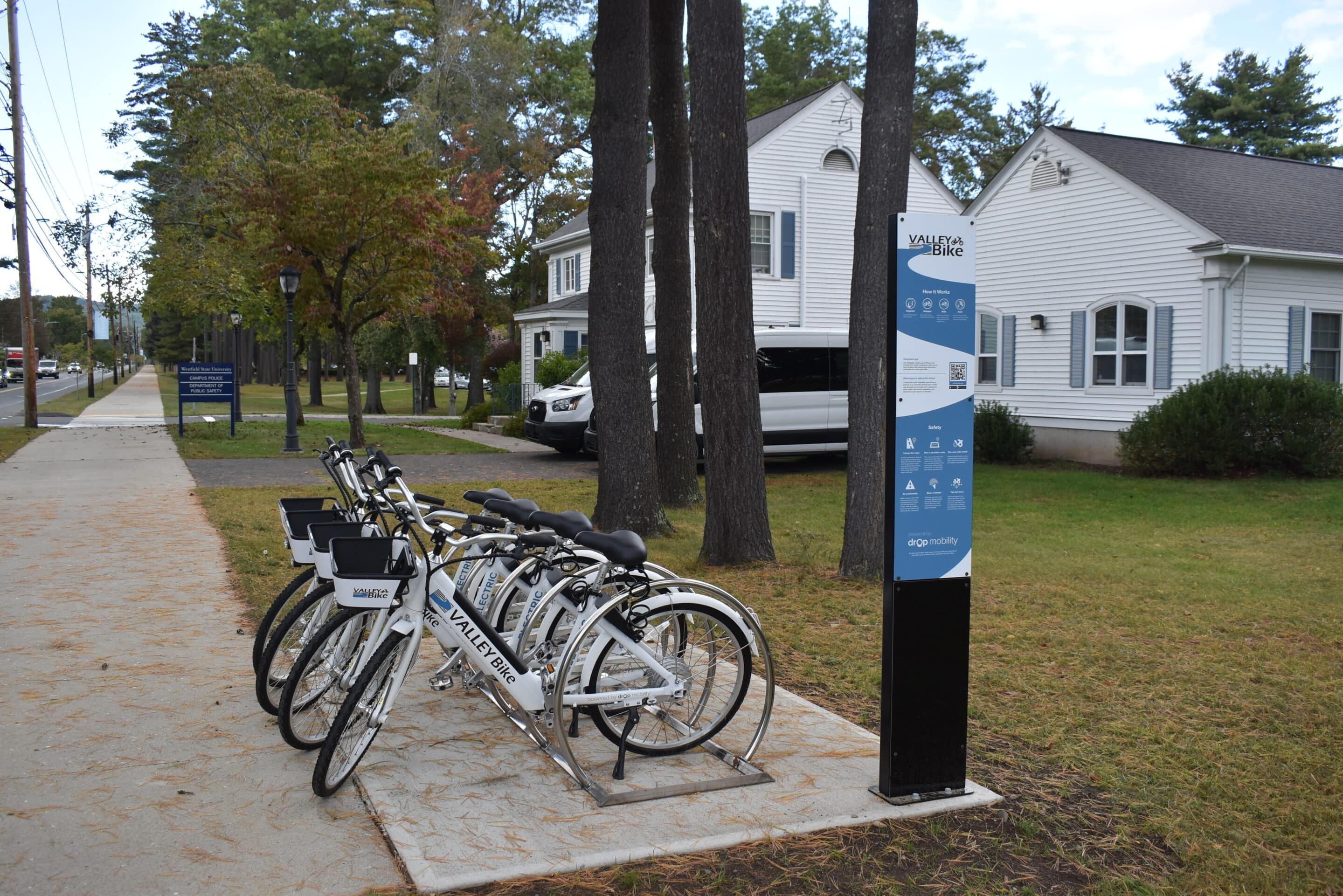
The ValleyBike station number 3 is at Westfield State University on Western Avenue, in front of the campus police.
Reminder Publishing photo by Amy Porter
WESTFIELD — Legislative and Ordinance Committee Chair William Onyski brought a new ordinance to regulate electric bikes to the City Council on May 20.
The ordinance passed the first reading after a vigorous discussion, with a second vote to be scheduled for the City Council meeting on June 19 after several suggested amendments are made.
Onyski said the ordinance was developed in conjunction with Lt. John Parrish, chair of the Traffic Commission, and City Solicitor Shanna Reed.
“The need for this I think we could all understand,” he said, adding that whenever he mentions to people that he is working on it, they tell him about close calls they have had with motorized bikes, which he said are an issue on the bike path as well. He said a lot of other towns in the state are adopting their own ordinances.
The ordinance lists definitions for several categories of electric bikes, scooters, mopeds and skateboards. Class 1 are electric bicycles or tricycles with fully operational pedals and an electric motor of 750 watts or less, which provides power only when the rider is pedaling, but no power assistance above 20 mph.
Class 2 electric bicycles provide power with or without pedaling, but no power assistance above 20 mph.
Electric scooters are defined as scooters with handlebars, designed to be stood or sat upon by the operator, powered by an electric or gas-powered motor capable of propelling the device with or without human propulsion.
Electric or motorized skateboards are devices with a deck, two or more wheels and an electric or gas motor designed for a person to stand or sit on while riding, as opposed to a regular skateboard propelled solely by human power.
Mopeds, which are Class 3 bikes, have a cylinder capacity of no more than 50 cubic centimeters; an automatic transmission and a maximum speed of no more than 30 miles per hour.
Onyski said what is being proposed in the ordinance will allow a regular pedal bike on streets and on sidewalks, but not on sidewalks in business districts, including the Core district, Broad Street, Court Street, mixed residential and business districts or commercial office districts. “The reason for no bikes there is because there are businesses, doors are opening and people could speed by on bikes, and it causes a danger where we have a lot of pedestrian traffic.”
A Class 1 bike, with a pedal assist, can be ridden on streets but not on any sidewalks in residential or business districts, Onyski said. It can be used on the bike path or rail trails, or on multi-use trails.
Class 2 electric bikes can be ridden on streets, but not on any sidewalks in residential or business districts. They can be used on the bike trail, but you have to be pedaling. “You can’t just use the throttle alone like you would a mini bike,” he said.
A moped can be used in the streets if it has a compliance decal from the state. It can’t be used on sidewalks or business sidewalks, and not on the rail trail.
A regular human-powered scooter can’t be used on streets, but can be used on sidewalks except in the business district, and can be used on the rail trail. Human-powered skateboards also can’t be used on streets, but can be used on sidewalks except in the business district, and can be used on the rail trail.
An electric or motorized scooter can be used on streets only if it’s got a compliance sticker from the state, but cannot be used on sidewalks, business sidewalks, and they cannot be used on the rail trail. Electric skateboards also can’t be used on streets, can’t be used on sidewalks, can’t be used on business sidewalks, and can’t be used on the rail trail.
When asked about the prohibition of electric or motorized scooters and skateboards on streets, sidewalks and on the rail trail, Parrish confirmed that both may only be used on private property, because they do not fall under Chapter 90 regulations.
The non-criminal fines in the ordinance are $50 for the first offense, $100 for the second offense and $300 for the third and each subsequent offense. Parrish said according to state law, bicycles may be seized for up to 15 days if driven negligently, after which they will go back to the rightful owner.
During the discussion at the City Council meeting before the first vote on the ordinance, Onyski said, “Now on the rail trail, there’s going to be a 15 mile-per-hour speed limit for any bike motorized or non-motorized. It wasn’t meant for a race track; it’s meant for people to recreate, walk. It’s a recreational path; it’s not a racetrack, so a 15 mile-an-hour speed limit will be set there, except for city vehicles being exempt.”
Councilor James Adams thanked Onyski for his work on the ordinance. “You need a law degree to figure this out. I mean, this is a nightmare not only for the citizens, it’s a nightmare for the Police Department. I was on L&O when we first started this, so I think a lot of the issues we’re having in town are with children and the parents buying these vehicles for their children that don’t realize what they’re doing with them. I’ve seen several accidents already with these things, and I think that the most important thing, everybody had the issue with the rail trail,” he said.
“The only way to do it is the way they actually did it, because it’s 15 mph, but also no throttle. So no matter what bike you have, you can’t use a throttle.You have to pedal it and it has to be 15 miles an hour. So there is no other way that the police can actually regulate it, except for the way that Lt. Parrish and L&O did it. As far as everything else goes, I don’t know how a regular police officer is going to figure this out, but we’re going to do the best we can do, because people are getting hurt. Every day, there are people getting hurt,” he added.
“L&O has done a great job and I think the police have done as good a job as they can. We may have to tweak some of these, but we had to start somewhere. So kudos to L&O and the Police Department for coming up with a base that we can start with,” Adams said.
Councilor Bridget Matthews-Kane also thanked Onyski, saying that they all know this is a big problem. “It’s taking a long time to address it because it’s so complicated,” she said. However, she pointed out that one side of Court Street is a multi-use path, not a sidewalk, and questioned the validity of some of the prohibitions listed for Court Street.
Onyski said the intent of the ordinance was to allow uses on the multi-use path on the other side of Court Street but not on the sidewalk side, and said he would straighten that point out before the second reading of the ordinance on June 19.
Councilor Kristen Mello asked about streets that have no sidewalks. “On the street I grew up on and on the street where I live now, there are no sidewalks. And as written, it looks like walking to the corner store with a kid on a scooter is gonna be illegal. Can we fix that too?” she asked, suggesting an allowance for kids on scooters or skateboards if no sidewalk is available.
Councilor Cindy Harris continued the point. “I think what Councilor Mello is saying, what you picture, and I see this downtown all the time because I’m in that area, of a young mother with her two little kids, and this little kid is five years old and he’s pedaling on his little scooter like this. And what you’re saying is that they can’t do that, and that’s totally unreasonable,” she said.
Harris said the ordinance is for the older kids who are out of control. “So I don’t think any police person’s gonna come and arrest, you know, this little tiny 4-year-old,” she added.
Onyski said they could maybe add that they can’t be ridden on the street without a parent, agreeing that there are a lot of streets with no sidewalks.
Councilor Michael Burns said he had sat through a lot of meetings about the ordinance. “I do have a problem with it, not the words in general, but specifically on the bike trail … They’re just not going to be able to control that bike path. I’ve been up there many times. It’s widely used, and those things just fly around. I don’t know personally, I don’t know why anybody would be on a bike path on an electric bike going up and down the bike path. What fun is that,” he said, adding, “So I guess I would like to make an amendment to not allow Class 2 bikes on there also.” A motion was made on the amendment, which did not pass.
“The real intent was to deal with the nuisance and the safety aspect of the law,” said Councilor Dan Allie. He said the ordinance keeps electric bikes off the sidewalk for safety, and riders must be pedaling on the rail trail. “This allows them to be very clear.”
“I just read where the state is coming up with mandates to register these vehicles. I know we have to have something — I cannot vote for this if those Class 2 bikes are allowed on those bike paths,” said Burns.
“A year or two ago we passed ordinances that allowed bicycles on sidewalks. Does that ordinance interfere with this?” asked Councilor Ralph Figy.
Onyski said once this ordinance passes, the committee will go through all of the ordinances and take care of amendments that need to be made.
“To Councilor Burns’ point, all users are required to obey 15 mph on the bike trail. Lt. Parrish was there, and was in favor of how this was written. Going over 15 mph would be a violation,” said Councilor Karen Fanion.
Councilor Nicholas Morganelli, Jr., asked if college kids at Westfield State University will be able to ride them downtown. “I don’t see how the speed isn’t more important than the actual mode of transportation. Some people can get on bicycles and ride pretty darn fast — it’s all about the speed. Barring motorized scooters on a rail trail is inappropriate; if someone wants to ride on a motorized bike on the rail trail, they can go all the way down to Connecticut,” he said.
Fanion said Class 1 and 2 bikes and mopeds can still be used on the streets.
Onyski asked for an initial vote on the ordinance, to allow him to make some minor changes suggested during the discussion. The vote passed 11-2, with a second reading scheduled for June 19.