
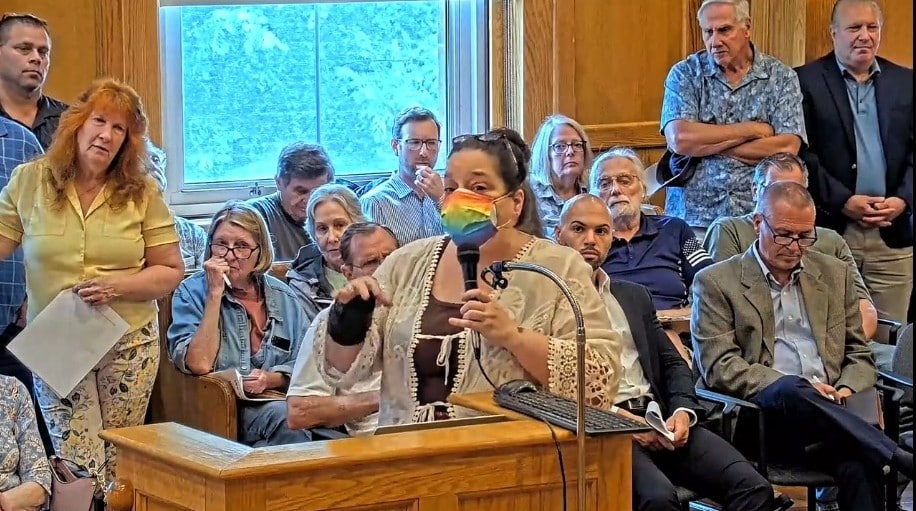
City Councilor Kristen Mello speaks during a jam-packed public hearing on the data center moratorium on June 18.
Photo credit: Westfield Community TV
WESTFIELD — One hundred residents jammed City Council chambers on June 18 for the public hearing and City Council vote on whether to impose a temporary one-year moratorium on data centers in the city, which passed unanimously following the hearing.
The vote followed a well-attended public hearing on June 16 at the Planning Board, which also recommended the moratorium to the council.
Councilor Kristen Mello, chair of the Natural Resources Committee, presented the argument at both meetings in favor of the moratorium to give her committee time to research the science behind data centers and to determine where in the city a data center could be safely sited without adverse health impacts on residents and the environment. She said she would be consulting with scientists at the University of Massachusetts Amherst, who have agreed to answer questions.
At the Planning Board meeting, Mello said the Natural Resources Committee will review environmental, public health and infrastructure impacts, in order to develop a permanent zoning ordinance.
“Some of the questions the committee and members of other bodies will be seeking to answer include where can the city support this land use without impacting public health, drinking water and air quality, and what conditions would need to be imposed in order to mitigate any impacts,” she said, adding that there is currently a moratorium in place on battery energy storage systems, and any data center application that came through right now could not include battery energy storage.
Mello also showed several slides that highlighted Westfield’s geographical vulnerability and the health impacts on Westfield residents from PFAS-contaminated water and air pollution. “When you look at our city, you can see that we are surrounded by mountains and we have a bowl shape in the center, and when you get air pollution, the people living in that bowl suffer more,” she said, referring to rates of asthma and PFAS levels that are higher than the state average. “So the question is, where could it be placed where it isn’t going to affect the air and the water?”
“Our population has been exposed to toxins. They deserve our protection. We are asking for 12 months to have local scientists who are experts about our aquifer, and experts about air currents, and experts about air pollution to help us find out if it is possible to safely zone these and … if it is not, then that information goes to the Board of Health, because we, you and the council are not allowed to ban anything. That’s the Board of Health’s territory,” Mello said. At the end of 12 months, if the Board of Health decides that it is a public health mandate to keep the moratorium, there is an option for them to extend it.
Before opening the council hearing to the public, Mello made a plea on behalf of City Council President John Beltrandi III, asking residents to confine their questions and comments to whether the City Council should pass the moratorium and not to data centers in general or any particular project. She said her committee would take any and all questions and comments into consideration, and asked residents to write them down on clipboards that she had distributed around the gallery.
The instructions had to be repeated several times, as many of the people in the room wanted to share their concerns about data centers, based on information and research they had done.
Although the vast majority of the public were in favor of the moratorium and opposed to bringing in data centers, there were a few on the other side who came forward, including Paul Corey, a representative with the Servistar Data Center project.
“I know it’s a little bit of a tough crowd,” Corey said to some boos as he gave his name and started to talk about the project. Beltrandi quickly stopped him, saying that the hearing was strictly on the moratorium, and if he allowed Corey to speak on behalf of data centers, he would have to allow everyone in the room to tell him the reasons why they don’t want it in Westfield.
“Can I ask one question, as long as it’s related strictly to the moratorium? I just want to clarify whether the moratorium applies to the existing Servistar Data Center that’s been approved by the Planning Board,” Corey asked.
Mello said zoning ordinances cannot act retroactively. “So a permit that has been approved is a permit that has been approved. Whether or not the company that has the permit enacts that permit in the right amount of time and in the right way is a separate issue that is not on the discussion tonight,” she said.
When asked after the Planning Board meeting, City Planner Jay Vinskey clarified the status of the current permit held by Servistar, LLC. “The special permit, for phase 1, was granted 10/19/21 and was good for 3 years, except that a state-wide two-year blanket permit extension was passed, so the lapse date [to pull a building permit by] is 10/19/26. Exception/extension may be made for ‘good cause,’” Vinskey wrote. “The proposed moratorium will not affect this zoning approval as long as the permit is valid. Regardless, the project is not ‘shovel ready’ as no wetlands permits have been sought.”
During the hearing, Richard Labrie of Big Wood Drive said he was told at the Planning Board meeting, at which he also spoke, that the Servistar Data Center was a done deal. He said since then, he had done some reading, and believed if the moratorium were to be approved, the building inspector and Massachusetts General Law have the authority at the mayor’s request to suspend or revoke the building permit in its entirety during the moratorium.
Kathy Labrie of Big Wood Drive also questioned whether Servistar is a company, or what she called “a corporate shell that is simply trying to flip a permit to the highest bidder.
”Ray Frappier of Berkshire Drive said he had a question about the moratorium. “Is it just another not-my-backyard scenario by the people on the north end, and, if so, after all the projects they canceled because of that, when will they start reimbursing a loss in revenue for taxes to the people on the south side of the river?“
After all the questions were asked, Beltrandi asked for a show of hands from those in support of the moratorium, to which the vast majority in the room responded in favor.
A motion to close the public hearing was made, after which Councilor Daniel Knapik questioned whether the comments taken and written down by the public at the meeting could be considered once the hearing is closed.
Mello and Councilor Karen Fanion, who is currently working on a city ordinance on battery energy storage systems in the Zoning, Planning and Development Committee, which she chairs, said the hearing was solely on whether to enact the moratorium.
“The intent of the moratorium is for us to investigate the ecological and public health impacts. So their questions about the ecological, and infrastructure, and public health impacts are the entire point… So, of course, Natural Resources will be taking in testimony,” Mello said.
“When we did the moratorium on the battery storage facilities, the point was just to stop any applications from coming in so that we would have time to write an ordinance; so we just voted on the moratorium, as Councilor Mello was saying, and then we’re taking information now into ZPD to write that ordinance,” said Fanion.
The council then voted unanimously for the moratorium. The second reading and vote are scheduled for the next City Council meeting in July.