
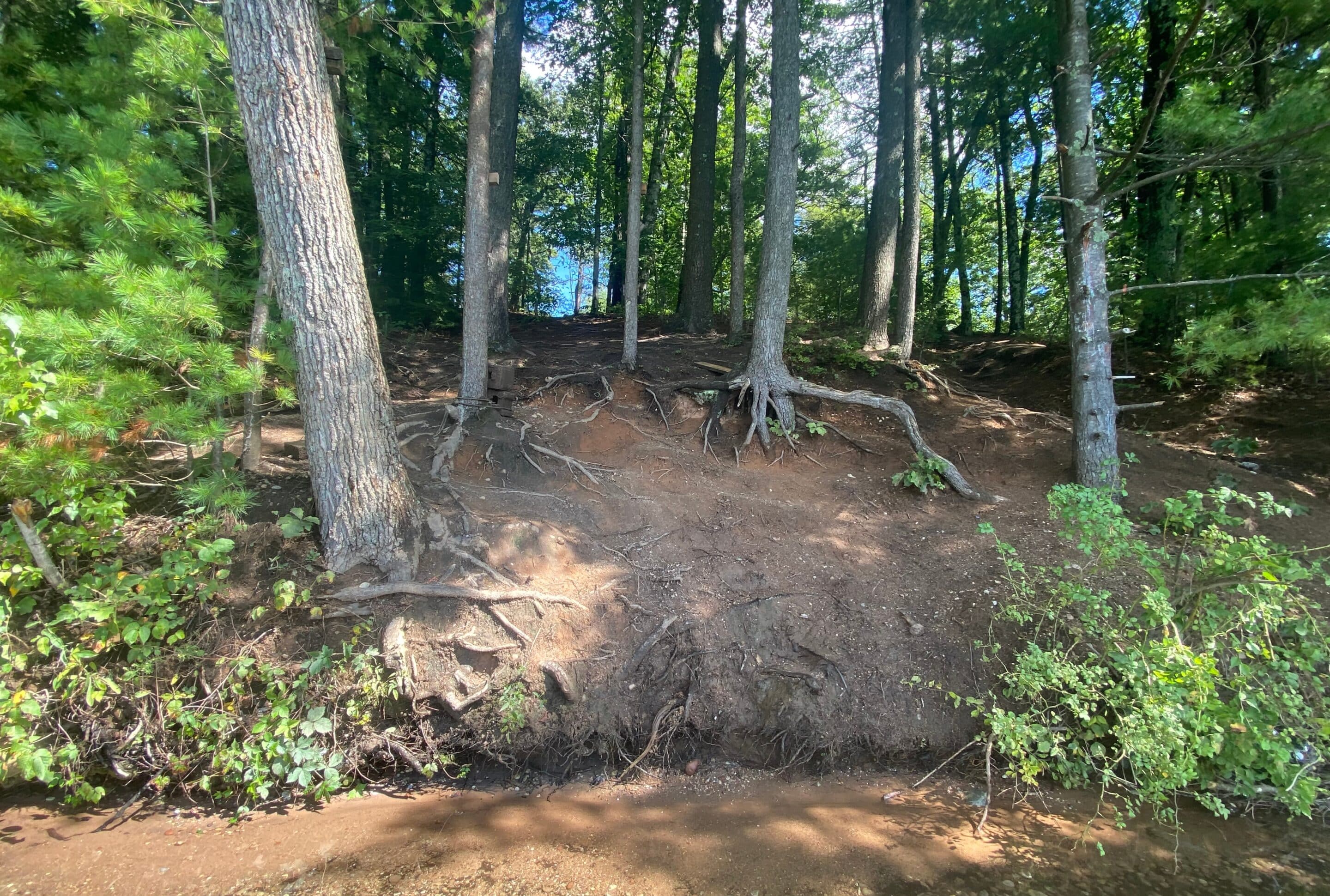
The Conservation Commission is starting the process of revegetating the eroded areas of the North Pond Conservation Area like the one shown in the photo.
Reminder Publishing file photo
SOUTHWICK — The Conservation Commission approved a plan it had been developing for over six months to restore the areas of the North Pond Conservation Area that have been severely eroded by foot traffic.
The decision followed a site visit with several staff members of the state’s Division of Fisheries and Wildlife.
“That all kind of fits right into your plan here. So, that’s excellent,” said Commissioner Dennis Clark after commission Coordinator Sabrina Pooler gave an overview of the plan and suggestions from MassWildlife staff.
The Conservation Commission is focused on the most significant spot in the conservation area: the land just above the former King’s Beach, which has a steep slope and bare soil caused by years of visitor foot traffic.
Last year, the commission began developing a planting plan for that spot and other eroded areas and chose the types of trees and shrubs to plant. They closed off what’s considered the Scenic Trail, which leads down to the sandy beach, to limit access and give vegetation time to take root.
The work couldn’t start without the approval of MassWildlife and a negative determination by the commission — issued during the meeting — that the work wouldn’t harm any areas under the state’s Wetlands Protection Act.
The plan is still awaiting approval from MassWildlife.
Pooler said that during the site visit, the staffers had several suggestions for reestablishing vegetation on the eroded slope and proposed an alternative to the plantings.
She said that, instead of putting loam down for plantings and eliminating the need to keep them irrigated, throwing branches, trees, and stones into the gully areas could be an option.
“Over time, the soil will build up, and even in that time, we can do some like spot planting. That might be easier for maintenance,” Pooler said. If the commission decided to follow through with the plantings, the officials suggested adding sand to the loam to help drainage.
“They’re worried about, over time, the loam [will start] slouching, which is like slipping down the hill. So, if you add a little bit of sand in, it the help with drainage,” Pooler said.
The officials also suggested installing logs crosswise on the slope and straw wattles, also called straw worms or bio-logs, to reduce erosion.
When the commission found a negative determination regarding the Wetlands Protection Act, it also approved three phases to restore the eroded areas.
Phase I is essentially the plan to restore the bare slope.
During the meeting, Pooler did not speak in detail about Phase II but included Phase II in a report to the commission about the site visit, noting that it is in the area of one of several unapproved trails. Currently, there are only three approved trails.
That area contains “limited understory vegetation,” a sparse or absent layer of plants, shrubs and seedlings growing beneath a forest canopy, and visibly compacted soils, according to Pooler’s report.
Soil compaction could be responsible for the limited understory vegetation and could prevent root penetration and establishment of planned plantings.
Pooler wrote that the MassWildlife staff suggested light scarification of soils using a garden rake may help improve rooting conditions and plant establishment.
Pooler wrote that the downside of that would be an increased possibility of erosion, which could be mitigated using water bars, such as shallow trenches or elevated bars, to redirect stormwater.
The plan for Phase III is to use one of the eroded, unapproved trails, which Pooler said appeared to be an old driveway, revegetate it with native plantings, and install a pea-stone pathway.
“The proposed pathway would involve the construction of reinforced wooden framed sections filled with pea stone to create a stabilized walking surface resistant to erosion and continued trail degradation,” Pooler wrote in the commission report, saying the pathway would be formally added to the approved trail list under the area’s conservation restriction.
“I think the reason for the stone path is to deter people from walking on a plant, and things like that, and stay on the stone path instead of venturing off and destroying what we fixed,” she said at the meeting.
The staff also proposed installing a fence at the beginning and end of the new trail to prevent ATVs from getting through and destroying the work.
Clark said there was already a fence at the beginning of the proposed new trail.
Pooler said there was some fencing, but “it’s not going to block it completely, but it’s a deterrence, and there’s only so much we can do.”
Commission Chair Norman Cheever said that, after the unanimous vote to approve the plan, the commission will now wait for the state’s response.
“Once we get those comments back from the state, we’ll have a clear idea of what we can do. And then maybe we’ll have another meeting on what we want to do,” Cheever said.
“Right,” said Commissioner Jerry Patria. “They may give us further direction … and revise it and do another approval [of the plan] subject to modification.”