
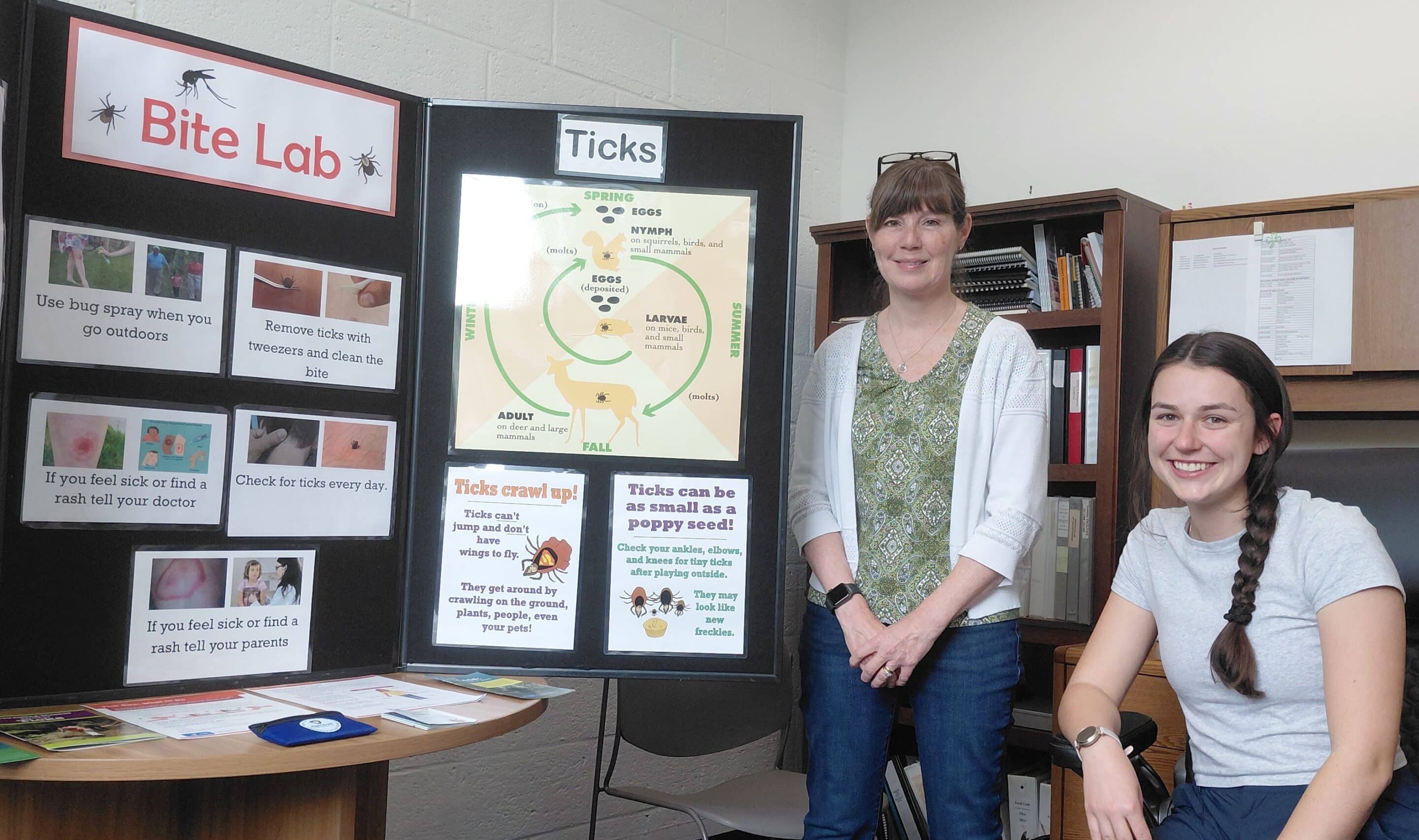
Maryann Deming (standing), who is the regional public health nurse for the Western Hampden County Public Health District, and Southwick’s interim Caileen Simonds stands with the presentation used when educating area residents about the dangers of ticks and how to prevent getting bitten.
Reminder Publishing photo by Cliff Clark
SOUTHWICK — It may sound counterintuitive, but the amount of snow the area got this winter has contributed to the dramatic increase in the number of ticks being reported by area health departments, including in Southwick.
“It was nice and cozy for them this winter, so they are really out this year,” said the town’s interim Health Director Caileen Simonds.
The snow cover was the perfect habitat for ticks, which are usually killed off during the winter by subzero temperatures, which the region did experience this winter, and freeze and thaw cycles.
And the statistics tell the story.
In April alone, the Northeast had the highest rate of emergency room visits at 188 per 100,000, the highest in the U.S., according to the Centers for Disease Control and Prevention.
With the increase, Simonds and MaryAnn Deming, who serves as the regional health nurse for the Western Hampden County Public Health District have been working to get the word out to area residents.
Over the last month, Deming has given numerous presentations at senior centers in the region to alert them and their families to the real dangers of a tick bite.
In this region, Lyme disease is the illness most heard about, and fortunately, at least so far, there have only been five reported cases, Deming said.
However, in the eastern part of the state, especially on Martha’s Vineyard, there is an abundance of Lone Star ticks. Those are widely considered among the worst ticks in the country that carry a malady known as alpha-gal syndrome, which is a bizarre, life-altering red meat allergy. They also carry the diseases ehrlichiosis and anaplasmosis, which cause flu-like symptoms and if not treated can cause life-threatening complications.
For Simonds and Deming, prevention is the best protection from being bitten.
“We’re pushing prevention,” Deming said.
They suggested following the guidelines published by the state’s Department of Public Health.
Use tick repellents with an EPA-registered active ingredient; always follow the directions on the label.
Weather permitting, wear long-sleeved, light-colored shirts and long pants tucked into socks. This will help keep ticks away from your skin and make it easier to spot ticks on your clothing.
After spending time outdoors, taking a shower can help rinse off a tick before it becomes attached, and putting clothes in the dryer on high heat for 10 minutes can help kill ticks.
Check yourself for ticks once a day; if you find an attached tick, remove it promptly using fine tweezers or a tick removal tool.
Pets that spend time outdoors may bring ticks back inside. Talk to your veterinarian about the best ways to protect your animals from ticks and tick-borne disease.
They also offered instructions on what to do, and not do, when a tick has bitten you and is attached.
Using tweezers, grab the tick as close as possible to the skin and pull up using gentle pressure, Deming said.
She said, if the mouthpart breaks off, don’t dig around for it, just leave it alone because it will eventually be pushed out by the skin. But she said to be extra safe visiting an urgent care center can help alleviate any fears and perhaps a prescription for doxycycline as a prophylactic.
Don’t try to burn it off or cover it with petroleum jelly or nail polish.
“That doesn’t really work,” Deming said.
Simonds said the bite area needs to be closely monitored and if it begins to become red or starts to look like a bullseye that means a mandatory trip to the emergency room or urgent care center.
Simonds said anyone who has questions should not hesitate to call the Health Department at 413-569-1212.
The Health Department also has a limited number of free tick removal kits available in Town Hall.
“We’re here to help,” she said.