
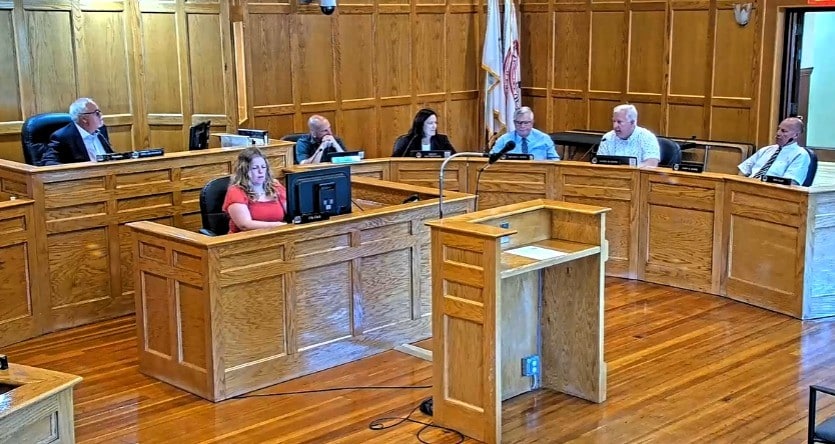
Finance Committee Chair Daniel Knapik, second from right, addresses councilors on proposed cuts at a budget reconciliation meeting on June 17.
Photo credit: Westfield Community TV
WESTFIELD — During a special budget reconciliation meeting on June 17, the City Council voted in favor of almost all of the Finance Committee’s recommendations to reduce Mayor Michael McCabe’s fiscal year 2026-27 budget by more than $1.5 million,
The roughly $170 million budget was then ratified at the regular City Council meeting on June 18.
The decision brings the tax increase down from 4% to 2.5%.
In presenting the committee’s recommendations, Finance Committee Chair Daniel Knapik, joined in committee by Councilors Brent Bean and Cindy Harris, said they had met many times with city department heads to review their budgets. He said he has also been meeting with the mayor’s office to understand the challenges facing the city over the next few years, and in the process developed a five-year forecast moving forward.
Before presenting the cuts, Knapik called local aid a massive problem. “It is way behind historic growth patterns … It’s clear it’s broken at the state level. There’s very little this body controls,” he said. “The one thing we can control is the spending.” He said the goal he had for the committee was to get in front of the City Council with $1.5 million in cuts to get to a 2.5% tax increase.
The cuts presented to the City Council included $637,944 to the health insurance line, which had been increased by 15%; $598,000 from engineering, which Knapik said could be charged to free cash if needed for one-time projects, and $170,000 for the new position of assistant fire chief, which the majority of the council felt was not needed at this time.
A $127,000 cut initially proposed out of the Police Department’s budget to pay for two of four cruisers was withdrawn by Knapik after he said Treasurer Matthew Barnes had contacted him with $150,000 in savings; $100,000 from the long-term interest debt account and $50,000 on the interest on temporary notes. “That’s a pretty good swap,” he said.
Knapik said the FY26 budget also includes $2 million in free cash and $1.25 in cuts to debt decline, totalling $3.25 million in offsets from one-time cash resources. In his long-range forecast, he said he carried over the cuts to the debt decline for the next four years, but no more free cash going forward.
Knapik also highlighted the lowered projection of new growth at $200,000 in the mayor’s budget, saying historically that since 2001, new growth averaged $1 million. In his long-range forecast, Knapik said he inserted the number of $400,000 in new growth going forward over the next four years.
In reference to new growth, the only cut from the Finance Committee that did not pass at the meeting was $50,000 to eliminate the new position of an economic development director. The budget had originally included $100,000 for a full-year position, but Knapik said the mayor had cut it to $50,000 for half a year in order to rework the job description and allow time for the hiring process.
During the discussion, Councilor Ralph Figy said he has probably been the loudest voice to put the economic development position back into the budget. “I’m going to be a no on this reduction, because you look at our new growth, and I think without an economic development coordinator … that number has really drastically reduced, and I think would only be increased if we had this position,” Figy said.
Bean said he was a no vote on the cut in committee, and has also been banging the drum for this position for a number of years. “I think the correlation of new growth, and not having that position filled, and moving the city forward is a big part of it,” he said, adding, “We can’t cut our way out of these things. We have to grow, and we have to be on top of the kind of industry we want and hopefully reduce the taxes that are being paid on the residential side and on the commercial side.”
Harris, who voted for the cut in committee, said she took the opposite position. She said a few years ago, the Boston papers had touted Westfield as a great place to go. ”All the big companies who want to come here, even small companies, they already know about Westfield. They have their own scouts that go across Massachusetts, and scout out where’s a good position, where’s a good fit for them,” she said, adding that between the mayor and community development, she did not believe the position was necessary.
Councilor James Adams disagreed. He said there are opportunities out there that somebody other than the mayor should address.
“Somebody that actually knows how to bring in business. I don’t know if the mayor knows how to bring in business. He was a captain of a police department. What does he know about bringing in business? He doesn’t. But somebody who’s trained and has done it, knows the little things to do, and it directly has an impact on our budget. We’ve all been complaining about the growth; well, because we haven’t had anybody in there to sell our city,” Adams said.
Knapik said while he initially voted for the cut in committee because the job description had to be reworked, he was going to change his mind and support the position. The vote to cut the $50,000 to pay for half a year of salary failed, with Harris and Councilors Bridget Matthews-Kane and Kristen Mello in support of the cut. Mello said she believes an advancement person is needed, but it didn’t seem like the city was ready to go forward.
During the meeting, Knapik again spoke to what he believes is the need for a new formula for payment in lieu of taxes by Westfield Gas & Electric, which has been capped for a decade at $530,000 to $550,000. He has requested that the mayor and his appointee on the Municipal Light Board bring WG&E back to the table. “It’s about being fair,” he said.
Knapik ended the meeting by thanking the councilors and saying the mayor and city department heads had been great to work with. “There are some hard decisions in the future that have to be made,” he said, but added, “The great news for this city is we’re not like these other ones that are having those debt exclusions and override votes. There’s a lot of folks along the way that got us into the position where we have some levy capacity … and we’re not facing the cliff right now, so we have some time.”