
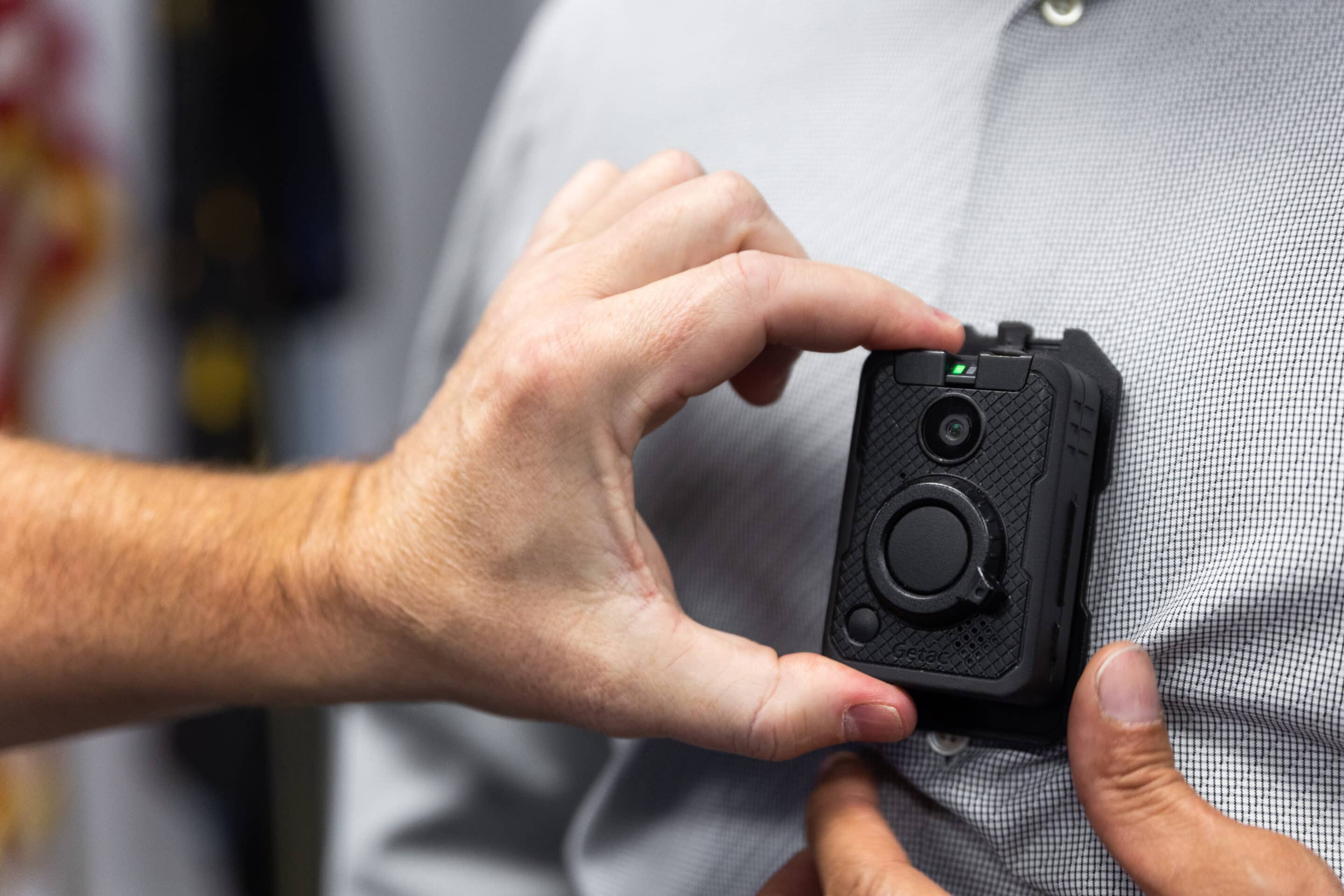
One of the police body cameras used at the Springfield Police Department. Westfield will soon implement a body camera program.
Republican file photo
WESTFIELD — The Westfield Police Department now has nearly $300,000 to fit its officers with body-worn cameras, which was one of Police Chief Jerome Pitoniak’s goals when he was appointed in 2024.
“We hope that happens in a few weeks,” said Pitoniak.
Before that happens, the Westfield Police Patrol Officers Coalition must reach a contractual agreement with the city that allows its members to wear the cameras. That agreement could include additional financial compensation.
“We’re optimistic that it would get done soon,” said At Large Councilor Brent Bean II during a City Council meeting on June 4 about the negotiations.
Local 574, the union that represents the department’s supervisors, has already approved the use of the cameras, Pitoniak said this week.
Bean made that comment after he reported to the council that the Finance Committee, on which he sits, had unanimously approved transferring $124,380 between Police Department accounts to complement a state grant of $174,000 awarded to the department in March for the cameras.
“I think the good news on this is that it will help protect the officer, the citizens, and the city on the liability side, but also just to be safer all around,” Bean said. “We all can appreciate that.”
Pitoniak and Police Capt. Eric Hall echoed Bean.
“It protects the officers,” Hall said.
And when an individual files a complaint against an officer, Hall said: “The vast majority of the time it exonerates the officer.”
During the council meeting, At Large Councilor James Adams, who serves as the liaison between the council and the department, added that he had spoken to patrol officers who told him that “it protects them more than it protects anybody else. And that is what they want, protection.”
“When people say, ‘You’re doing this to me,’ and they actually aren’t, it can be proven,” Adams said.
While preparing to roll out the camera program, Pitoniak and Hall spoke with several other departments that already use the cameras to learn about issues those departments had encountered.
The primary issue was requests from individuals for recordings of interactions they had with the officers, Pitoniak said.
“When they first got the program, they said they were overloaded with requests,” he said.
However, after about three to six months, the number of requests dropped off, Hall said.
This was attributed to most recording requests not producing the outcome the requesters wanted.
If there are many requests in the short term, Hall said it will be a challenge for the department because of the time it will take to pull the recording and make any necessary redactions.
Those redactions would include graphic violence, blurred faces, home interiors and family photos, muted audio to protect privacy and blacked-out license plates.
The funds will be used to purchase 87 cameras, associated software and data storage services, Bean said.
The full council also unanimously approved the transfer.
The grant was part of the Law Enforcement Body-Worn Camera Program, which was established in the state’s 2020-2026 Capital Plan. The grant represented the final award issued through the program.
It was designed to help departments shoulder the upfront costs of launching body-worn camera systems, including equipment, data storage, and maintenance, according to a statement from the Healey administration, which announced it in March.