
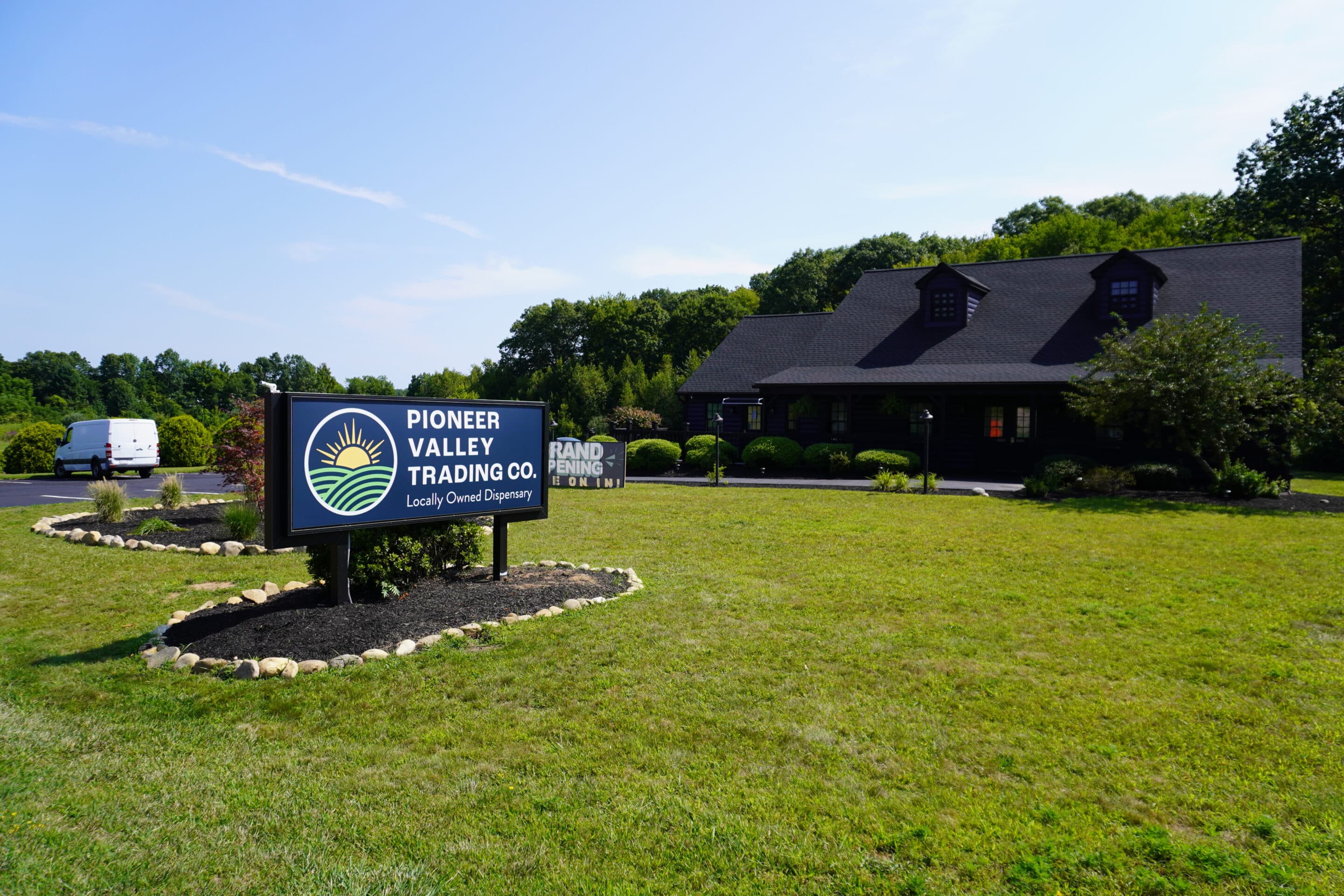
Pioneer Valley Trading Co.’s location at 660 College Highway, Southwick.
Reminder Publishing file photo
SOUTHWICK — When the owner of Pioneer Valley Trading Co. agreed to a host agreement with the town to open a recreational marijuana dispensary, he said that he would eventually return to ask for permission to start a grow operation, which he did during the Select Board meeting on March 2.
“The time has come,” said PVTC owner Michael Albert.
He reminded the board that when he opened the dispensary last August, he let them know that he wanted to “vertically integrate” the company to produce its own products to sell at his store in Southwick and the other PVTC in Westfield and to other marijuana retailers, but with a caveat.
“What we’re not proposing is being a massive facility to go statewide,” Albert said. “We want to keep it in-house so it’s just Pioneer Valley Trading Co. and our partners in other stores.”
To keep the operation small, Albert proposed using three acres of a 24-acre parcel he owns on Granville Road to install three 35-by-100-foot greenhouses and use half of those three acres to grow outdoors.
Albert said a lot of companies are now moving their grow operations to greenhouse productions, “using the power of the sun, rather than pumping in a ton of electricity [at an indoor operation].”
“So, you’re starting to see a shift in the industry for outdoor production, which is my background,” he said.
The greenhouses are unique in that the amount of sunlight can be reduced during the long days of spring, summer and early fall with black curtains.
He explained that’s because the cannabis plant is photosensitive, and it needs to be “tricked into thinking it’s fall,” which is the way it grows buds for pollination.
While the property is now used to grow vegetables, he told the board he purchased the property in 2019 to grow hemp after it was allowed in the 2018 Farm Bill.
“It was hemp, so it was CBD plants. If you’re looking at it, it smells the same, looks the same, and has the same characteristics [of a marijuana plant]. It just does not have that THC cannabinoid byproduct in the flower. You can only have 0.03%,” he said.
What he was proposing during a March 2 board meeting is “kind of what we did back then, just the real stuff now,” Albert said.
If approved, he also plans to build a 4,800-square-foot metal building that will be used to dry the plant, trim it, process it and for the extraction of oils, which will be used for vape pens, often referred to as weed vape pens, and other products like gummies and tinctures, which are all tested. “It’s very stringent,” he said.
The extraction room will be designed and constructed in accordance with applicable fire, building and safety codes. The room will be physically separated from other processing areas and equipped with appropriate ventilation, gas detection and explosion-resistant features as required, Albert wrote in his proposal for the grow operation.
“There are evacuation alarms … if [the equipment] senses any gas, it will purge the whole room for safety purposes,” he said, adding its “high-tech” equipment that is widely implemented throughout the cannabis grow industry.
The greenhouses and auxiliary building will be installed at the very back of the property.
While growing hemp there for several years, Albert said he never had any issues with abutting property owners, who had to be notified when he started the hemp operation.
“Everyone was really cool,” he said of the abutters, adding that the operation will not be visible from Granville Road.
A security fence will also be installed around the operation with a sliding gate with pin-pad access. The Police Department will have to sign off on the operation’s security procedures as part of the special permit process the company will need to begin operations.
“That’s all governed by the [Cannabis Control Commission]. They’re really, really strict on these things for access,” Albert said.
He said having the grow operation will expand the business’ profit margins.
“That means I’m not buying it from Worcester or Boston …there’s a ton of growers out east,” he said.
Albert also said that any revenue generated by this grow operation, which will produce between 3,000 to 4,000 pounds a year, is still subject to the 3% excise tax paid quarterly to the town.
The board members didn’t have any objections to modifying the existing host agreement the town now has with PVTC, which board Chair Diane Gale said would be amended by a formal vote at the board’s next meeting.
“Then I can get the ball rolling, and then I can start talking to the Planning Board,” he said.
The grow operation will need a special permit from the Planning Board.