
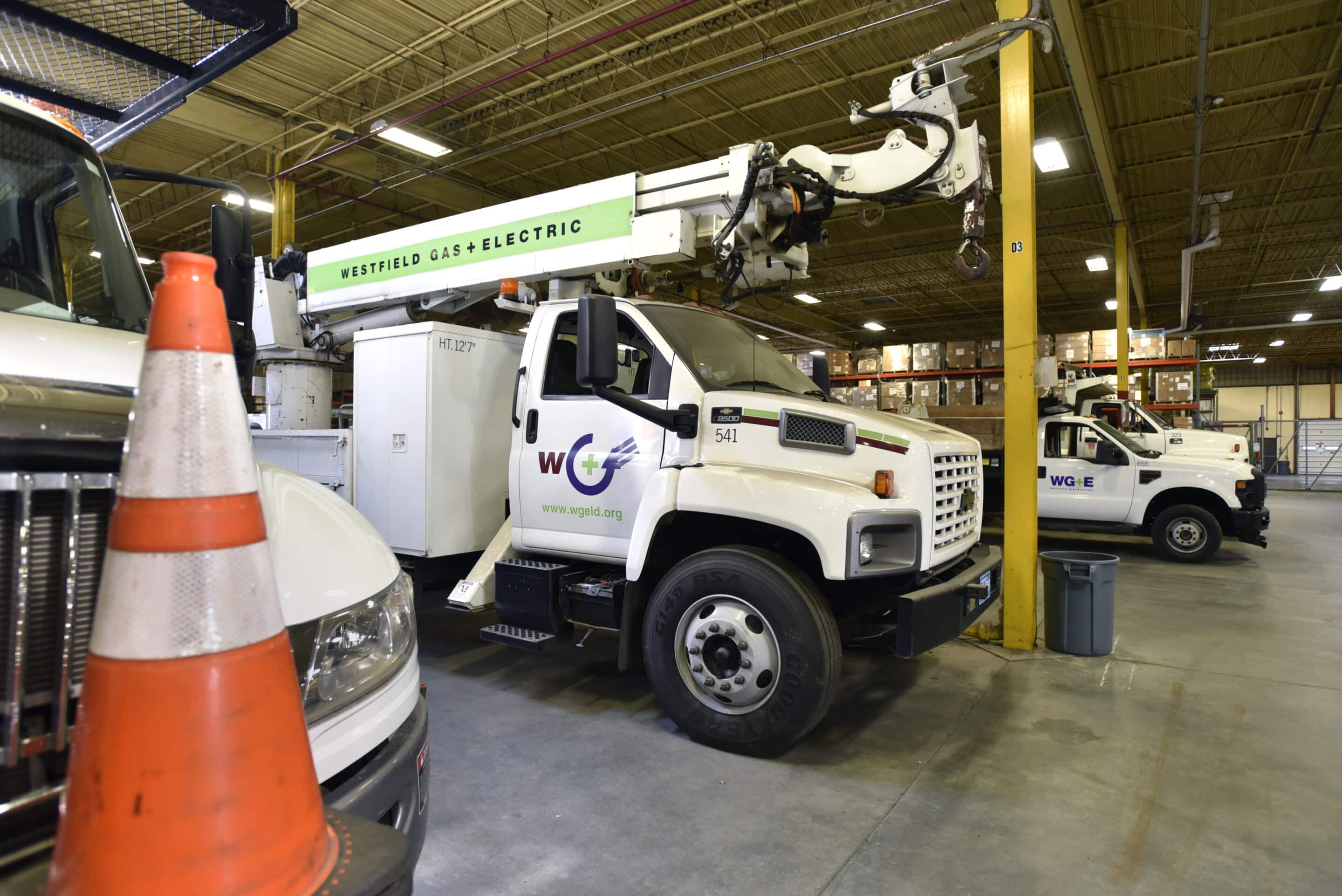
Westfield Gas & Electric trucks parked in their Operations Center on Turnpike Industrial Road.
Republican file photo
WESTFIELD — The commissioners serving on the city’s Municipal Light Board have a compensation package unlike any other board, council or committee in the city.
Members who opt to take the city’s health insurance can have the full amount of the premium paid by Westfield Gas and Electric while maintaining the annual stipend of $7,500.
And while WG&E General Manager Thomas Flaherty doesn’t have an issue with the arrangement, at least one member of the Municipal Light Board does.
“There’s not a commission or board, city council, school committee … nobody gets 100% of their health insurance paid for,” said Light Board Commissioner Robert Sacco at the board’s meeting on April 1.
Flaherty, on the other hand, supports the decision the board made last September to modify its compensation package to reflect the dramatic increase in health insurance premiums over the last two years.
“It’s a benefit of the elected office,” Flaherty said.
The board’s discussion about modifying its compensation started at its meeting last July.
During that meeting, Flaherty started the discussion by announcing that health insurance premiums had risen 28%, and that increase exceeded the $625 monthly stipend paid to the commissioners, according to the minutes of the July meeting.
He recommended allowing WG&E to cover the difference between the monthly stipend paid to commissioners and the amount they pay for coverage under the city’s health insurance plan.
Flaherty estimated it would cost WG&E $20 to $30 per board member who takes the city’s health insurance, according to the minutes of the July meeting.
As for the $7,500 annual stipend, Flaherty indicated it was “not a favorable topic” and would be left to the discretion of the board, according to the minutes from that meeting at which Sacco expressed concerns about the “potential for inequity.”
Several city employees have contacted Reminder Publishing about that issue.
“It’s just not fair,” one city employee said, asking not to be identified.
Another pointed out that every other city employee pays 20% of the health insurance premium, asking why Light Board commissioners are treated differently.
Sacco at the July meeting also questioned whether providing the commissioners with additional benefits beyond what city employees receive could result in unequal treatment, according to the minutes.
Former Light Board Commissioner Ed Roman, who retired from the board in January, initially raised the issue but stressed at the July meeting that he was not looking for an increase in the stipend but wanted to hear the thoughts from other commissioners.
He said at the meeting that he was comfortable paying a small portion of the premium out of pocket, and if he was the only commissioner who was affected by the premium increase, he’d “drop the matter.”
Sacco suggested maintaining the status quo, but wanted the WG&E attorney to determine the legality of the proposal attorney advised the board that it had the authority to change its compensation package.
At the Light Board’s September meeting, a majority of those in attendance voted to “approve the payment by WG&E of the full cost of health and dental insurance for members of the Municipal Light Board upon their individual request dependent upon plan eligibility, to participate in the WG&E health and dental insurance program, and that the health and dental insurance benefits shall be in addition to the stipend paid to such Municipal Light Board members,” according to the minutes.
The motion, made by Roman, was approved by Ray Rivera, Dawn Renaudette, Bill Parks, Robert Goyette and Roman.
Opposed were Kevin Kelleher, who also retired from the board in January, and Sacco.
Those who voted to approve the motion offered their reasons for supporting it.
Roman said the issue may be more relevant for future board members, echoing Renaudette’s reasoning.
She said future commissioners may have different circumstances, like someone who wants to run for the board to serve the city, but who is struggling financially and needs access to health insurance.
Rivera, who was serving as chair during the September meeting, acknowledged the amount was small, but if WG&E had the ability to offer the benefit, the board should at least consider it.
Sacco, however, continued to oppose and said that serving on the board should be for public service, not employment, and therefore should not include additional benefits.
Flaherty, who served on the board in the early 2000s, said the compensation for the Light Board has been adjusted over the years because of rising premiums.
“Each time it was raised, it was to cover the increased cost of health insurance,” he said.
He also recognized that seats on the board are elected, and he didn’t think the additional compensation was an issue.
“They’re putting themselves out there to serve the city,” he said.
As for shouldering the cost of the premium, Flaherty said the amount is so small it wouldn’t affect the city department’s bottom line. WG&E had revenues of $110 million last year.
Flaherty acknowledged that the Light Board would have a unique compensation package in the city, but he also said that any board, commission or council can adjust its compensation if they want to.
At the April 1 meeting, Sacco told his fellow board members that he had asked Flaherty to put the issue on the agenda for discussion during May’s board meeting.
“I’m not going to ask for a vote, but I want to put it back on the agenda for next month to let the new commissioners think about it and learn what they need to learn,” he said.
After Roman and Kelleher retired, Tom Fanion was elected to the Ward 1 seat, and Jason Bean was appointed to the board.
Interestingly, the compensation package had yet to be implemented, according to Annie Larkham, the city’s personnel director.
Flaherty said that after the May meeting, he expects it to be implemented and backdated to Jan. 1.