
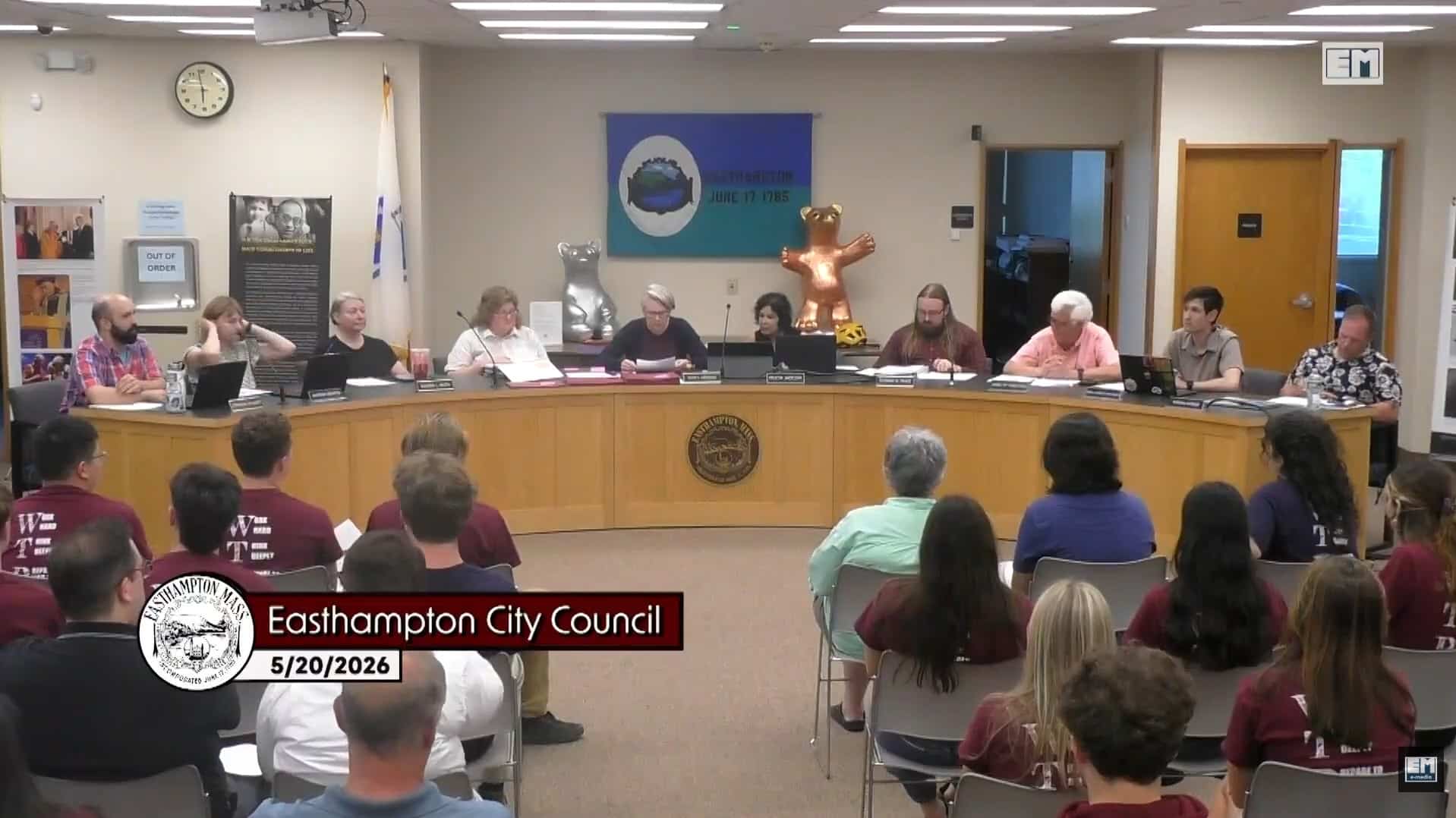
The Easthampton City Council met on May 20 to discuss and eventually approve housing ordinance changes.
Photo credit: E-Media
EASTHAMPTON — The Easthampton City Council approved a series of amendments on May 20 to the city’s Affordable and Fair Housing Partnership Zoning Ordinance.
The amendments advance changes supporters said will modernize local housing rules, reduce barriers to development and better align the ordinance with state law and contemporary definitions of family and neighborhood design.
All five proposed amendments passed after discussion among councilors about housing affordability, inclusivity and the role zoning language can play in shaping who feels welcome in a community.
One of the simpler updates references in the ordinance from the state Department of Housing and Community Development to the Executive Office of Housing and Livable Communities, reflecting a recent administrative restructuring at the state level.
Another amendment is centered on parking requirements for multifamily housing developments. The amendment establishes a blanket minimum of 1.5 parking spaces per unit for all multifamily housing projects, while allowing the requirement to be reduced to an average of one space per unit depending on unit mix and project location.
The previous standard required one parking space per bedroom plus one additional space for every 10 units.
Ordinance Committee Chair Kiam Jamrog-McQuaid explained that reducing parking minimums could help lower housing costs while encouraging greater use of public transportation.
Parking spaces often function as a “hidden tax,” Jamrog-McQuaid said, because the cost of the parking space is included in the rent even if it’s not used.
The council also approved language changes intended to ensure local zoning regulations align with and defer to state housing law where applicable.
Another amendment updated the ordinance’s definition of “family” to include “all the people who occupy a single housing unit, regardless of their relationship to one another.”
Supporters said the revision reflects changing household structures and more inclusive understandings of family life.
“Families have changed,” said Councilor Nathan Markee during the discussion.
Councilor Thomas Peake said the updated language removes the city from making subjective judgments about residents’ personal relationships.
“It’s not our job to tell people what a family is,” Peake said.
Councilors spent significant time discussing revisions to language referencing “community character” throughout the zoning ordinance. The approved changes remove or clarify vague references to neighborhood “character” and replace them with more objective and specific criteria.
Jamrog-McQuaid argued that the phrase “community character” can be overly subjective and potentially discriminatory if left undefined.
The councilor warned that such language can be “weaponized” to justify racial or class exclusion under the guise of preserving neighborhoods.
Councilors emphasized that the revisions are not intended to eliminate legitimate land-use considerations such as density, scale or design standards, but rather to encourage more precise language focused on measurable aesthetic concerns.
Peake illustrated the issue by recounting the story of his own “ugly house,” noting that buildings and neighborhoods evolve over time as materials, construction methods, economics and available supplies change.
Rather than relying on broad appeals to “character,” councilors said zoning ordinances should clearly define what qualities are expected or prohibited in a development.