
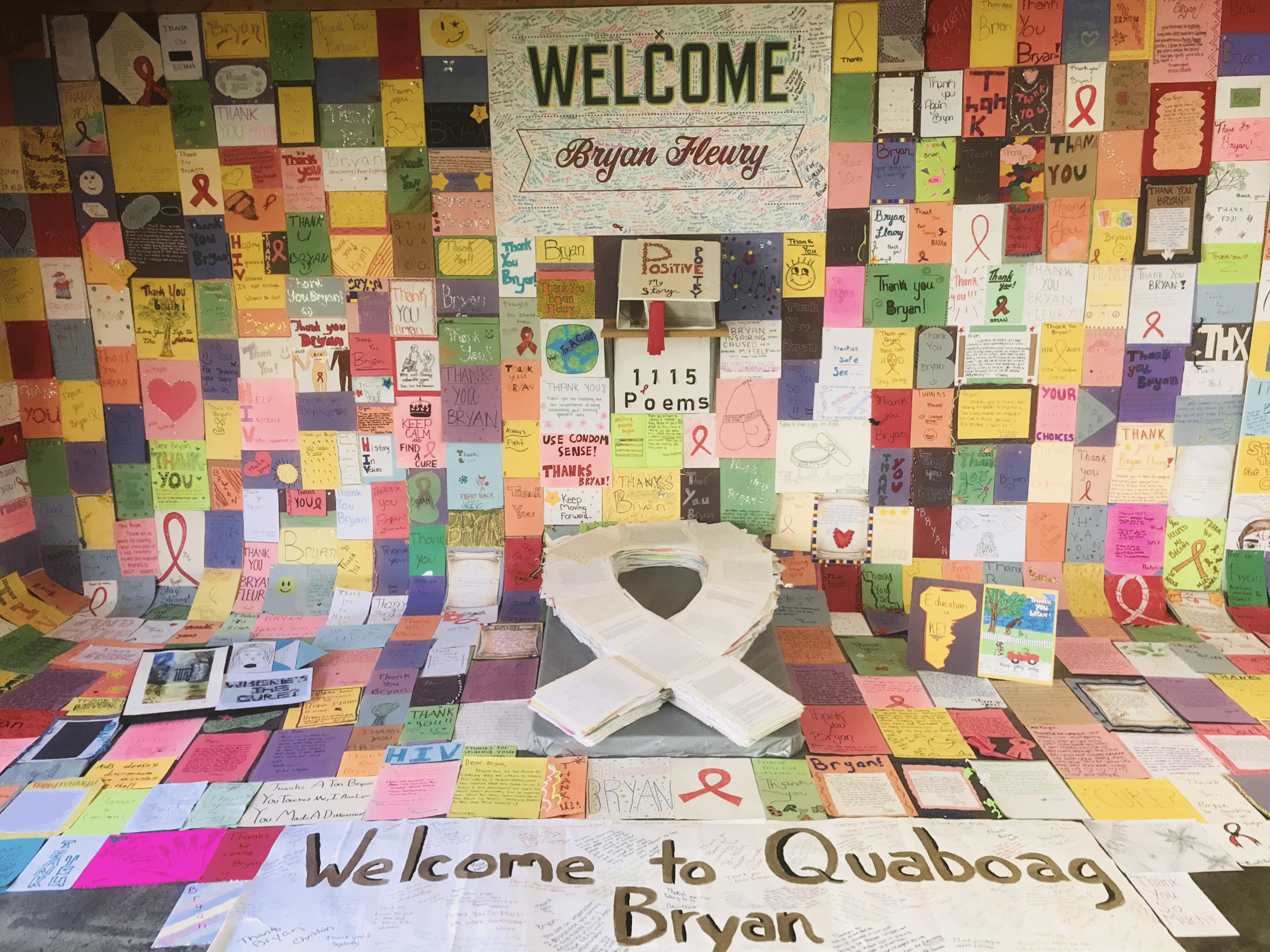
A look at many of the thank you cards and poems Bryan Fleury has received over the years.
Reminder Publishing submitted photo
WEST SPRINGFIELD — For Bryan Fleury of West Springfield, living with HIV has never simply been about surviving. It has become a lifelong mission to educate others, reduce stigma and ensure young people have the information they need to protect themselves.
“I’ve been living with HIV for 35 years, testing positive when this disease was considered a death sentence,” Fleury said. “Like many long-term survivors, we were told to get our affairs in order.”
At first, disbelief overshadowed acceptance.
“I was in denial because I was always a strong, healthy guy,” he recalled. Then came a pivotal moment while watching a “60 Minutes” documentary filmed inside an AIDS ward, with a nurse discussing how most of the patients would die alone — their families having abandoned them. “I was never so scared in my life.”
Treatment in the early 1990s was grueling. Fleury was prescribed AZT, requiring 32 pills a day. When he struggled to keep up with the demanding schedule, his doctor delivered words that would shape the rest of his life.
“He sat me down and said, ‘Listen Bryan, you have a decision to make. You can either learn to live with this disease or die with this disease.’ I told him I absolutely didn’t want to die,” recalled Fleury.
The doctor then introduced him to Tommy Baker, a case manager at River Valley Counseling in Holyoke.
“He became my case manager. He was a hero to so many and worked tirelessly at his job,” Fleury said. Although Baker repeatedly encouraged him to share his story publicly, Fleury wasn’t ready.
That changed in the late 1990s when he spoke at his first World AIDS Day event. “Whenever I shared my story, words would just start flowing out of me. I remember Tommy sitting in the audience so proud.”
After Baker died in 2001, Fleury made a promise. “I knew I was on a mission to forever keep him proud.”
That same year, he joined Tapestry’s high school speaker program, determined to make HIV prevention personal rather than statistical. He created colorful poster boards explaining what HIV is, how it is transmitted, common misconceptions and ways to stay safe.
“I knew when I started this wasn’t going to be my style of prevention education,” he said reflecting on the first speaker he saw who had a very different approach. “HIV doesn’t discriminate. It doesn’t matter what age, race, religion or your sexual preferences.”
Over the years, students have become his greatest teachers. Fleury has saved more than 7,000 reflection letters and collected 1,115 poems inspired by his presentations.
“I use the feedback I get from students and work them into conversations I might have in the future,” he said. One letter remains especially meaningful: “Dear Bryan, I’m a 10th grader. All my friends are having sex and every day they make fun of me because I haven’t.” Since then, Fleury has emphasized resisting peer pressure and becoming “leaders, not followers.”
Fleury has also used this work as inspiration for his own poetry and receives poems that the students have written based on his speeches.
“My poetry collection is definitely one of a kind,” explained Fleury. “At the end of every class, I share a couple poems, one I wrote called Saving Private Bryan. Students started going home and putting my story into some incredible poetry. I have 1,115 poems in my book. I’m pretty sure there’s not many guest speakers that can say that.”
Today, advances in medicine have transformed HIV into a manageable condition. Fleury reminds students that “knowing your status is a lifesaver” and explains that people who achieve an undetectable viral load cannot sexually transmit HIV. “U=U, undetectable equals uninfectable,” explains Fleury, while stressing the continued importance of condoms to prevent other sexually transmitted infections.
Although arthritis has limited the number of schools he visits, Fleury remains committed to the work he calls his gift.
“I still won’t give up on my goal,” he said. “I realize HIV prevention education has been my gift and tools for fighting HIV.”