
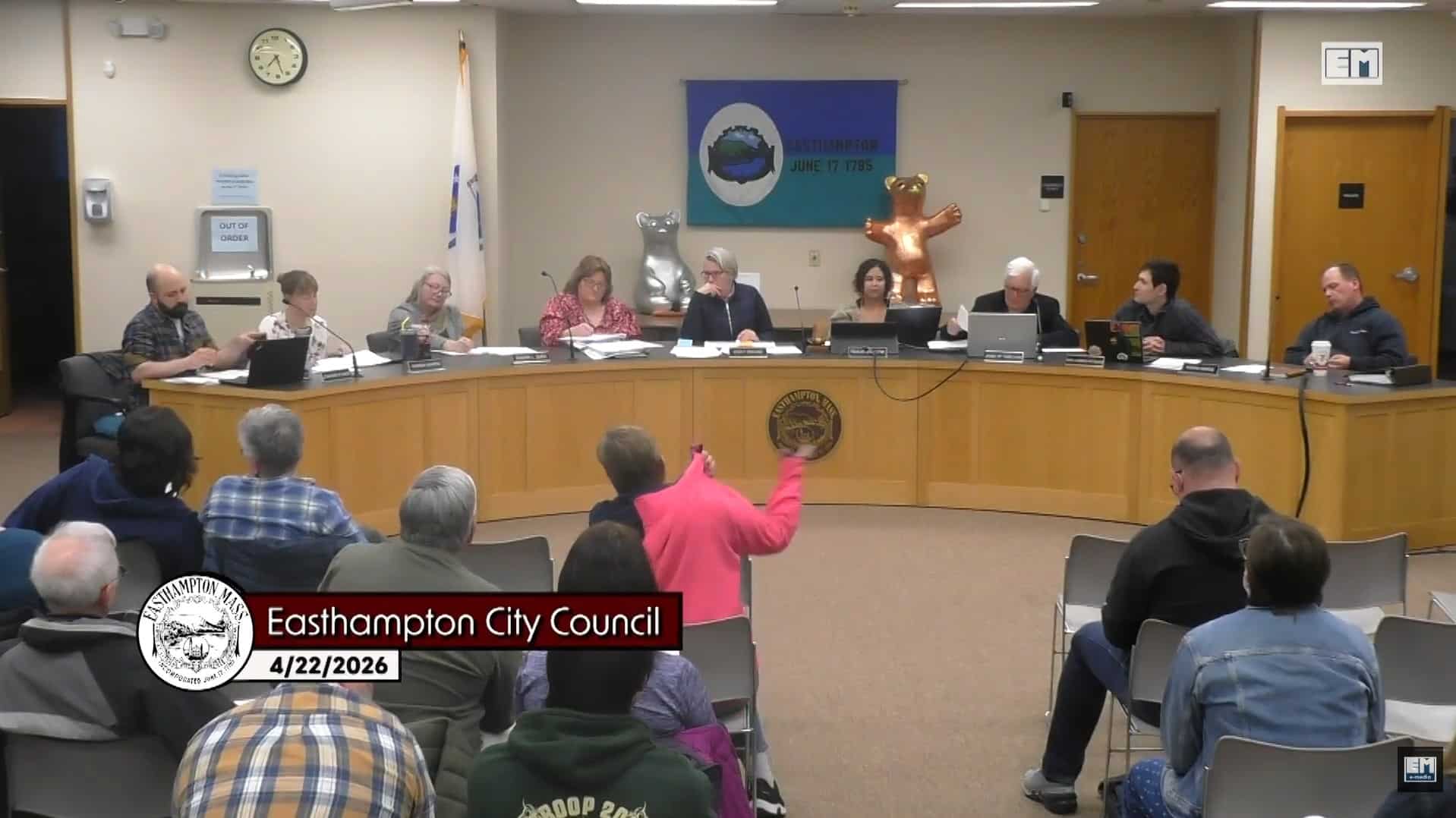
In what was a lengthy four-hour meeting, the Easthampton City Council elected to delay a decision on what to do with the Town Lodging property during its April 22 meeting.
Photo credit: E-Media
EASTHAMPTON — In a lengthy meeting, the Easthampton City Council carefully weighed several financial decisions and ultimately decided to hold off on a decision about the disposition of the Town Lodging property.
At the start of the public hearing, Councilor James “JP” Kwiecenski moved forward a plan to declare the Town Lodging property as surplus and start the process of the city finding potential buyers for it.
The roughly 54-acre property at 75 Oliver St. includes a former lodging house that has fallen into disrepair and many acres of agricultural land. The property, which is on the National Register of Historic Places, has three deed restrictions: agricultural, historical and affordable housing. The buyer would need to manage all three of those deed restrictions, and the city plans to require that the buyer pay at least 10% in property taxes so that the city can gain revenue from it. That desire for revenue for the city is one of the reasons for the move to dispose of the property now.
“The city is in quite dire straits,” said Kwiecenski. Just a couple of weeks ago, Mayor Salem Derby let the City Council know that it faces a roughly $3.8 million deficit for fiscal year 27.
Several residents who live near the property, including the owners of Chicoine Family Farm, spoke out against the potential sale. Owner Bill Chicoine said that recently he had been told his lease agreement to farm several acres of the property for hay for his farm would not be renewed. According to Chicoine, there was no prior notice. His daughter, Elodie, also noted that the deed to the Town Lodging property says that it was deeded to the inhabitants of Easthampton and that should be taken into consideration.
Chief Procurement Officer Michael Owens said that he had let Chicoine know that he could farm the fields this season as long as the property isn’t sold. Owens later explained that the city had offered the property for lease in 2018 and received no offers. According to Owens, it would cost $1.2 million to bring the property, which has been empty since 2017, up to a reasonable condition.
“What do you then use it for?” Owens asked.
Council President Koni Denham encouraged people in attendance to form partnerships to explore what could be done with the property. After several councilors said they felt like they needed more information and time to consider that the property had been deeded to Easthampton residents, the council voted to continue the public hearing to its May 6 meeting.
This council ultimately voted to move forward with two Community Preservation Act projects that will fund the design of the library annex design and fund three mortgage subsidy programs through Valley CDC for people trying to buy homes in Easthampton. Kwiecenski voted against both because he would like to see a more detailed accounting of CPA funds. These funds can only be used for certain aspects of open space and recreation, historic preservation and housing. These funds generally cannot be used to help balance city budgets.
The council approved most of the proposed supplemental appropriations for items like required buyback of vacation and sick time for retired city employees, transfers of funds from free cash into various stabilization accounts and transfers of funds from enterprise retained earnings to upgrade water meters and repairs for the wastewater treatment plants. However, the council withdrew a proposal adding a part-time clerk to the tax collector’s office and continued spending money to support computer servers and vault storage that would keep data safe during a disaster.