
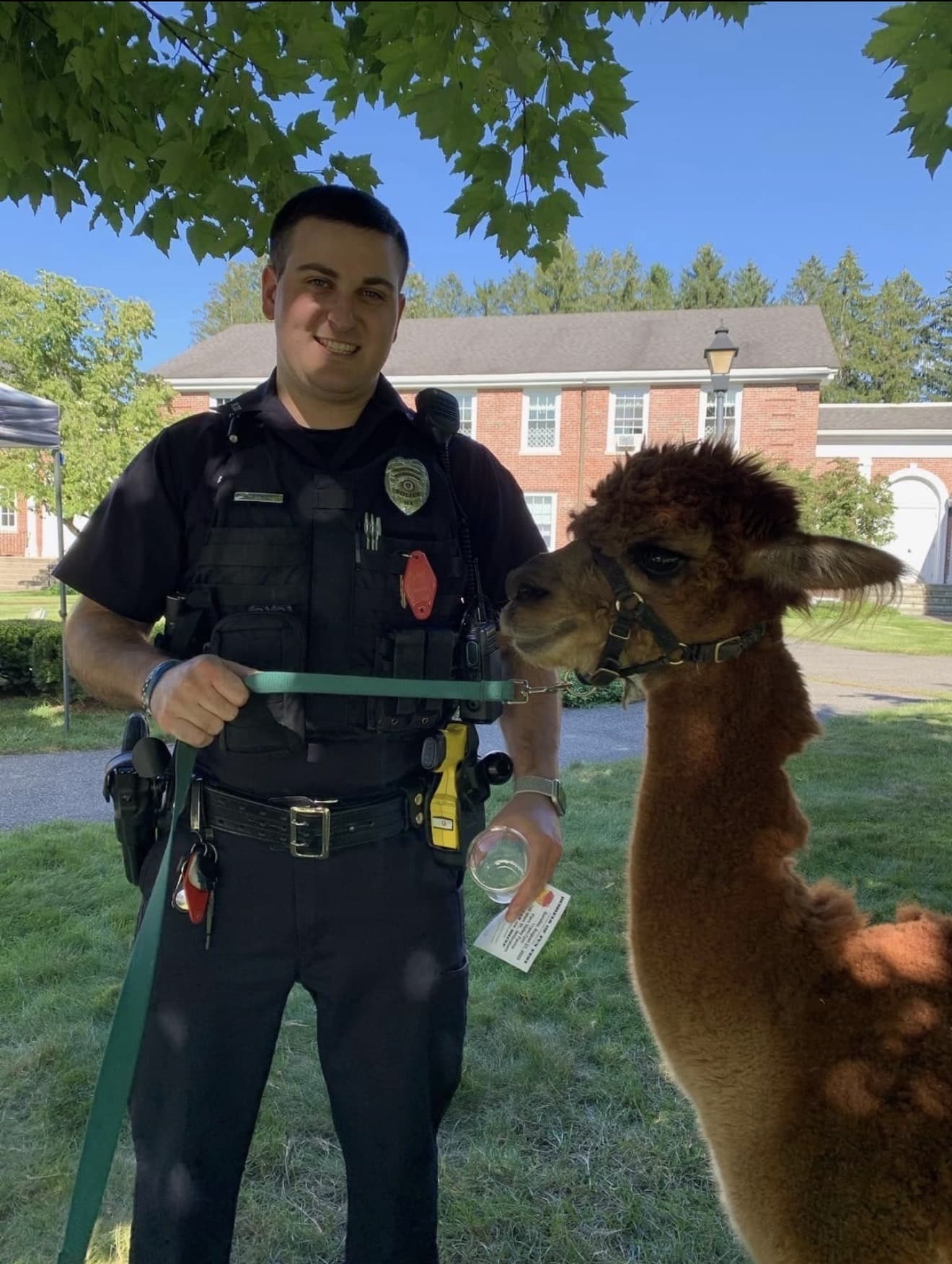
Wilbraham police officer Jack Alberici poses with an alpaca.
Reminder Publishing submitted photo
WILBRAHAM — A decorated officer in the Wilbraham Police Department is seeking a kidney donor after an unexpected rare kidney disease diagnosis.
Police officer Jack Alberici was working a routine shift back in March when he started to feel cramping in his hands, later revealed as one symptom of focal segmental glomerulosclerosis.
Alberici is 27 years old and a Longmeadow native and a Springfield College and Merrimack College graduate. He joined the Wilbraham Police Department in 2022 and received a Massachusetts Medal of Valor after responding to a domestic violence call in 2024 that led to an exchange of gunfire. The exchange left officer Cameron Prosperi wounded.
Focal segmental glomerulosclerosis is found in only seven people per million worldwide, according to UCLA Health. The disease is genetic in Alberici’s case and causes scarring in sections of the kidneys. Scarring impairs the kidney’s ability to filter waste and can ultimately progress to end-stage kidney failure.
He said his uncle received an FSGS diagnosis around 20 years ago, but didn’t know it was genetic until being tested after Alberici’s diagnosis. This renders him unable to find a donor in his family since those who carry the gene can’t be considered.
Alberici described the initial feeling in his hands as being stuck, only able to move by force. His supervisor made a call to the Wilbraham Fire Department for an evaluation, where his 220/120 mmHg blood pressure showed a need for immediate medical attention.
“I went to the hospital and then started doing a bunch of tests and figured out I had some mysteries with my kidneys,” Alberici said. “I was shocked, I really felt fine. I didn’t feel like I was sick or having issues with my kidneys, but obviously there were some underlying issues that were really affecting my health.”
Alberici is on dialysis three days a week and has become limited in his role as a police officer. He said the most challenging part is not being able to do what he wants to do as an officer.
“I can’t go out and patrol,” Alberici said. “I can’t be with the community, I have to be inside at the desk, and the only way I can talk to the community is if it’s a phone call. I can’t be face-to-face like that on the phone. I really miss the community aspect of it.”
He said there are misconceptions around being a kidney donor, such as some people thinking it’ll change their lives because they only have one kidney.
“There’s many people out there that live on one kidney,” Alberici said. “They continue to do all the things they want to do, and my aunt’s the perfect example of it because she donated to my uncle. She’s still doing everything she loved to do when she had two kidneys. Donating is probably one of the greatest things you can give to someone, the most selfless thing you can do.”
More information on Alberici’s story and the donor qualifications can be found at nkr.org/GXY896.