
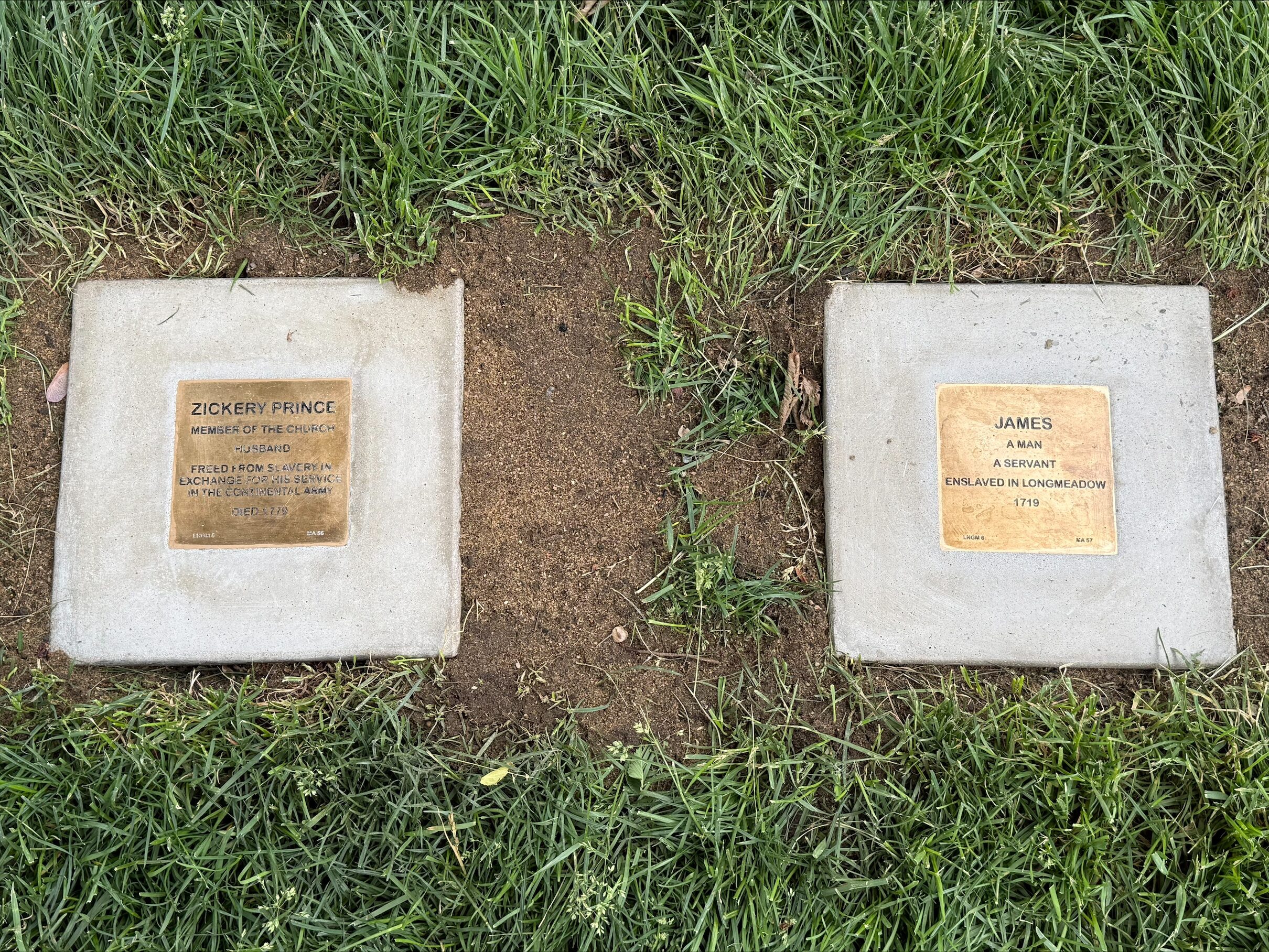
The two new plaques honoring Zickery Prince and James on the grass outside of First Church of Christ in Longmeadow.
Reminder Publishing photo by Peter Tuohy
LONGMEADOW — The Longmeadow community has memorialized the lives of two people who spent parts of the 1700s enslaved in the town with brass plaques, becoming the fifth and sixth people to be remembered and honored so far in Longmeadow by the Witness Stones Project.
This ceremony marks the third year of Longmeadow’s Witness Stones Project, an educational initiative by the organization Historic New England to restore the history and honor the humanity of the enslaved individuals who helped build our communities.
The ceremony was held at First Church of Christ on May 21, with the project being a collaboration between the church, the Longmeadow Historical Society and Longmeadow Public Schools. It was funded by the Longmeadow Educational Excellence Foundation. The plaques are placed in the grass outside of the church.
The two people honored this year are Zickery Prince and a man named James. Seventh grade students at Williams Middle School have spent the past several weeks researching them through primary sources like diary entries, church records, census materials and wills.
Since 2024, the town has also memorialized enslaved people named Phillis and Peter, a couple who married inside the First Church of Christ, a person named Nicholas and a second person named Peter.
These six people are the first to be memorialized out of the 16 known individuals enslaved in Longmeadow during the 18th and 19th centuries. The project intends to say the names and honor each one.
Not much is known about James, besides that he was enslaved around 1719 by the Rev. Stephen Williams, Longmeadow’s first minister of the First Church of Christ. Some of the only proof of James’ life came from three entries in Williams’ diary and a household accounting record noting the 10 pounds that Williams paid to purchase James.
Williams wrote about James’ behavior, mentioning James being “out of frame” and once about him being out late at night. James disappeared from the record after the diary entries and it is unknown what became of him.
One student said that James wasn’t property or an object, he was always a human being “capable of love, happiness, emotions and making decisions for himself” and that he found ways to show humanity while he was dehumanized and denied freedom.
Prince has a much more documented life with records that span across 40 years. He was enslaved as a child in Longmedow by an elderly man named Nathaniel Bliss in the 1730s and 1740s. The first piece of evidence for Prince’s life came from a 1737 probate that valued him at 110 pounds.
Records show that Prince was enslaved in seven different households throughout his life, marrying a woman named Citty along the way. He joined the Continental Army during the American Revolution in 1777 after Abel Forward, Prince’s enslaver, promised his freedom in exchange for taking the place of his son.
He died in the winter of 1779 in a hospital at the Fishkill Supply Depot in New York. A Continental Army payroll listed Prince’s salary as “received his freedom.”
One student spoke about how records show the price for Prince changed as he progressed through life and that it is belittling and dehumanizng to put a price of value on a human being. Another student said Prince’s time in the war showcased his bravery and the sacrifices that enslaved people made “for freedom and for the country that abused them.” She added that Prince “died for a country that was never his own.”
First Church of Christ Reverend Doug Bixby said that these ceremonies are done in the spirit of “humility, honesty and responsibility,” and avoiding “denial, deception and disassociation from this sad part of our own history.”
“So often in the north, we want to disassociate ourselves from the sad history of slavery and the painful realities of it,” Bixby said. “But the truth is, before the Abolitionist Movement, slavery was a part of life in New England as well as in the south. This history is in danger of being forgotten.”
Witness Stones Program Director Patricia Wilson Pheanious said these programs strengthen one another and recover what has been lost, permanently placing that history into the landscape of everyday life.
“This work deeply matters, perhaps now more than ever, at a time when some would narrow, dismiss or erase difficult parts of our shared history, these programs insist that polar proof matters,” Pheanious said. “They remind us that understanding history is not about assigning blame, it’s recognizing humanity … These men were here. Their lives and free labor supported this community’s prosperity. They helped shape Longmeadow and free our country, and know that today we’re taking action to help Zickery and James’ names and contributions never to be forgotten again.”