
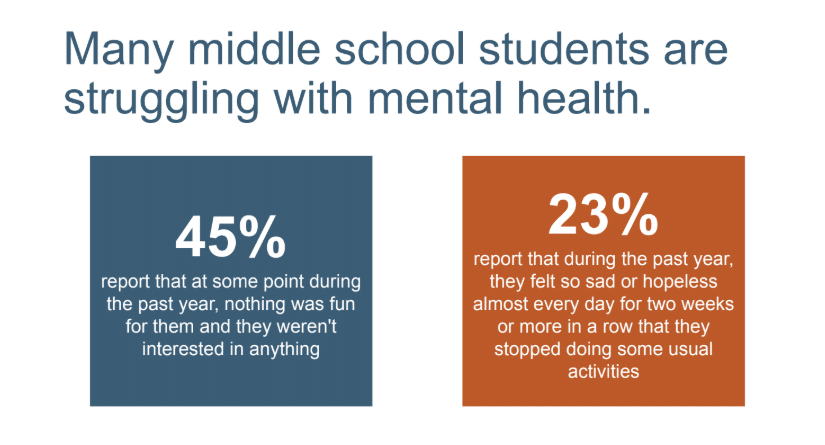
A slide showcasing how students responded to a mental health question on the Youth Risk Behavioral Study.
Photo credit: Hampden-Wilbraham Partners for Youth Coalition
WILBRAHAM — Results from a 2025 Youth Risk Behavioral Study administered to Hampden-Wilbraham Regional School District students show a staggering percentage of Wilbraham Middle School students struggling with their mental health.
The Youth Risk Behavioral Study focuses on the major risk behaviors that threaten the health and safety of young people, such as mental health and substance use with alcohol, nicotine or cannabis.
Brianna Berneche, coalition director for the Hampden-Wilbraham Partners for Youth Coalition, joined the HWRSD School Committee meeting to present the survey’s findings on June 11.
Seventh- and eighth-grade students at the middle school were administered the survey in April 2025. All students who were present at school on that day received the survey, which came out to 356 represented students, or 86%.
The survey showed that a large number of middle school students last year were in a struggle with their mental health, with 45% of students reporting that “at some point during the past year, nothing was fun for them and they weren’t interested in anything.”
Twenty-three percent of students reported that in the past year, they felt “so sad or hopeless every day for two weeks or more in a row that they stopped doing some usual activities.”
Berneche said, “This is showing us that the middle school may need some extra support in terms of mental health services.”
The study did show that depressive symptoms in students peaked during the pandemic at 38% and again in 2023 at 39%, but have been on a decline in the past two years and currently stand at 23%.
Only 1.5% of middle school students reported using a vape in the past 30 days, with cigarette use even lower at 0.6%. Only three students had reported vaping on school property within the past 30 days as well.
Only 13 students reported having ever vaped, with the majority using a friend’s and giving it back. The majority reported that the reason is because “they wanted to know how it would feel,” along with helping anxiety and to go along with others.
Alcohol use increased slightly from the 1.7% in 2024 to 2.1% in 2025, but is a decline from 6% in 2019. Cannabis use is at 0.9% from 2.4% in 2019, with not-prescribed prescription drug use at 1.9%.
Berneche said 1.9% is low, but it isn’t 0%, and that the coalition would love to see it be closer to or at 0%.
About half of the students also reported that they have spoken with a parent or guardian in the past year about the risks of vaping, drinking and tobacco use.
“We encourage these parents to really talk to their students about the risks of these,” Berneche said. “If they can’t, or they need communication tips, the coalition can provide that for them.”
School Committee member Sean Kennedy brought up a concern about the middle school student use of ZYN nicotine pouches and it not being shown in the survey results, stating that “they’re not vaping anymore, but they got something new that they’re doing.”
“I’m feeling that we’re missing the boat on this,” Kennedy said.
A random sample of high school students enrolled in a semester-long health and physical education class were surveyed. The responses represent 422 students, or 43% of high school students.
The survey showed that the rates of depression and self-harm have continued to decrease since peaking during the COVID-19 pandemic, with 9% of students reporting that they have hurt themselves on purpose and 7% of students reporting that they have considered death by suicide.
Twenty-four percent of the surveyed students reported that they feel sad and hopeless, with 79% of students who needed counseling in the past year reporting that they were able to access it. Seventy-one percent reported that they know how to connect to help if they are concerned about their own or another’s feelings.
The “past 30-day use” of vaping products dropped from 32% in 2019 to just 5% in 2025, with the majority of responses stating that they borrow devices from a friend. Cigarette use has stayed consistently between 1-2% since 2019.
Past 30-day alcohol and cannabis use have also been on the decline since the pandemic. Alcohol use went from 18% in 2019 to 9% in 2025, only seeing an uptick between 2023 at 9% and 2024 at 12%. Cannabis use stayed steady at 12-13% from 2019-2021, but has since gone down to 5%.
Only 1% of students reported the use of prescription drugs not prescribed to them in the past 30 days, and 0.8% reported using any type of illegal drug other than cannabis, nicotine or alcohol in their lifetime.
Most of the high school students reported speaking with a parent or guardian in the past year about substance abuse.
Berneche also shared that the coalition’s federal grant funding will end on Sept. 30, and that it is at risk of shutting down. With the loss of the coalition, these surveys and this data would be lost as well.
“We are applying for what is called a ‘no cost extension,’ which means whatever funds you’ve accumulated over the years and carry forward, you can use for, sort of, an ‘extra bonus year,’” Berneche said. “However, when we were meeting with our grant program officer, they were not positive about the likelihood of that being approved due to the current administration, budget cuts, etc.”
More information on the coalition can be found at hwp4y.org.