
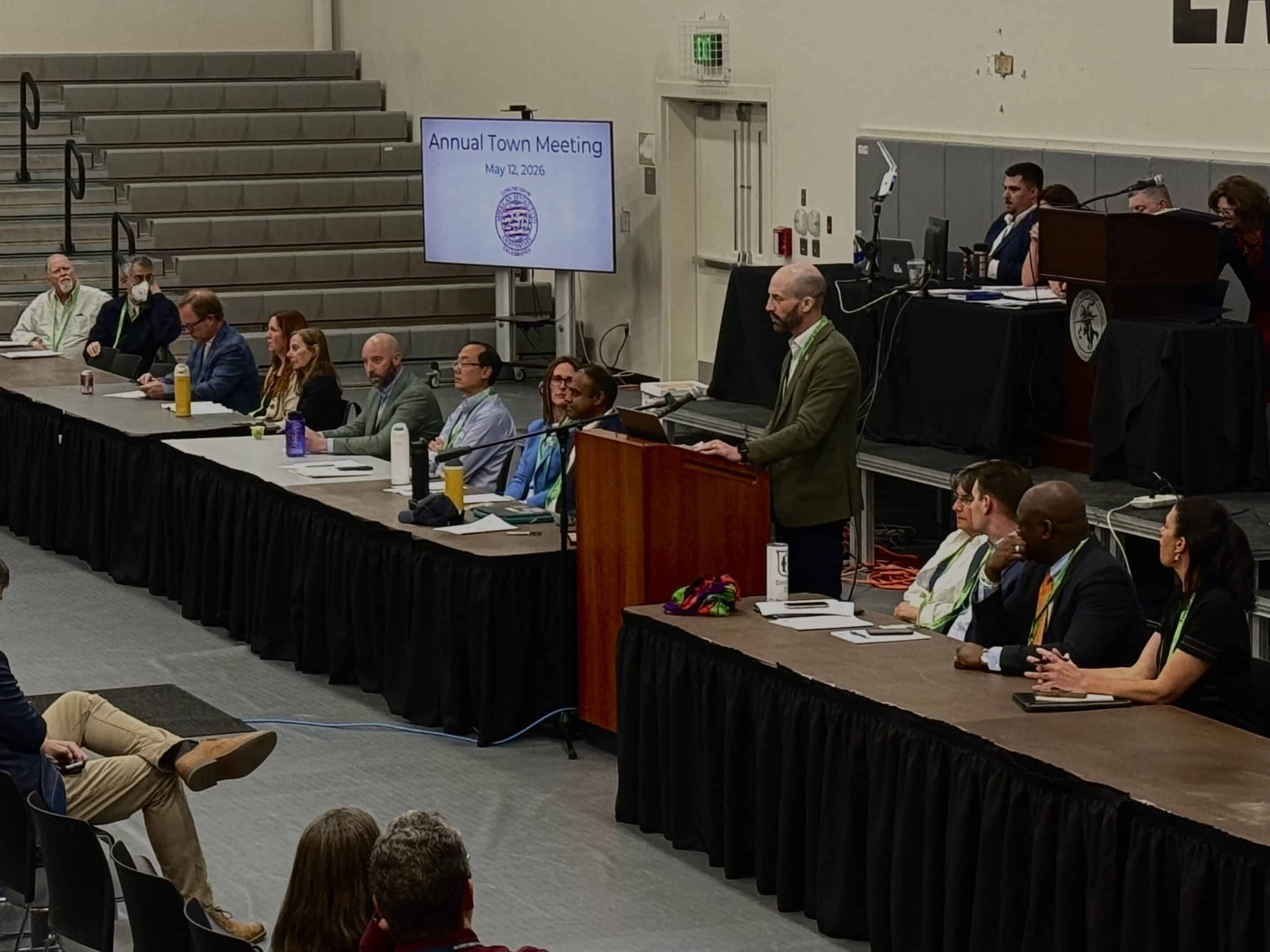
The Annual Town Meeting begins at Longmeadow High School on May 12.
Reminder Publishing photo by Peter Tuohy
LONGMEADOW — A town-owned fiber network has been a hot topic of debate in Longmeadow since the idea began in 2024, and especially for the months leading up to the Annual Town Meeting.
Now that the meeting has come and gone, the debate has as well.
The Longmeadow High School lobby was filled with chatter from voters before the May 12 meeting began murmuring that Article 7 was “the big one.”
Discussion took place for an hour and the article was shot down in a 374-270 vote.
Article 7 was looking to see if the town would approve the appropriation of $8.6 million for the initial phases of the $27 million fiber project, paid for by a property tax increase of $97 per year. Ben Brown, a member of the original Municipal Fiber Task Force, was chosen as the Select Board’s designated speaker. Brown presented a final look into the benefits of approving the project, how the town got here, why it matters and what the town would have owned after the fact.
Brown said that other companies had filed pole applications but nobody had built anything yet, stating that the town couldn’t wait for “someone else to decide we’re worth their investment, we have to decide for ourselves.”
“Here’s the real consequences if we don’t vote yes tonight,” Brown said. “The pole applications expire, the engineering work we paid for becomes obsolete, the window closes. If we want to restart in two or three years, we reapply, we pay another quarter million for new applications. We start from scratch, and while we’re waiting, someone else builds to the profitable neighborhoods, probably less than half of the town and leaves the rest of the town behind forever. We lose our chance to build equitably, to control it and to own it. We can’t get that back.”
Brown also compared the asking rate of roughly $90 a month for one gig speeds of town-owned fiber to Comcast’s same speed for $110. He said one gig at Comcast is actually slower than promised and any advertised price is simply promotional and can expire.
“With town-owned fiber, you actually get what you pay for,” Brown said. “Speed that doesn’t slow down at peak hours, reliability that doesn’t drop when it rains, pricing that’s transparent, no promotional rates that quietly double after a year, no random fees, no surprises on your bill … the fiber we put in the ground today, is the same fiber that will carry whatever speed comes next.”
The Finance Committee voted twice not to recommend the project, once on April 6 and second on May 5. Finance Committee Chair Erica Weida said that the committee is not against the project moving forward in the future, but at this time, the information did not sufficiently answer multiple financial questions.
These questions were included in the warrant, and the Select Board responded to each one at a special meeting on April 16.
Weida added that the financial model hadn’t been fully vetted or finalized at the time of the Finance Committee’s vote on April 6, and that this should have been a requirement for moving the warrant forward.
“The article we are voting on tonight is not whether we build a municipal fiber utility, it’s on one option for how we could finance this utility,” Weida said. “The $8.615 million debt exclusion being voted on tonight, which will cost the taxpayers $12.2 million when interest is included, should be viewed as a subsidy for this utility. Through this bond, taxpayers will cover 32% of the building costs of utility. This will not be paid back to the town from the revenue, from the statute.”
Weida said if the Municipal Light Plant had to repay the full costs of this build without the subsidy, the $90 rate would not work but a $110 or $115 rate probably would. She said “so apparently, we could get it for the cost of Comcast.”
Resident Tom Shea said the $12.2 million property tax subsidy was not disclosed to taxpayers, and that the Select Board did not know about it until the meeting on April 6. He said the initial phases of fiber, construction and interest costs were originally meant to be covered by borrowings and revenue.
“It is not typical that property taxes subsidize fiber,” Shea said. “An updated financial model was provided to the Select Board on April 6 from the prior one on Jan. 5. The current model was then voted on at that same meeting, there was not enough time for discussion … Longmeadow has too much debt for its current rating. We have $321 million in debt to be issued under our five-year capital plan, which includes $96 million in school. This could have been done differently.”
Resident Tom Lachiusa said that so many towns around Longmeadow are moving in the direction of fiber, and that it’s more valuable to the residents to own the distribution.
“I do think about how much it would have cost Comcast to connect all these homes, as it is now,” Lachiusa said. “We know the price of everything continues to go up, and I don’t see why we should wait any longer to move forward in this acquisition of something that will give us some money in the future … this does offer an opportunity for us to make new revenue and Comcast would be against this because they are making a lot of revenue.”
Resident Curt Freedman said electronic technologies are changing rapidly and that “we cannot limit ourselves to a single technology or risk falling victim to a second best condition.” He urged the town to vote no.
Resident Benjamin Tansky asked the Select Board how the financial model was created, and Select Board member Vineeth Hemavathi said that it was first put together by Fiberspring’s finance director and then adapted by Longmeadow Finance Director Ian Coddington to fit what the town was trying to do.
Hemavathi added that he didn’t know where any of the numbers presented by the Finance Committee came from and that they didn’t come from someone who was hired by the town.
“The model we’re working with was actually put together by folks who were paid to do this, who have experience doing this and had a track record of actually putting together a project like this and having that budget work,” Hemavathi said.
Resident Estelle Jordan was met with applause when she moved to call the question, which ends debate when there is no new information being presented. The motion passed 604-44 and immediately brought on the Article 7 vote, which did not pass.
Another big topic discussed after the fiber vote was Article 28, a snow removal bylaw amendment which had been motioned to move up in the warrant. Coverage of that discussion will be in the May 21 edition of The Reminder.