
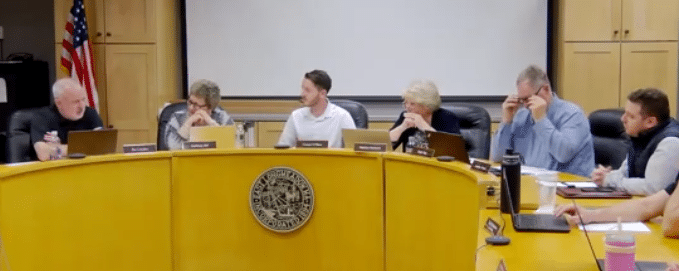
The East Longmeadow Town Council hears Councilor Jim Leydon’s position on the marijuana ballot question.
Photo credit: ELCAT01028
EAST LONGMEADOW — The East Longmeadow Town Council voted to shut down a referendum seeking to overturn the 2017 moratorium that banned the commercial sale of marijuana in town, with Councilor Jim Leydon saying the decision was made for the ‘health and safety of all the young kids in town.”
Residents approved the moratorium in a townwide vote in 2017. Voters also did not support the ballot measure legalized marijuana in Massachusetts in 2016.
The appeal was brought to the council by two residents looking to open a marijuana dispensary and was shot down 4-2 by Leydon and Councilors Marilyn Richards, Kathy Hill and Jon Torcia at the meeting on April 14.
Jeffrey Brooks and Christina Rivera Brooks, the husband and wife looking to open the store on Shaker Road, originally met with the council in November 2024 for a zoning bylaw change that would allow the store’s opening. There was an effort in February 2025 for a ballot question, but Council President Connor O’Shea said it was too late for that year’s election, so the pair met with the council again in August 2025 for the June 2026 election.
The question would have been non-binding, meaning the council still could have decided against it if it were voted in approval by the town. The discussion for the question was opened back up at the Jan. 28 meeting, where Councilor Ralph Page said it would be added to get an overall feel of what the town’s thoughts are.
“Truthfully, you could have 10,000 people, 9,900 say repeal it, and the council may say ‘eh, you know after thinking about it, we don’t wanna,’” Page said on Jan. 28.
Leydon said he thought there were “enough access points” in the areas surrounding East Longmeadow and that as a parent, there’s a protectionist angle for protecting the youth, and a public health angle that should be considered, mentioning the recent A’s Smoke Shop liquor license revocation for multiple allegations of selling alcohol to minors.
“Not to conflate that with this, I understand this is more regulated,” Leydon said. “This is not an ascent industry any longer, this is a built up industry with plenty of access in surrounding towns and the more I thought about it, I felt like, in good conscience, I couldn’t lend my voice and my vote to forsaking, I think, a lot of people, more so children in this community, youth.”
Leydon noted concerns of high school and middle school aged children getting out of school and walking through the center and said he’d vote against the question no matter what the specific language was.
Richards said she should have spoken up earlier when the residents first approached the council and that she’s sorry she didn’t, adding that the council has just been “kicking the can down the road.”
“You do not change a zoning bylaw to address the needs or desires of an individual entity,” Richards said. “You make changes because it’s for the better good of the community … there are obviously reasons why we would want to modify our bylaws, but to strictly change the bylaw because an individual wants to open up a retail marijuana shop in East Longmeadow is not proper, it’s an individual goal. It’s not a town goal, it’s not for the betterment of the community.”
Richards added concerns about youth safety, and that she can’t wrap her head around changing the law when the town has already spoken out in opposition several times.
Hill said that in her experience as an educator and chair of the Licensing Committee, underage individuals will still find a way to “obtain illicit substances.”
“A 15-year old will find a way,” Hill said. “I’m concerned that, given the fact that we already stumbled into a situation that we had no awareness of and the fact that, in terms of the health and safety of our youngsters, we’re struggling as a society with overuse of cell phones. The impact of various types of social media that have been documented to be detrimental to the mental health of teenagers … we don’t need to put another roadblock in front of the younger population in this town and tempt them with anything else.”
She said there is no shortage of places to buy marijuana in the immediate area and that she doesn’t have a bias toward the consumption of marijuana, just a bias toward “children being endangered.”
Page said it doesn’t hurt to put it on the ballot to get the “temperature of the town” and hear from residents since it is a non-binding question.
Torcia said he believed it to be a “quality of life issue” and had concerns with marijuana being sold in the center of town and so close to the new high school. He added that he did feel “leery about stopping it from being voted on” and letting the citizens share their opinion.
O’Shea said not putting it on the ballot would be a “disservice” to the people that petitioned for it and that a whole year would have been wasted.
He said it could be followed again next year or a citizen initiative process could be done to “force the council to repeal it at their discretion with an appropriate number of votes.”