
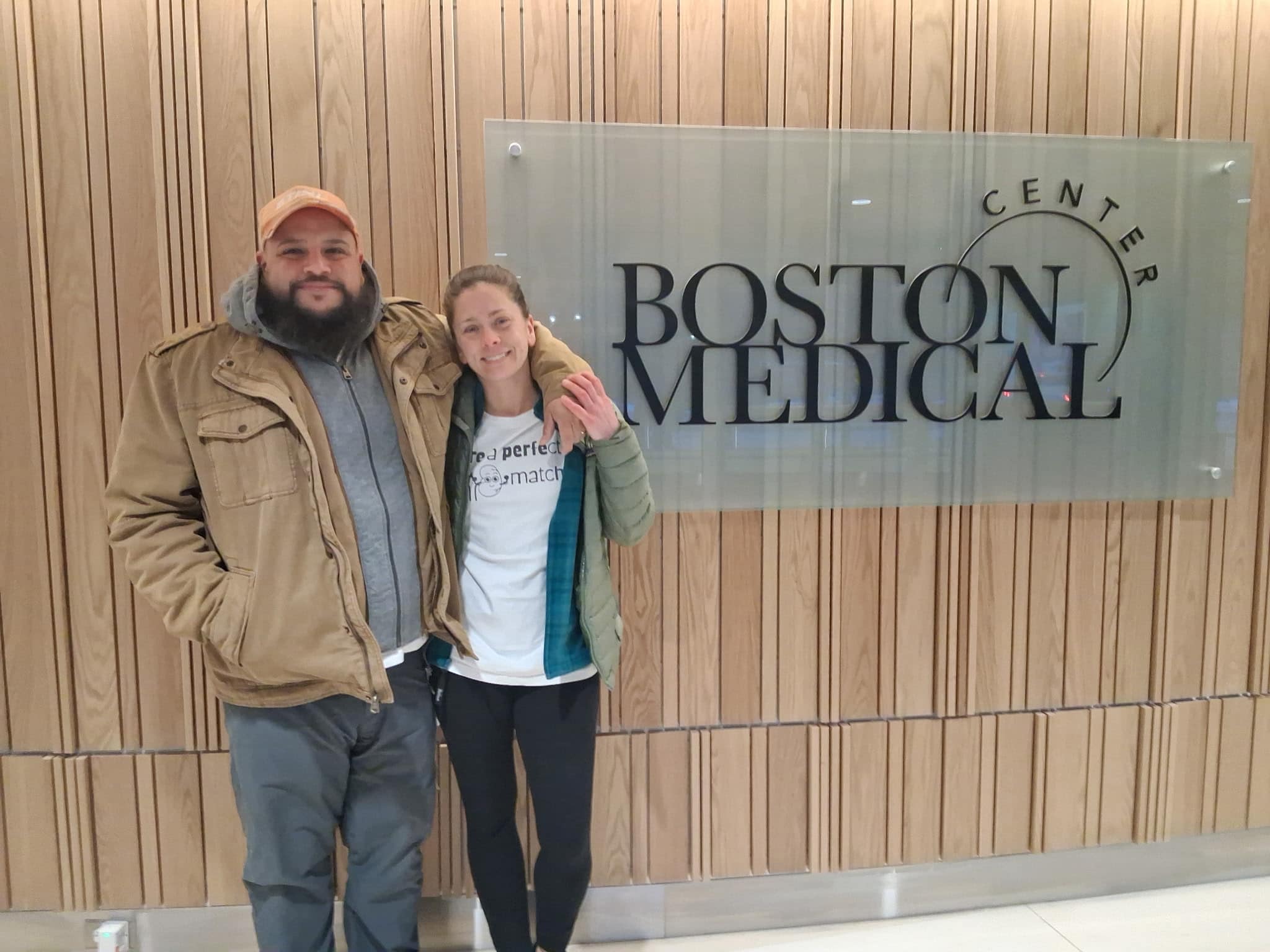
Julian and Rachel Morales at Boston Medical Center.
Reminder Publishing submitted photo
EAST LONGMEADOW — One East Longmeadow couple is not only now connected by love, but by a transplant, after a resident donated her kidney to help her husband fight Complement 3 Glomerulopathy, an extremely rare kidney disease.
Rachel Morales has been with her husband, Julian Morales, for 20 years.
This unexpected journey began when Julian had an appointment after work with his primary care physician to explain some symptoms he had been feeling in August 2024. He was advised to go to the emergency room, arriving with very high blood pressure and very low hemoglobin, a protein in red blood cells that assists in transporting oxygen throughout the body.
Julian was going into kidney failure with severe fluid buildup. He needed three blood transfusions before being transported to Baystate Medical Center, spending eight days on emergency dialysis with four hour rounds each day. His kidneys were only functioning at 5% when he arrived and painful biopsies confirmed the C3G diagnosis.
C3G only affects one in a million people and impedes how well the kidneys work. There is no cure but treatment can help slow it down and reduce symptoms.
It can lay dormant for years until something tips the scale, which was a bad case of poison ivy for Julian, according to Rachel. He never had any kidney problems or a family history of them.
He initially had over 60 pounds of fluid removed from his body, losing over 100 pounds over the whole journey.
“Nobody even knows much about it, that’s how incredibly rare this disease is,” Rachel said. “It was heartbreaking, absolutely heartbreaking thinking the man that has pushed through so much and done so much in his life and has done so much for everybody, like he is the giver for everyone else. He never asks for anything … he always has a positive outlook through everything, and I think that really took us as far as we did, because he has such a positive outlook on life. It leaves you speechless to think about how sick he was.”
Julian continued hemodialysis, or in center dialysis, for three days a week and four hours each day after being released from the hospital. Rachel said he entered the transplant phase after learning his kidneys wouldn’t bounce back to a functional level, and that a transplant would be his best bet at a “normal life.”
His care was moved to Tufts Medical Center in Boston after finding a doctor interested in C3G, before being transferred to Boston Medical Center. He had over 90,000 people in front of him on the wait list and would have had to wait over ten years for a transplant.
He switched to peritoneal dialysis treatment at home during the transplant phase for seven days a week and eight hours a day, which also involved surgery for a different kind of catheter. He spent a total of 78 weeks on dialysis treatment.
“Doing home dialysis added another layer onto this journey,” Rachel said. “Every month it involved ordering and organizing medical supplies, 45 boxes of 15-pound fluid for treatment, adding another drain to our bathroom and sanitizing everything, all the time, as infection is a huge factor in all of this.”
Rachel said she knew she’d be his donor from the beginning when she found out they were the same blood type, and her journey officially began with 27 vials of blood work and 24 hour urine tests. She then had a year of more blood work, physicals, CT scans, specialized renal tests and psychosocial evaluations. Julian endured the same to ensure his body was up to even receiving a transplant. She said it was all worth it.
Married couples are said to have a one in 100,000, or .001%, chance of being a genetic match for a kidney transplant. Rachel found out she was the exact match.
“After a very long year of testing for both of us, we got our date for transplant, October 2025,” Rachel said. “We were ecstatic, but were crushed when we received notice there were some nodules in his lungs that they needed to test more. He endured more CT, MRI and a bronchoscopy.”
Additional tests eventually gave them the go-ahead and the transplant surgery was completed on Feb. 13. Julian is now officially off dialysis treatment and well on the road to recovery. She spent seven weeks in recovery and is now back at work as a paraprofessional.
“There’s been so many little things that have just come up that we didn’t realize we were missing out on,” Rachel said. “He was on a fluid restriction, food restrictions, working restrictions, and now we’ve been cleared to do all of it. We’re back to normal activities and I’m seeing bones in his hands I haven’t seen in ten years. He didn’t realize how sick he was until he started to feel better … He’s on a really high dose of immunosuppressants in the hope that this disease will not get into the new kidney, however that is a possibility. As of now, it’s doing everything it should and I feel great, I have no long term effects from it. It’s the best and easiest decision I’ve ever made.”
Rachel said she and Julian were meant to be together and that she would do it again in a heartbeat.
“It has brought us so much closer,” Rachel said. “Every day I look at him and I’m in awe of the man that he’s become and is becoming, and just his strength through all of this … he’s so grateful, he just can’t say thank you enough and I say ‘you say thank you enough, this is it, this was my choice, I wanted to do it.’”