
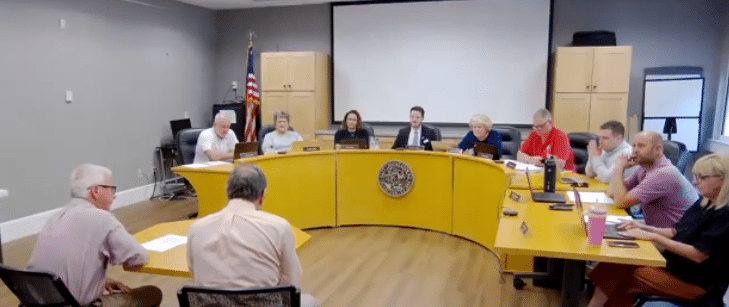
Financial Oversight Committee representatives Rich Freccero and Russell Denver present to the Town Council on May 26.
Photo credit: ELCAT01028
EAST LONGMEADOW — The East Longmeadow Town Council has brought its budgeting season to an end after voting to approve all 17 motions regarding the fiscal year 2027 budget.
The Town Council heard a budget study presentation from Financial Oversight Committee representatives Rich Freccero and Russ Denver during a public hearing before voting on the budget at its meeting on May 26.
The Financial Oversight Committee was in support of the budget, with Freccero stating that it is “accountable and will serve the citizens of this town well.”
“Even though we recommended it with no changes, we really debated, we studied, we questioned this budget,” Freccero said. “We really did a deep dive to make sure that it was going to be successful for the town, and we all believe as a committee that it was and is going to be successful for the town.”
Freccero added that collaborative work was done with members of the Town Council and School Department, Town Manager Tom Christensen and Director of Municipal Finance Kim Collins to ensure that the current proposed budget was the right budget.
The operating budget was approved at around $81 million, which includes an estimated $99.9 million in revenue. Freccero said the budget increased by an overall 2.5%, with a decrease of 2% on the town side and 3% increase in the School Department. The council also voted to approve $8 million in capital projects.
The current school budget was approved at $38 million after successfully decreasing from the originally proposed 6.2% increase by eliminating six staff positions through attrition. The biggest increase for the town budget came from insurance at a 25.9% increase, which was able to be balanced out by a 23.3% decrease in town debt and a 1.5% decrease from town departments.
“We feel that the town is in solid financial condition,” Freccero said. “We do have some challenges ahead, in the area of payroll, insurance, health benefits and retirement contributions. It will make the budget more constrained for the town and the schools.”
Denver followed Freccero with four recommendations on the budget, such as reviewing the current health insurance programs for employees and retirees to see if changes can be made to slow the cost increases.
He added to review all union contracts under the town’s purview to get an accurate view of how much the “extras are costing the town,” such as paying for unused sick time or uniform reinforcements. The next step would be to determine what is within the Town Council’s scope and what changes it might recommend to the town manager to bring those costs under control.
Denver also recommended to see if the Massachusetts Paid Family Medical Leave Act is financially and administratively beneficial and to reactivate the Insurance Advisory Committee.
Councilor Ralph Page brought up a concern he had about the school budget. He said money left over by departments at the end of the year is required to be turned back and that the school has taken $225,000 to prepay Lower Pioneer Valley Educational Collaborative services for the next school year.
“It’s my thought process that it’s not a true 3% budget, it’s 3% plus $225,000,” Page said. “My only concern is, going forward, if they don’t have that same amount each year, they’re going to run into a problem down the road.”
Page added that he is okay with the budget as a whole, and the numbers mean the town is “tightening our belt” and looking at everything.
“I just want the residents to realize we’re not just out there blowing money just because, ‘hey the money’s coming in, we’re spending it on anything, that’s not the case at all,” Page said. “I think going forward, we’re going to have a couple tough years. It’s hard with Prop. 2½ keeping you at two and a half.”
Page had also made a recommendation to change the water rate to $4.97 per 100 cubic feet, which is an 8% increase instead of the initial 11% increase at $5.10. The council voted to approve this change. The sewer rate was also voted to increase from $4.84 to $5.06 per 100 cubic feet.