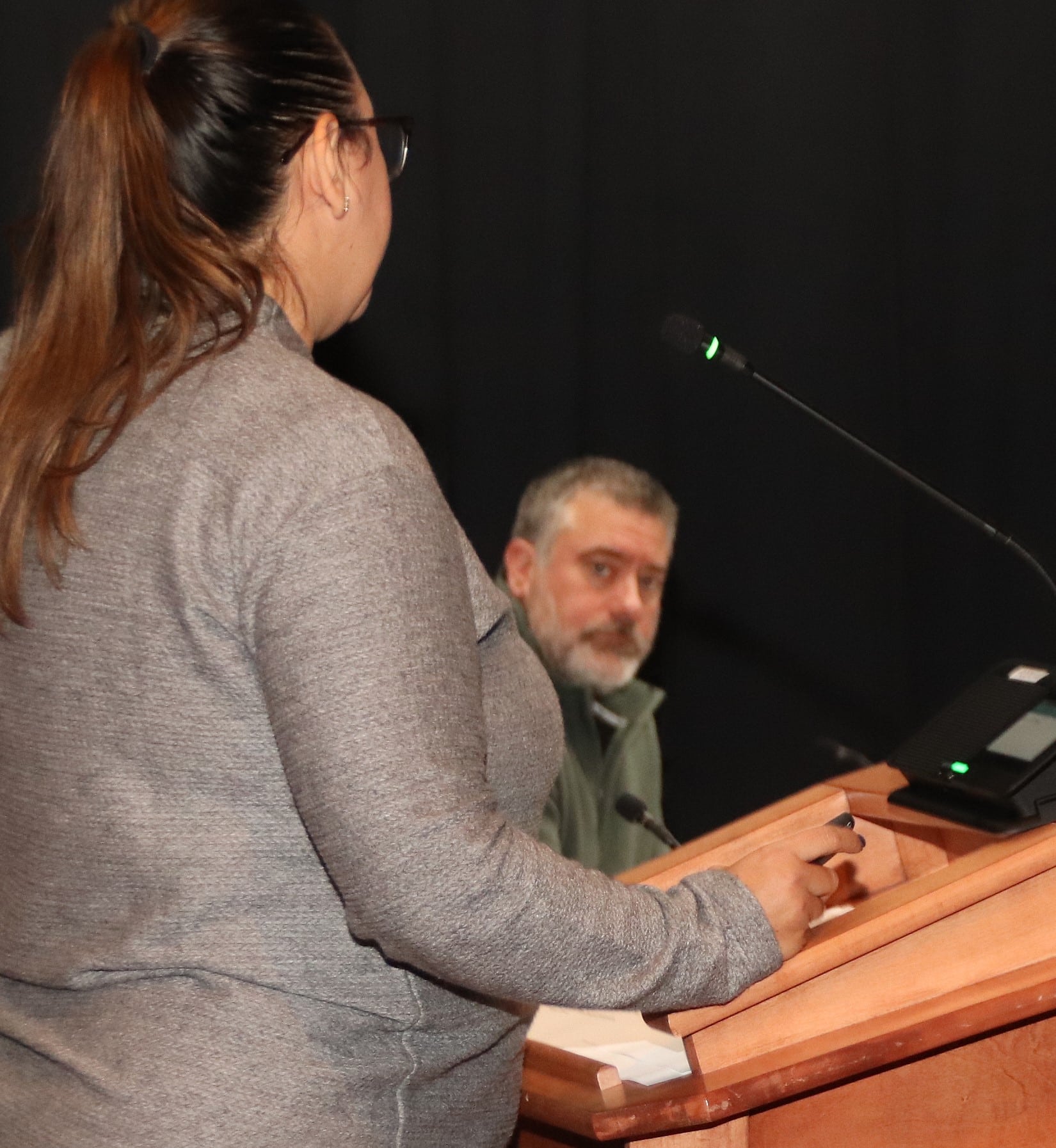
Agawam School Committee member Michael Perry listens as Rosa Rodriguez Pion, director of English Language Education, gives an overview of the district’s multilingual learner program at the committee’s Jan. 13 meeting.
Reminder Publishing photo by Mike Lydick
AGAWAM — Agawam schools have a diverse multilingual population of nearly 300 students who speak nearly 30 different languages.
The top five languages are Russian, Ukrainian, Turkish, Spanish and Albanian. This diversity not only rivals some larger districts in the region, but it also highlights the richness of the community as well as the complexity of the work teachers do with these students.
“We want to make sure we’re putting instruction in place so that they acquire English and can access grade level content as quickly as possible,” said Rosa Rodriguez Pion, the district’s director of English language education, told the School Committee at its Jan. 13 meeting.
“Many of our students come with academic strengths in their first language, so a lot of it is the transfer from their first language to English,” she added.
Pion provided the committee with a brief overview of the district’s multilingual learner program. She said the district currently has about 290 English learners from pre-K to grade 12. In 2025, the highest number of multilingual students was 319, but 37 of them met the exit criteria and left the program.
“Every year, we’re turning over students who are going into the general education population and are no longer coded as multilingual learners,” she said.
Pion added that the multilingual learner population is built around three core goals. The first is accelerating access to grade level content in English for students coming to Agawam speaking a variety of languages.
The second is fostering a sense of belonging and identity. “We want students to feel valued for who they are and feel like their language is appreciated and that we appreciate them being part of our greater community,” said Pion.
The third is expanding student voices and opportunities. “That’s a goal we’re working on for all students, and we want to make sure that our multilingual learners are not just supported, but also feel empowered across all academics and social life,” she said.
Approximately 70 students in the multilingual program are first year students — meaning it’s their first year in the United States. They are level one English learners. There are also 55 students who are dually identified as English as a second language and students with disabilities and 97 former ELs still being supported after four years.
Pion said students who graduate from the program are monitored for four years. She added that if they need additional support, they are pulled back into the program.
Each year during January and February, EL students must take a state test with criteria they must meet to exit and graduate from the program. There are four parts to the test: speaking, listening, reading and writing. Pion said the overall performance of students who have met the target set by the state is 54%. English proficiency has improved by more than 84%.
“We have strong, strong growth among students who have returned to us. So, we do have somewhat of a transient population. We have students who come in and leave. Students who have been with us over multiple years show the most growth. It takes about five to seven years to exit. Most of those students — the 37 last year and the 41 the year before — are fourth and fifth graders who started with us in kindergarten,” said Pion.
She added that when students stay for five to seven years, they are making some “really good gains” in reading and writing as well as having a high percentage of year-to-year improvement. “All students are showing growth. That was one thing that we were really excited about. They all went up in levels. Some just missed their target. Some of the targets are really high. Usually, we expect students to move up one level per year. The state sometimes sets a goal that they have to move up 1.7 levels.”
Using the data, Pion said they work with teachers to try and support those goals. At the same time, she said they are facing ongoing challenges. “We have a large influx of new students each year, so we need to support speaking and writing, which is usually the most difficult domain to master. And we just want to ensure that we have some consistent, accessible instruction in every classroom — not just with the language teachers, but in all content areas.”
Pion said the data helps guide professional development, curriculum work and resource allocation. She told the committee that the district recently received a grant to support curriculum development.
“We’re really excited about that. We want to strengthen our multilingual learner curriculum and this funding will allow us to build a sustainable system, rather than isolated supports,” said Pion.
“Our focus is to ensure consistent instruction across all schools. We want to provide targeted professional development for teachers, and we want to improve access to grade level standards, using data to monitor growth. This work directly supports long-term academic success and district-wide instructional coherence,” she added.
Looking ahead, Pion said there will be a continued emphasis on measuring student growth. “We want to use multiple data points. We’re paying attention to how our multilingual learners are performing and looking at ways to support teachers and students. We want to expand teachers’ toolkits. We want to remain committed to the schools and classrooms where students feel welcomed, supported and part of the greater Agawam community.”