
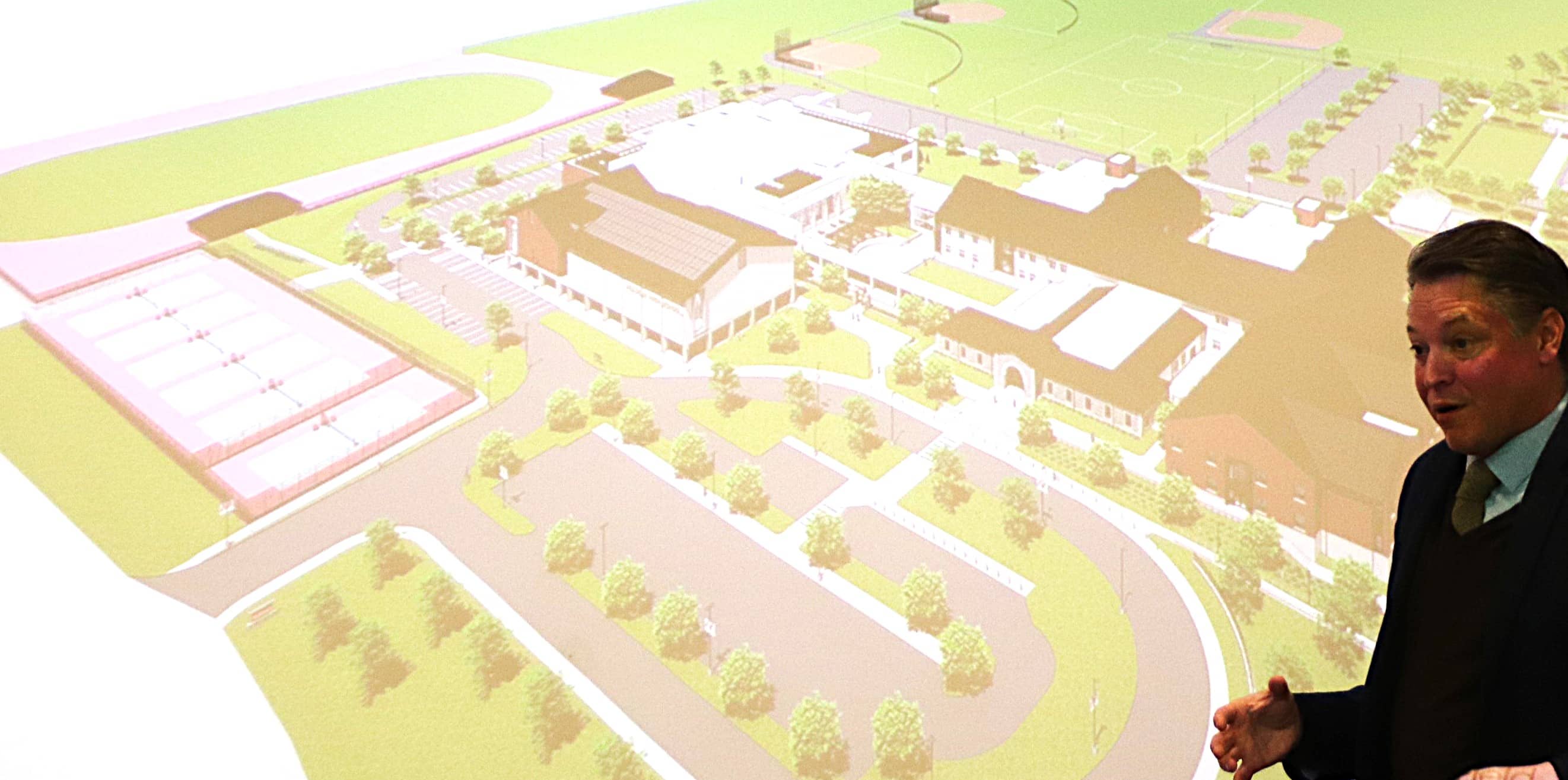
Kent Kovacs, principal architect at Flansburgh Architects, told the School Committee during a sneak preview of the new AHS that it will be “uniquely Agawam,” with New England style pitched roofs and academic pods.
Reminder Publishing photo by Mike Lydick
AGAWAM — The School Committee recently got a detailed sneak preview of what the new two-story, state of the art high school will look like when completed in 2028.
Meeting Feb. 24 in the community room at the town library — just steps away from where the new high school’s community wing is rising out of the ground — the committee first watched a virtual video tour narrated by Mayor Chris Johnson showing what the exterior and interior of the school will look like.
The new school will feature academic pods, sloped roofs, and a community wing with a new auditorium and cafeteria. Exterior safety measures include a loop road, key card access and a secure courtyard.
Following the video, Kent Kovacs, principal architect at Flansburgh Architects, used a series of slides to go through some of the interior areas. The slides depicted what the academic pods will look like as well as some of the major areas in the community wing.
He told the committee that the images on the screen were the result of years of gathering input about the new school’s interior spaces. “We had teachers. We had students in here. It was really exciting,” he said. “We came to derive what’s the best ideas — what do we need for Agawam in the future?”
Kovacs said it’s “incredibly exciting” to actually see a “very robust” community center being built. “We love this part of the process. It’s all going to be state of the art, new and purpose built and built to the code.” He said students will be in an environment where they can learn, with full air conditioning,
Portions of the community wing will have locker rooms, physical education areas with a fitness center. Special education offices are also embedded in this wing. The auditorium, cafeteria and woodworking and advanced manufacturing will shift to the community wing and be ready for teachers and students in January 2027.
Kovacs said there’s 2,500 square feet to do the loop around the existing building. “That’s a lot of travel time. We had a student say it takes five minutes to get from one side of the building to the other. This building fixes that.”
That was the one of the impetuses for creating academic pods in the new school. “You have a large building, but you want to break down the scale. Students and teachers embraced it, saying they wanted academic pods where the students feel special, where they feel recognized, where the work that they’re doing is on display and recognized.”
At the very beginning of the design process, Kovacs said teachers and students said they didn’t want long corridors with classroom after classroom. “That’s not the way you learn today. You learn in neighborhoods. You learn in collaborative spaces, where you get the most out of teachers converging on space,” he said.
The new building will feature three academic pods – each one of which Kovacs said is “a beautiful collaborative space.” In addition, there will be satellite media centers that are also major spaces. “Everywhere you pass in this building, you’re going to see the great work students will be doing,” he said.
More time was spent during the visioning sessions on the academic pods to find out what “teachers needed to make their jobs be the most effective and get the most out of students,” said Kovacs. Instead of long corridors with 20 classrooms, the pods will be a center of learning, with classrooms off of them.
“Teachers can build off the projects they’re working on. They can meet with multiple classrooms,” said Kovacs. “This is going to be phenomenal when this school opens up. Teachers are not left behind. Teachers have wonderful space within this.”
There also will be a satellite STEM learning space with teacher instructional and office space. “When you have teacher planning within each pod, you have that represented with multiplies by three,” he said,
Each classroom will have room for 24 students and will have 900 square feet. They will have built in case work for plenty of storage. Kovacs emphasized that there also will be many science classrooms, each 1,440 square feet. He said the bulk of the academic space will be completed in 2028.
Kovacs said while many schools in the state are going to three and even four-story buildings, it was important to make sure that the new high school represented what’s important to the town: the scale, the massing, the character.
“What was developed here was a two-story building with sloped roofs where we could do it. We’re probably at about 55% to 58% of sloped roofs — where we can pitch a roof, we’re pitching a roof,” he said.
Other than that, there will be flat roofs for mechanical reasons. Kovacs said “the beautiful New England characteristics” of pitched roofs and the academic pods “really captures what this school is going to be.”
Only the high school portion will have two stories. In the pre-K section – which will replace the current Early Childhood Center (ECC) — there will be 10 pre-K classrooms, along with all the support areas needed, including offices and the relocated Family Resource Center.
The pre-K section will be located the rear lower section of the existing high school, which currently is the woodworking and advanced manufacturing area. Additionally, the 1996 addition to AHS is being retained, which Kovacs said will be “a special piece” to this project.
The community wing will have two gymnasiums, one on each floor, along with a Hall of Fame to showcase athletic accolades and school pride. Working with the different user groups, Kovacs said the cafeteria is being created as a “space that’s timeless, that represents us,” with “notes of wood” structure, lots of tables, very simple ceilings and natural light. The cafeteria also can be converted for assemblies and also for large event venues in the evening.
The current auditorium has served the town well for many years, said Kovacs. However, the new one will be state of the art, not only for Agawam, but also if the town wants to lease it out to traveling companies to get some revenue. He said that’s not uncommon for many Massachusetts School Building Authority (MSBA) projects.
Kovacs said he’s “really excited” about this project. “It’s going to be awesome. It’s way more than what you have now, much better improvement, and just gives you that much more flexibility and that much better of a learning environment for your students. What you see here is uniquely Agawam, and I think that’s what makes our job so wonderful.”