
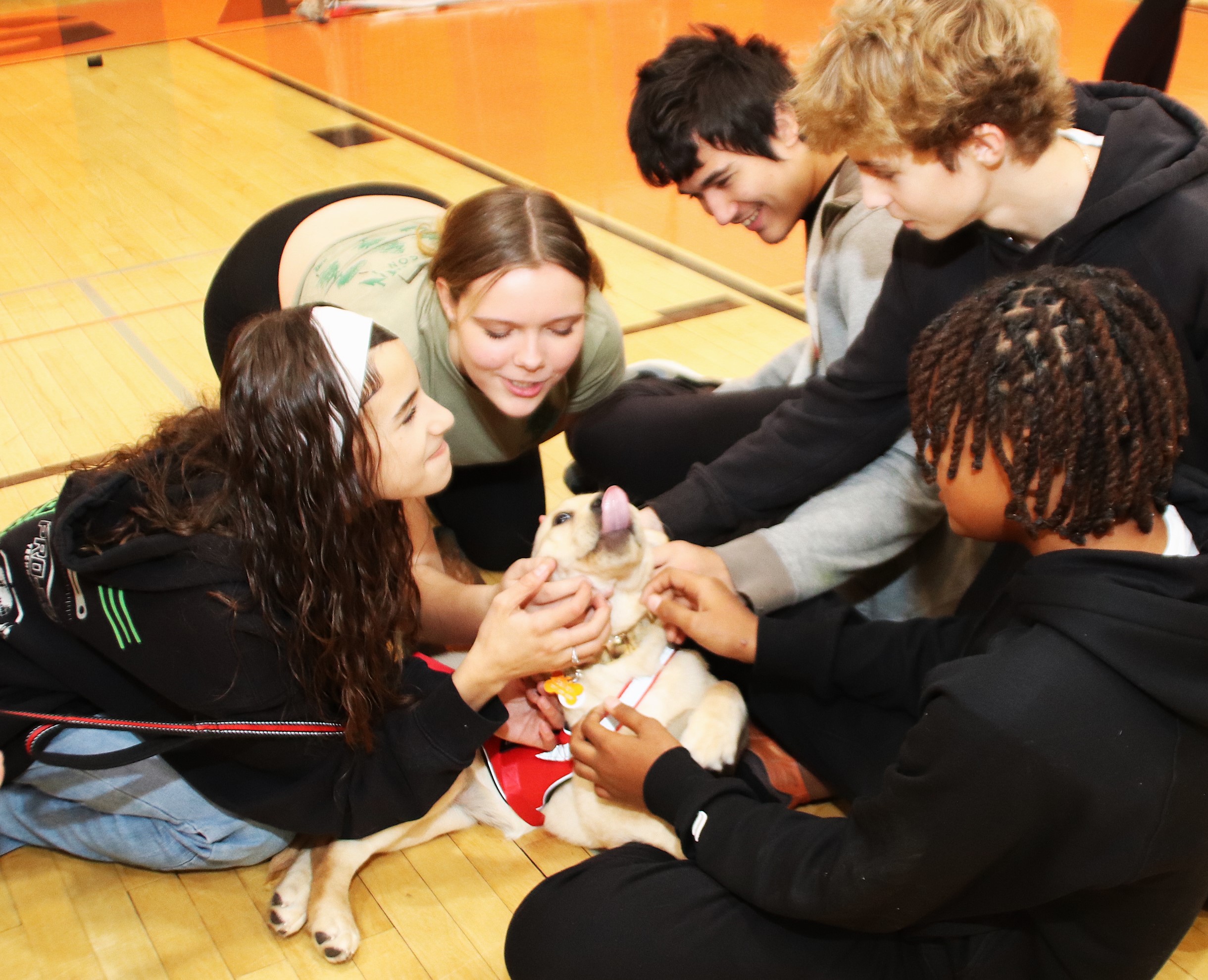
Students take turns petting Bailey, the new therapy dog at Agawam High School. Since her arrival, the now four-month-old puppy has boosted morale for students and staff.
Reminder Publishing photos by Mike Lydick
AGAWAM — Thanks to the passion and determination of one teacher, the high school has its first therapy dog.
Jamie Podworski, a physical education teacher at the school, is a dog lover who has seen the positive impact dogs have on people when they interact with them. He’s also aware of how beneficial therapy dogs can be in educational settings through his research on these dogs.
His advocacy to get a therapy dog into his school took several months. It became a reality in early November when Bailey, a yellow lab, arrived with much fanfare at AHS.
“There was a huge buzz once Bailey came into school,” said Podworski. “It’s amazing when you sit and pet a dog for five seconds — you know how much it can calm you. They’re just nonjudgmental creatures.”
On the first two mornings, Bailey, then just three months old, had a small group of students and staff waiting to get a quick meeting with her before the school day got underway. Students in the art department made her a welcome poster, and a few people brought her toys to play with during her downtime. There were even a few donations, including an additional crate and a gift basket of dog-friendly goodies.
Podworski said the biggest thing since Bailey’s arrival has been an overall improvement of student and staff morale in the hallways throughout the day. “Smiles are abundant everywhere.”
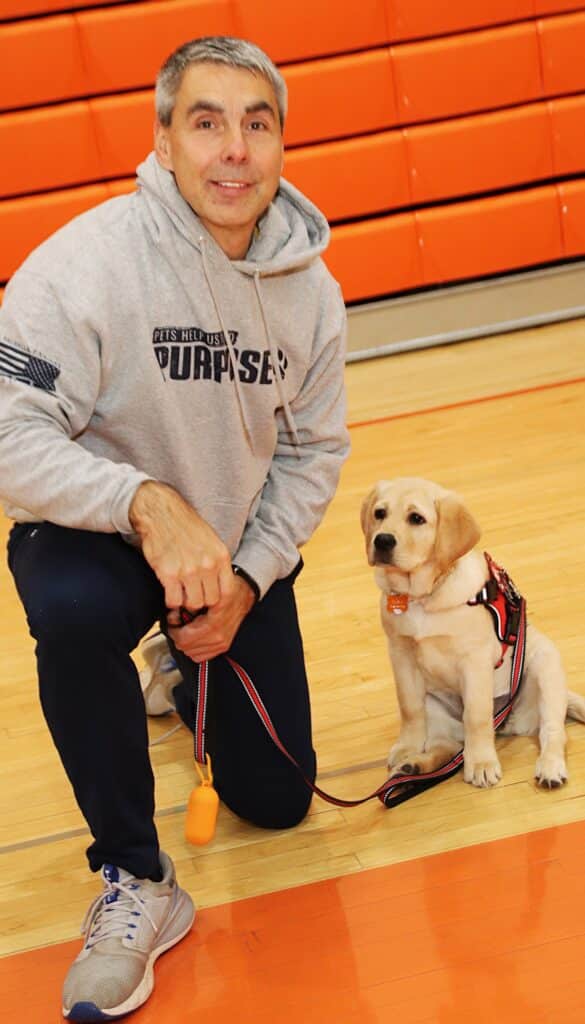
Reminder Publishing photo by Mike Lydick
He said Bailey — who lives with Podworski and his family — is being taught by him that when she has her therapy dog vest on, she’s working. “When the vest comes off and she’s home, she’s our family dog,” Podworski added.
Bailey has met one-on-one with at least 10 students during her first month to provide individual support. Every Thursday, Bailey meets with groups of students — assembled by counselors — who may need positive support. She also has participated in one puppy yoga class with another one scheduled for later in December.
Podworski came before School Committee members at the Oct. 14 meeting to talk about the benefits of a therapy dog. He told the committee that therapy dogs have proven to reduce anxiety, which is probably the most important thing that it would do at the high school level.
“Anxiety has appeared in 31% of adolescents between the ages of 13 and 18. These are things that our high school students are experiencing on a regular basis, so the calming nature of a dog really helps in this area,” said Podworski.
He added that therapy dogs have helped to improve literacy, which could also help with the school’s English Language Learner students. The idea of a therapy dog at the high school is not a new idea. Former AHS Principal Steve Lemanski and Social/Emotional Director Marlene DeJesus were working on getting one just before the COVID-19 pandemic.
Podworski said people often confuse therapy and service dogs. “Therapy dogs serve many people, and service dogs serve one person. A therapy dog is there to help all the kids. Their interaction with a therapy dog is that it can be petted, but a service dog can’t.”
Therapy dogs — unlike service dogs — are not recognized by the ADA. He said that’s why a service dog is allowed to go into a cafeteria or other spaces to support the individual they are with. A therapy dog, however, is more restricted and must be invited or welcomed into areas. Another difference, according to Podworski, is that therapy dogs are trained for obedience and socialization, whereas service dogs are trained to perform a specific task.
While the committee was receptive to Podworski’s plan for a therapy dog, they did have some concerns, such as students who might be allergic to pets. Podworski said there are currently 40 students who have cat allergies at AHS, 20 of whom are also dog related. He said letters would go out annually to parents informing them that the school has a therapy dog.
Bailey can support counselors in helping students who have anxiety or greeting students before testing — which is a point where there’s a lot of anxiety. “That’s a great time where we can help students with anxiety. We can support our special needs students by talking about reading and feelings, or help our ELL students feel comfortable in a new environment or a new country,” said Podworski.
Puppies that will become therapy dogs are trained from four weeks old to get used to crowds and loud noises. They’re put on various things to become comfortable and used to many different environments, as well as receiving lightning and thunder training, Podworski said.
After a long discussion on the pros and cons of a therapy dog, the School Committee voted to hold a special meeting on Oct. 17 so members could have time to get some additional information. At the special meeting, the committee unanimously approved the therapy dog.

You must be logged in to post a comment.