
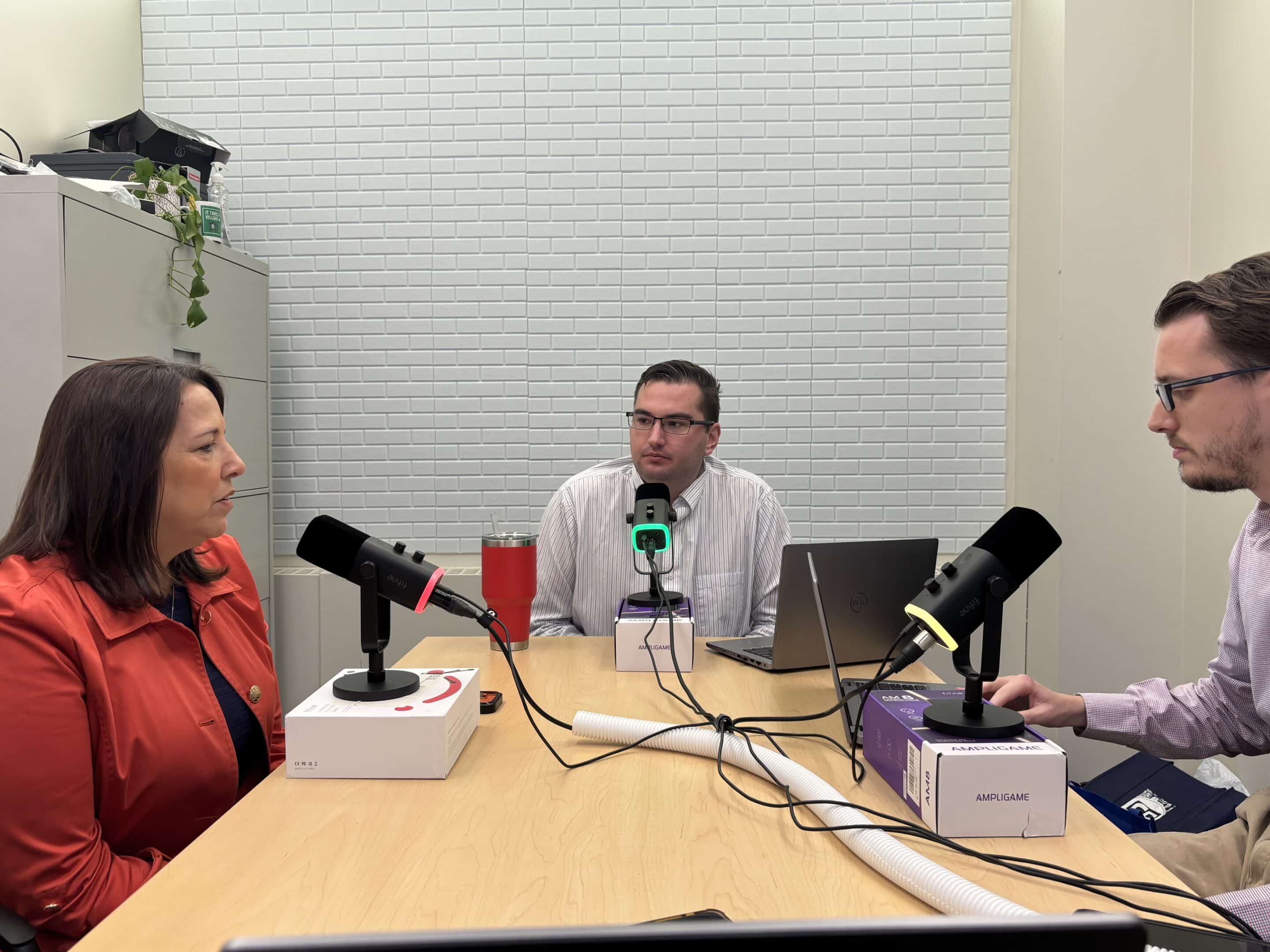
Lt. Gov. Kim Driscoll joined Managing Editors Dennis Hackett and Ryan Feyre on the latest episode of “So That Reminds Me”.
Reminder Publishing photo by Tyler Garnet
EAST LONGMEADOW — On the latest episode of “So That Reminds Me” hosts Ryan Feyre and Dennis Hackett sat down with Lt. Gov. Kim Driscoll to discuss a wide range of topics, from the proposed two-month gas tax holiday to the new courthouse in Springfield and much more.
Driscoll made a stop at The Reminder’s podcast studio following a whirlwind visit to The Big E to celebrate Massachusetts Day on Sept. 24.
Asked about the recent news that the Healey administration was proposing a two-month gas tax holiday, Driscoll said that move to help Massachusetts residents cope with rising costs had been in the works for several weeks.
“We are being harmed by higher grocery prices, higher gas prices. Many of these things are federal policies tied to the conflict in the Middle East. Certainly, inflation is harming a lot of people in a meaningful way. We thought this was a targeted, responsible way to try and give relief to people,” Driscoll said. “We have some surplus revenues in the fair share, and that means it’s not going to harm existing transportation projects or infrastructure needs that we have and put a little more money back in people’s pockets at a time we’re heading into a winter heating season that’s probably going to be more expensive.”
Though the gas tax is actually applied to wholesalers, Driscoll said the administration knows it trickles down to affect people at the pump.
“We think it’s responsible, to return dollars at a time when, frankly, folks in Washington aren’t seeing the harms that are being created. The governor doesn’t control everything … we don’t control interest rates. We don’t control tariffs, Frankly, we don’t control conflicts in the Middle East. But we can do something here, and we wanted to step in and try to offer some relief,” she said.
She couldn’t say exactly when the proposed gas tax holiday would begin as the start date was dependent upon when the legislation is passed.
On the issue of affordable housing, Driscoll said the crisis isn’t new, and now also affects the retention of young people and workforce talent in the Bay State.
“You know, it’s the number one challenge we have in my mind is not having built enough housing for the last 30 years, and so the housing that we do have now is very costly,” Driscoll said. “Right now, the average age of a first-time home buyer in Massachusetts is 40 years old. That’s the highest it’s ever been.”
She said the state needs 220,000 new housing units by 2035 to make housing more affordable in Massachusetts, adding that the second bill she and Healey got passed when they took office was the $5 billion Affordable Homes Act.
“We got to work on that right away. There’s already 100,000 units that have either been built, are under construction or in the pipeline,” Driscoll said, adding that the administration is leveraging state land, looking into office building to housing conversions and putting resources into play to help first-time homebuyers with issues such as downpayments. She said the administration has also worked with local governments to try and streamline streamline permitting to get housing built faster.
Addressing the concerns about the new Springfield courthouse, Driscoll said the age and health issues at the current Roderick L. Ireland courthouse have prompted an expedited replacement process that utilized a public-private partnership.
“We worked with local officials. We worked with stakeholders in the court system. You know, the courts are really sort of the client here in terms of meeting their needs,” Driscoll said. “We went through a fair process. We had proposals that came in. A selection committee, which included both court personnel and personnel from Western Mass., reviewed all of the proposals, recommended the one that has been selected, not only because it met their needs and there were criteria built into the RFP, location, proximity, things like that, but also because it had to be something that we looked at resources too.”
Not only was the proposal chosen the most affordable of those submitted, Driscoll said it best met the criteria set by the selection committee.
“The other proposals are much, much higher. I mean, hundreds of millions of dollars separating other proposals and this one,” Driscoll said, “It was the highest ranked out of the selection committee, and we’re excited to make an investment.”
Driscoll added that the location will bring a much-needed investment to that section of Springfield and provide jobs for local labor.
“There’s going to be other ways to invest in this building and build resources and make sure Springfield and Greater Springfield benefit from it,” Driscoll said. “So, we’re excited to see it move forward.”
On the issue of data centers, Driscoll acknowledged that Massachusetts is an innovation economy but stressed that supporting that economy must be done without harming the quality of life in, and natural resources of, the state.
“It’s got to be done the right way, and we’ve seen a lot of examples of data centers done the wrong way, particularly outside of Massachusetts,” Driscoll stated.
She said Massachusetts isn’t anti-data centers but acknowledged that any centers built here must work for the surrounding communities.
“It’s got to not harm our electricity needs and harm our water and our infrastructure that’s here,” Driscoll said. “And I think there’s ways to do that, sited in the right place, working with communities.”
“But it’s got to be done right,” Driscoll continued. “And we’re not going to allow, you know the innovation economy and the tech economy to override what we know are important values in all of our communities, and the best way to do that is to put that out there very clearly. This is our bill of rights for data centers. Here’s what you got to do if you want to build a data center here.”
Education funding, which is closely tied to issues such as the innovation economy, is another area where Driscoll said the administration is working on creating more support.
Acknowledging that many communities have been looking at Proposition 2 ½ overrides to fund critical education expenses now and in the future, Driscoll said the Healey Administration has been looking for ways such as the recently expired Student Opportunity Act, to infuse more funding into local education.
“We’re working hard as we think about a new formula opportunity coming forward and bringing more voices around the table, specifically for schools,” Driscoll said. “But in the meantime, we’ve proposed $100 million in additional resources for communities. Again, coming out of fair share, some additional dollars we have collected beyond benchmarks that could provide some immediate relief, has to be spent on public education, that could account for 24% increases in health insurance or wage increases that communities have to also contend with at a time that they’re seeing the price of everything they’re buying going up.”
“So we want to be a steady and good partner to our municipalities,” Driscoll continued.
Addressing the SNAP and health insurance cuts enacted under the Trump Administration’s Big Beautiful Bill, Driscoll said Massachusetts is doing what it can to fill the gap in funding within the governor’s proposed supplemental budget bill. She said the supplemental budget will restore some funding trimmed by the Legislature during the earlier budget process, providing monies to help support food and health insurance programs, and hire more case workers.
“The federal government has changed a lot of these rules, and frankly, I think they’re designed to make sure people do not use these benefits to make it harder to access whether it’s SNAP benefits or health care,” Driscoll said. “We will see the full impact of the trillion dollars the Trump administration has taken out of health care as the next budget is prepared, and it’s really going to be harmful.”
On the issue of government oversight, Driscoll said she and Healey also support the audit of the legislature and more transparency in government.
“I mean, the governor and I both have said we voted for the audit. We think the audit should happen. We’re audited all the time,” Driscoll said, adding that in her 17 years as mayor of Salem, she was audited all the time. “Again, as a local official, I lived under the open meeting and public records law. Those are good pieces of both transparency and opportunity for people to know what’s happening in the government that they support. So, we’re supportive on both counts.”
With the Nov. 3 election less than two months away, Driscoll closed by expressing thanks for the trust the electorate of Massachusetts has put in her and Healey to guide the state for the past three and a half years.
“We’re excited to continue to do the work to support a strong and healthy Massachusetts, and that means you’ve got to have a strong economy,” Driscoll said. “We’re pro-growth. We want to continue to see investments here, and we’ve got to make sure we’re thinking about ways we can support a strong safety net. That’s the way I think Massachusetts has always led, going back to 250 years ago, and started the start of this country.”
To hear the full episode, visit thereminder.com/our-podcast or search for “So that Reminds Me” on your favorite podcasting platform.