
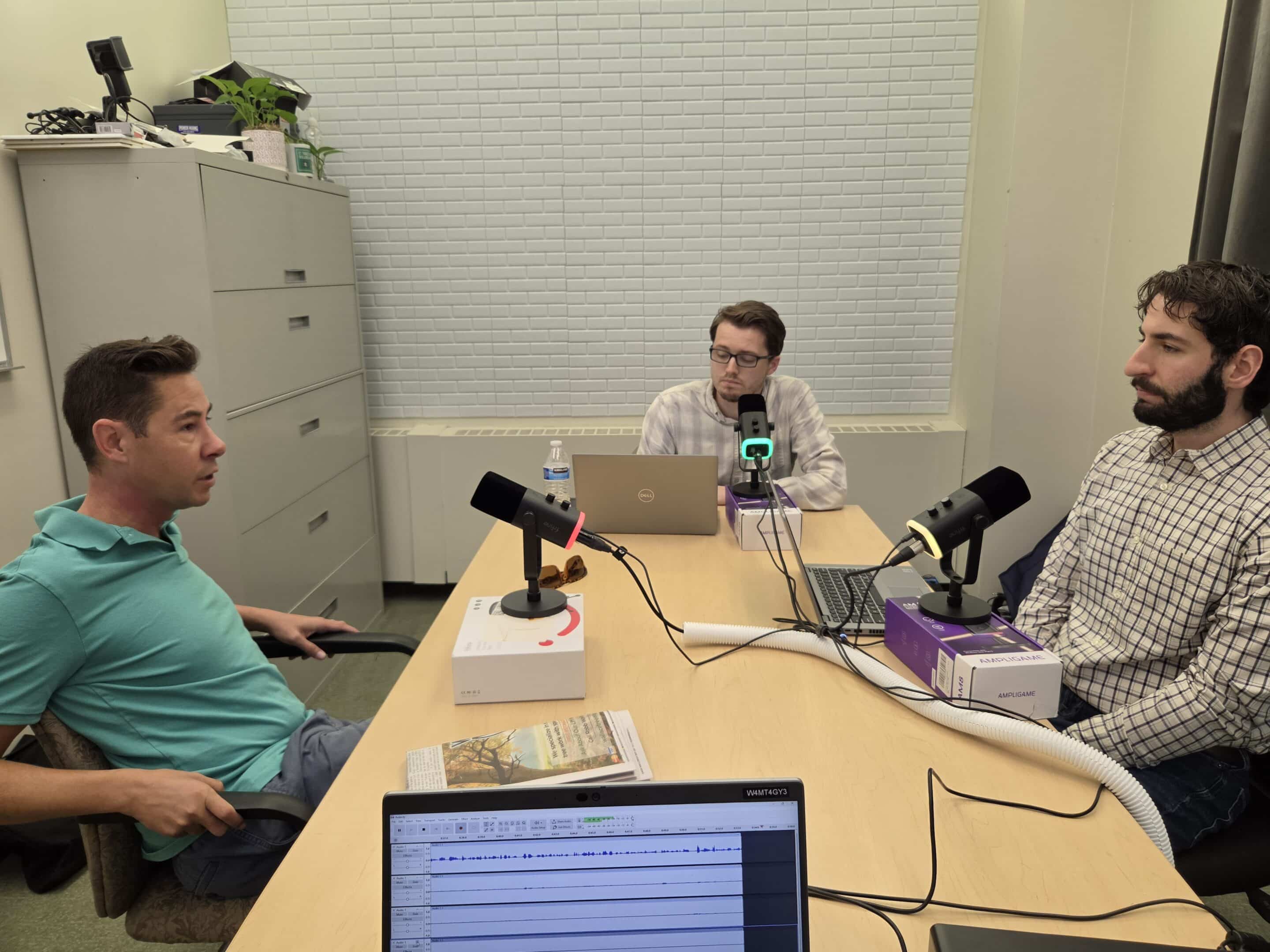
State Sen. Jake Oliveira (left) joined hosts Ryan Feyre (middle) and Tyler Garnet (right) to discuss statewide issues on the most recent episode of “So That Reminds Me.”
Reminder Publishing photo by Chris Maza
State Sen. Jake Oliveira made a return visit to Reminder Publishing’s bi-weekly podcast, “So That Reminds Me,” on Oct. 14. And during this visit, he was up for lively discussions on myriad topics, including the new Springfield courthouse, state funding reforms to better support communities, the Quabbin water use issue and much more.
Diving into hot-button topics, Oliveira readily acknowledged that replacing the Roderick Ireland Courthouse in downtown Springfield is critical, as it has been implicated in many health issues in recent years.
“The need to build a courthouse is paramount; the workers that work there, the people that utilize it, deserve to have a courthouse that is not making them sick, that people can feel safe going into,” Oliveira said.
And though the courthouse project is not technically in his legislative district, what he has questioned from the beginning is why it will be a leased venture and not a state-owned building.
“From the beginning, I think it was a mistake not to have a state-owned and state-built courthouse in the city of Springfield, especially the largest courthouse in the entire Commonwealth of Massachusetts,” Oliveira said, adding that every year, as part of the budget-writing committee, he sees the Trial Court system ask Ways and Means for additional funding to cover long-term courthouse leases. A state-owned building would eliminate that need.
The administration and the Division of Capital Asset Management and Maintenance have answered with timing.
“In fact, I think the DCAMM commissioner mentioned … publicly at a Ways and Means hearing, in fact, that could add five years on to the project,” Oliveira said.
Oliveira also noted the advantage of having the leased courthouse building on the city’s tax rolls for the next 40 years, something that would not happen with a state-owned building. He also applauded the proposal to use local construction firms to build the new structure. In the end, he said the need for a new building is a mitigating factor in moving the project forward quickly.
“We need to get going on this,” Oliveira said. “The workers in the Hampden County Courthouse, the people who visited, deserve to have a courthouse that works for them. They deserve to be in a building where they can be healthy and work safely. So, it’s my hope that we can move forward with a project that can get them the relief that’s needed. However, I still maintain serious concerns with the long-term piece of emphasis.”
When asked about the growing push by communities to implement Proposition 2 ½ overrides to help fund services such as schools, public safety, and more, Oliveira said part of the conundrum lies in how communities must raise funds for their annual budgets.
“Let’s be clear: property taxes are one of the worst ways to finance government because it hits everyone. Whether you’re a homeowner, you face those property tax increases each and every year,” Oliveira said. “If you’re a renter, your rent is reflected by those property tax increases that the owner of that building is having, so you’re creating a system where across the board people are being impacted by property tax increases.”
“I think the best way, in a better way, in a more progressive way, to fund the services that we rely on at the local level, whether it’s public safety, whether it’s schools, whether it’s transportation, is more reliable, consistent, and increasing state funding,” he explained.
For example, Oliveira said, in the current legislative session, the body voted to change how Chapter 90 monies, which help communities pay for work on roads and bridges, were calculated this year, taking road miles into account for communities in Western Massachusetts.
Because of that adjustment, “Western Mass. communities saw anywhere from a 75% increase to 130 % in my district increases in their Chapter 90 for one year because we changed the funding formula to benefit Western Massachusetts,” Oliveira said.
He said one of the changes he fought very hard for in the Fiscal Year 2027 budget was a proposal to revisit the formula for administering Chapter 70 funding, which supports school budgets in each community. This was the second legislative session Oliveira said he’s pushed to revisit the formula, which was last reevaluated over a decade ago. “That funding formula commission, the Chapter 70 commission, that’s already started to meet and to provide recommendations back to the Legislature in order to change that funding formula to help out with numerous communities that are facing Proposition 2 1/2 overrides because their funding has not kept pace with inflation through Chapter 70,” Oliveira said.
On budget topics, when asked about Gov. Maura Healey’s proposed two-month gas tax holiday, Oliveira said he sees dubious help in the proposal, if and when the legislature takes it up.
“I think we saw during the pandemic, when just after we saw gas prices rise, you know we’re in a border community here in East Longmeadow. We saw Connecticut suspend their gas tax, their 24- or 25-cent gas tax. They never saw a 24-cent reduction in their gas prices,” Oliveria stated. “And I think the problem is when you suspend the gas tax. I think it’s an important conversation of where that tax revenue goes to.”
The gas tax, he shared, is what helps fund the Chapter 90 monies that support transportation projects in Massachusetts.
“We need the consistent funding coming in, so I’m not supportive of undercutting our revenue for our roads and bridges and sidewalks that are in desperate need of repair, without having, you know, that 24-cent tax. People saw it at the pump that … if we eliminated that and they saw a 25- or 24-cent reduction at the gas pump, then I might be considering it,” he said.
The blame for the increase in all fuel prices — gas, heating oil, diesel for transporting goods and products — as well as crippling healthcare changes and costs and the loss of other important programs such as SNAP — should fall squarely on the Trump Administration and their war with Iran, Oliveira argued. The best way to mitigate these increases and program losses, he opined, was to cast your vote in November for change.
Water issues, including both those in Springfield and with communities surrounding the Quabbin Reservoir, were also on Oliveira’s mind. He said he’s proposed changes to the Springfield Water and Sewer board to broaden its representation. Regarding the request from unnamed eastern Massachusetts towns to take an additional 20 million gallons from the Western Massachusetts-based reservoir, he finds that difficult to support when the surrounding communities, including Belchertown, which he represents, have had to implement water bans in the past few years.
“I think it’s foolish to siphon off another 20 million gallons, which could only perpetuate the drought that’s around the Quabbin Reservoir in those communities, without having a serious conversation about access for the communities around it,” Oliveria said.
To listen to this episode and previous episodes of “So That Reminds Me,” visit https://thereminder.com/our-podcast/ or search for “So That Reminds Me” on your favorite podcast platform.