
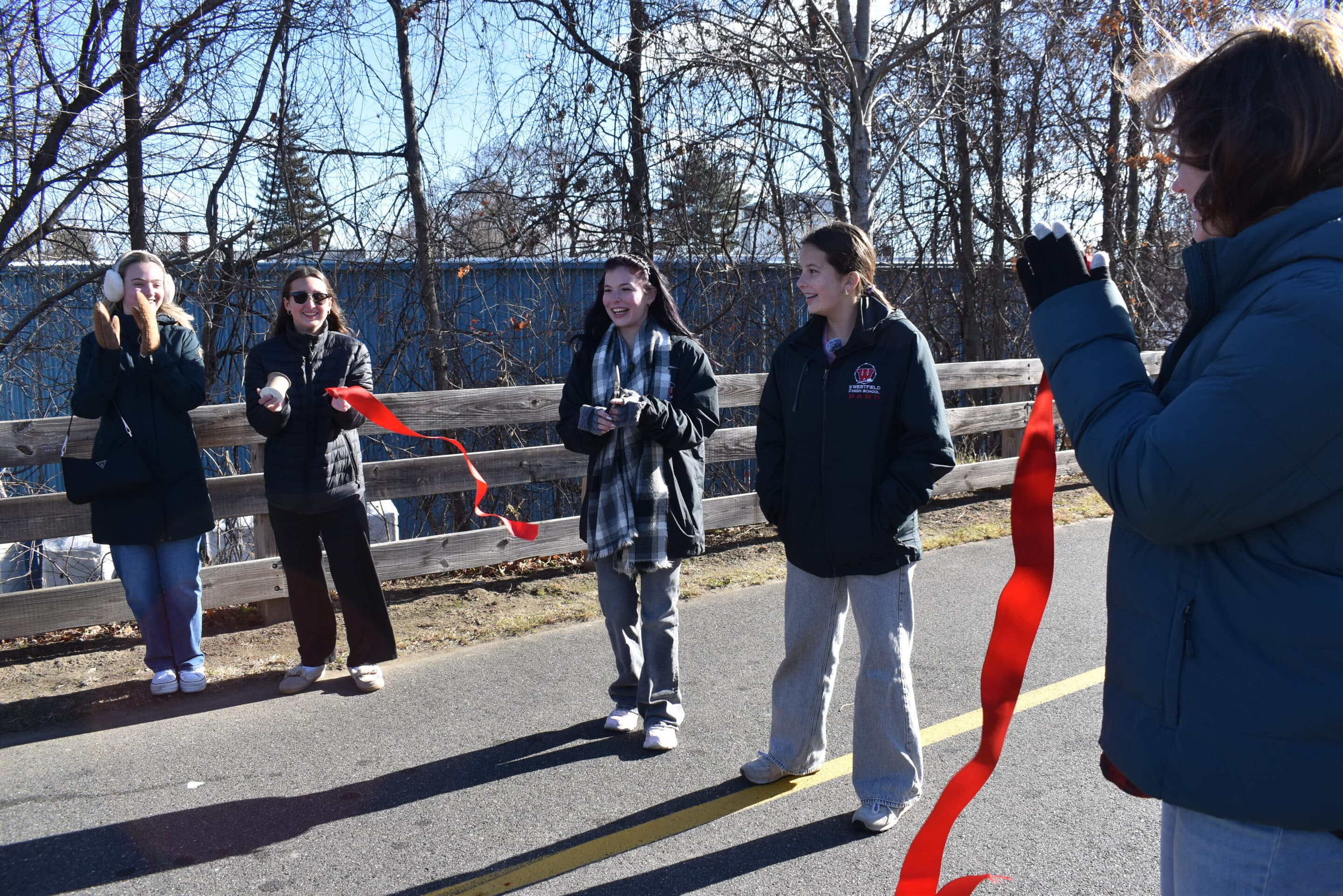
Kaitlynn and Krystyna Goulette cut the ribbon to the solar system walk they created on the Columbia Greenway Rail Trail.
Reminder Publishing photo by Amy Porter
WESTFIELD — Before the ribbon cutting for the solar system walk on the Columbia Greenway Rail Trail on Nov. 29, created by Westfield High School Astronomy Club members Krystyna Goulette and Kaitlyn Goulette — president of the club — Krystyna thanked everyone who made the walk possible.
She started with Westfield Bank, a sponsor of the walk, and its permanent signs illustrating the planets; the Department of Public Works, especially Fran Cain, who installed them, and the Friends of the Columbia Greenway, singling out Kathleen Hillman for her guiding hand.
Krystyna said a solar system walk shrinks the enormous distance of the planets from the sun down to one mile, with every foot equalling 530,000 miles in space. This one starts at the CGRT entrance at Stop & Shop and travels south.
Kaitlynn then took the group of about 30 on the tour through the solar system’s sun and planets, beginning with the sun, responsible for life on Earth.
She said the first planet, Mercury, which is 36 million miles from the sun but just a short distance on the walk, cannot be seen by the naked eye because of its proximity to the sun, and because of its size. It is slightly larger than our moon. It also rotates more slowly, with one day on Mercury equaling 59 Earth days and one year equaling 88 Earth days. Some of the facts Kaitlynn relayed are posted on the signs for the planets.
The second planet from the sun, Venus, named after the Roman goddess of love and beauty, is 67 million miles from the sun. The brightest object in the sky, also known as the evening star and morning star, is also the hottest planet at 900 degrees Fahrenheit. Its day is 243 Earth days, but its year, or orbit of the sun, is 225 Earth days.
Kaitlynn said the next planet, Earth, is her favorite because it is the only planet in the entire universe, not only the solar system, with Oreo cookies.
Mars, at 142 million miles from the sun, is known as the red planet because its soil is made of iron. Half the size of Earth, one day is 24.6 Earth hours, but one year is 687 Earth days. Kaitlynn said Mars is an interesting observation in a telescope, because viewers can make out the polar ice caps and the different deserts, as well as the largest volcano and canyon systems. She said NASA has sent five spacecrafts to touch down on Mars.
It was a bit of a walk to Jupiter at 484 million miles from the sun, and Kaitlynn said to watch out through the asteroid belt. The largest planet, she said 11 Earths, can fit along its equator. One day is 10 Earth hours long, which she said is good for observation. It also has 97 moons, two of which were discovered this past July.
Saturn, at 886 million miles from the sun, is the second largest planet, also a favorite for observation with its seven main rings made of ice, rock and dust. One day on Saturn is 10.7 Earth hours, and one year, 29.4 Earth years. Saturn has 274 moons, 128 of which were confirmed only nine months ago. She said life is not possible, but is possible on some of the moons.
After another stretch, making room for bikers and pedestrians along the way, the group came to the sign for Uranus at 1.8 billion miles from the sun. Kaitlynn said it is an ice giant known for its unique tilt, with rings appearing to go up and down. She said one theory is that it was knocked on its side when the solar system was first formed. Spinning backwards like Venus, one day is 17 Earth hours, and one year, 84 Earth years. Voyager II, in 1986, is the only spacecraft to have visited Uranus.
The last stop on the solar system walk is Neptune, at 2.8 billion miles from the sun and one mile from the beginning of the walk. Kaitlynn said Neptune was discovered by doing the math when astronomers were studying Uranus and believed there was a large planetary nearby. It has 16 moons and is the densest gas giant. She said Voyager II in 1989 was the only spacecraft to visit the planet.
The ribbon cutting and solar system walk was videotaped by Brady LePage of Westfield Community TV and is available for viewing on Westfield Community Programming on YouTube.
Kaitlynn said the WHS Astronomy Club hopes to schedule one more telescope observation evening at the end of the solar system walk, which is by an old tobacco field and perfect for viewing, in the not-too-distant future.