
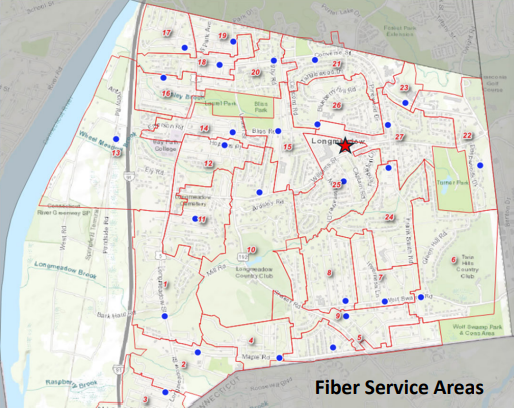
A projected map of each of the 27 fiber service areas.
Photo credit: South Hadley Electric Light Department
LONGMEADOW — South Hadley Electric Light Department met with the Longmeadow Select Board to present the current progress in the Fiberspring project at its Jan 5 meeting.
Longmeadow has been partnered with SHELD since 2024 to provide the town with a local fiber network.
Fiberspring is a high-speed internet service, powered and introduced by SHELD in 2019, that delivers fiber optic networks directly to homes. Optical fibers use pulses of light along thin pieces of glass to carry out signals rather than electricity.
A wide range of benefits are available through Fiberspring, such as a lower monthly rate, compared to Xfinity or Verizon. It also typically provides faster download and upload speeds, the capacity for more connected devices and isn’t affected by power surges. Fiberspring also notes that a fiber network can add about $5,000 to the purchase price of a house.
SHELD and Fiberspring General Manager Sean Fitzgerald began the presentation with the project’s history since 2024 before turning it over to Director of Operations Adam St. Martin. Fitzgerald said a lot of work has been done in the past 12 months.
On the engineering and design side, SHELD conducted 91 miles of walkout data collection through the town, which rolls over to the pole applications to Verizon and Eversource. 54 applications would be submitted for 2,268 poles in the town.
“As we developed the engineering, the consideration and part of the boots on the ground evaluation was to count all the passings and make sure that we had sufficient fiber to support access for all those individuals,” St. Martin said.
A central office would be the “brain of the operation,” located next to existing Verizon infrastructure near the high school’s tennis courts. It would be used as a network and distribution hub, equipment housing and fiber management. St. Martin detailed a centralized pond network that would manifest itself from the central office and proliferate throughout the town. 27 different fiber service areas would each get above ground fiber distribution cabinets to split the fiber and provide service throughout the town.
St. Martin said a centralized network will also help identify and troubleshoot issues much faster, maximizing uptime for customers. Each fiber service area accounts for 288 customers and holds spare fiber to allow for future development or housing.
Financial Manager Michael Conchieri then ran the Select Board through the project’s financial review. Initially, the cost was looking to be around $25 million with a 50% take rate at $85 per subscriber. Since the new data, SHELD now believes the project may cost $27.2 to $30 million, depending on a take rate between 40% to 60%. Conchieri said a higher take rate means a higher cost per subscriber, potentially at $90 per subscriber, and it may be at least seven to 14 years before the town sees a positive cash flow.
“People may look at that and say, ‘wow, that’s not great,’” Fitzgerald said. “You have to remember, you’re building a utility. You’re building a 50 to 100 year utility, and it’s not an easy task but it’s a great task if you can accomplish it.”
Select Board Vice Chair Veneeth Hemavathi said that something he thinks should be noted is that although it may be a $27.2 to $30 million project, most of the cost would be covered by subscriber fees. The amount the town would be paying is between $1.5 to $4.3 million based on the take rate. He said the worst case scenario would be the town covering the $4.3 million at a 40% take rate.
“I think the other unique part about what makes this project much different than other capital projects is that we are offering our residents an opportunity to take a monthly bill that they already have… and to replace that bill with something that’s most likely going to be much cheaper for them,” Hemavathi said. “When we’re talking about reducing costs or making it more affordable to live in Longmeadow, this is a way to make it more affordable to live in Longmeadow in the long run.”
Hemavathi said a phrase that keeps coming back is “fiber is future proof,” and if the technology was expected to become obsolete, the town wouldn’t be asking to borrow $30 million to implement it. He said fiber performance has been monitored over two years in South Hadley and there was only one report of a small outage that lasted for an hour.
“That is such a stark difference to what we have now,” Hemavathi said. “If you go to the Longmeadow open forum any day, people are complaining. The internet service is disrupting their work from home, disrupting school work, disrupting their entertainment. To just have something that you know is going to just work and something you just don’t have to even worry about. I mean that is priceless.”
Select Board member Andrew Lam said that everyone has acknowledged that moving forward is a risk, but there is a good chance the risk could turn into a wonderful investment.
Moving forward, SHELD plans on getting “make ready costs” from pole owners to create a refined cost projection. A town vote will then be conducted in May to approve funding and construction. A two-thirds vote by the town will be required for approval.