
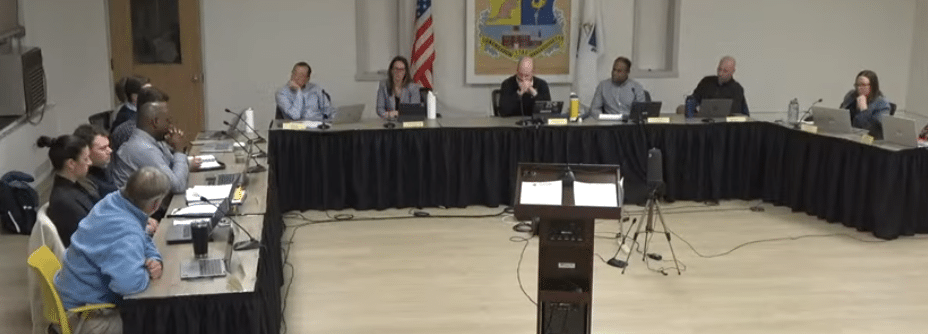
The Longmeadow Select Board met alongside the Finance Committee at a joint meeting on April 6.
Photo credit: LongmeadowTV
LONGMEADOW — Longmeadow officials have determined the initial cost the town will face if voters decide move the fiber project forward at the Annual Town Meeting on May 12.
The article requires a ⅔ majority vote to pass.
Article 7 on the Town Meeting warrant proposes the town will pay about $8.6 million for the first phase and half of phase two of the $27 million project’s borrowing plan. This would increase average property taxes by about $97 per year for a total of about $2,140 over the loan’s 20-year span.
The first phase and a half would include the construction of the central fiber hub and the connection to 1,600 single-family homes, 30 commercial units and 20 multi-dwelling units.
The Longmeadow Select Board held a joint meeting with the finance committee April 6 to discuss the current borrowing plan for the fiber project.
The cost to taxpayers was initially projected by Fiberspring to be between $1.5 million with a 60% take rate and $4.3 million with a 40% take rate on a 30-year loan. Finance Director Ian Coddington informed the Select Board that state law limits the loan term to a maximum of 20 years at its meeting on March 23, increasing the projected range to between $3.3 million at 60% and $8.7 million at 40%.
“If the question is about doing a shorter term borrowing, then for the purpose of this article, the only option that the town has, if they do not want to have it as part of the general fund budget, is a 20-year borrowing through debt excluded property tax,” Coddington said. “That is the only option the town has. Outside of that, when we’re looking at the future projects in the form of funding it through the enterprise fund, that is where we can look at different financing options, if the board or the [municipal light plant] chooses.”
The enterprise fund, paid for by the monthly subscriber fee of $90, is projected to cover the project in phases two through five, assuming a 40% take rate is achieved. Select Board member Vineeth Hemavathi said the assumption of a 40% take rate comes from experiences in other Western Massachusetts towns with fiber, where 40% has been the lowest take rate seen, adding that a fiber project has not failed in any town.
“South Hadley, who we’re partnering with on this, just finished building out their entire town last summer and they have a 55% take rate already,” Hemavathi said. “More than half the town is already subscribing to their fiber internet.”
He said the initial 40% covers all the operating expenses for the enterprise fund and the debt service to build out the rest of the town, which takes up about 80% of all operating costs.
About $17.9 million would be borrowed as construction progresses and the project will convert to a long-term loan after construction completes in 2032. The 20-year loan would not begin until after a three-year short-term loan in which only interest is paid, making the entire loan complete in 2051.
Chair Josh Levine said the approach the Select Board would like to model involves “doing everything we can to limit the impact on taxpayers, which, as [Town Manager Lyn Simmons] was saying, we have the ability to do.”
The town’s approach looks to use short-term borrowing with only interest paid at first, then switch to long-term once the project is complete, in order to keep “early costs lower, better matches when revenue starts coming in and results in smoother cash flow and less upfront impact on residents,” according to the Finance Department’s fiber borrowing memo to the Select Board.
Fiberspring’s approach is much different and looks to borrow everything as long-term debt from the start and pay “both principal and interest immediately,” according to the memo.
Finance Committee member Maury Garrett asked if there were any risks if the project was put off for another warrant cycle, and Hemavathi said construction prices would most likely increase and that there are time limits on how long the pole applications last with Eversource and Verizon.
“I don’t know, if we were to defer this a year, two years, whether we’d have to reapply and spend another $250,000 on pole applications,” Hemavathi said. “That’s another consideration.”
Levine said another consequence of waiting is that other companies, like Gateway Fiber, also have pole applications in, and if the town waits, “they’ll smell blood and hop in on this,” and potentially only build fiber to the more affluent parts of town with higher rates.
Simmons said that the town has a revenue problem and these types of projects can’t be done without borrowing.
“If it’s not this project that you’re asking about the credit rating for, it’s going to be the next project and the next project and the next project,” Simmons said. “This is one of the very few, if not only, projects that has come forward that actually generates revenue, so I think that’s important to think about when you’re looking at the long-term. There is a revenue source attached to this, whereas all of these other borrowings that we’ve done, there is no revenue coming in.”
Levine added that there are aspects to the project that make him nervous, but sometimes “there are risks that are inherent, and you take a big swing.”
“One of the things [Simmons] always says to us is ‘we keep knocking on the same doors,’” Levine said. “There’s only so many places we can make revenue in this town and it’s raising taxes. The fact that there is something here that may have a net positive for the town is really tempting. If I could, if we could guarantee it was going to work, we’d all vote for it, absolutely, but we just don’t know … maybe it can, and we just have to really take that into account.”
Select Board member Andrew Lam said he doesn’t know if this will “truly be a success,” and there are valid points for and against the project.
“I think it’s really a referendum on if people in this town want fiber,” Lam said. “If they do and they think it’s important, it’s gonna pass. If they don’t and they don’t think it’s worth it, it’s not gonna pass. Every one of us probably falls somewhere on the spectrum between against it and for it, but like [Levine] said, right now I think we’re deciding to put it on the warrant. I certainly see, no matter how any of us feels about it, that there’s no reason not to put it on the warrant so the town can decide.”