
SOUTHWICK — Election season is nearing its apex, with the Nov. 3 general election just days away.
Ahead of Election Day, Reminder Publishing reached out to the three candidates running for the 3rd Hampden District House of Representatives seat, which covers Southwick and Tolland, Blandford, Chester, Granville, Montgomery, Russell, Huntington, Middlefield and most of Agawam.
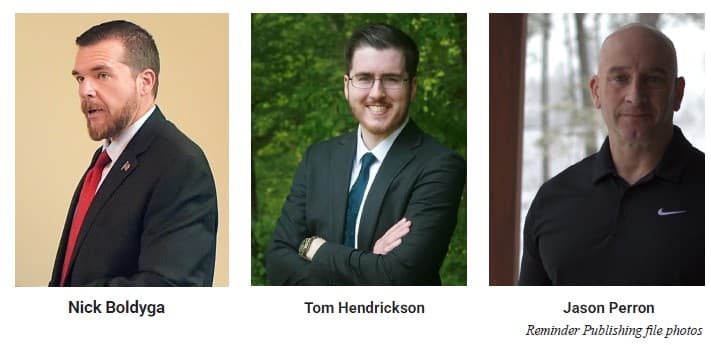
In this year’s race, incumbent Nick Boldyga will face off against Agawam City Councilor Tom Hendrickson and Jason Perron, an Air Force veteran, career law enforcement officer and former Southwick Select Board chair.
The candidates answered the same questions. Their names are listed alphabetically.
Reminder Publishing: Please say a few words about yourself and why you are running for state representative.
Boldyga: As a resident of Western Massachusetts, a husband, and a father of three, I understand the challenges facing families and businesses in our communities.
I’m running for reelection because Massachusetts is becoming increasingly unaffordable, and Beacon Hill needs greater accountability, transparency, and fiscal responsibility.
My priorities remain fighting to lower taxes and the cost of living, reforming Beacon Hill, and ensuring the values and priorities of the people I represent are heard in Boston.
I believe government should work for the people, not special interests and lobbyists who control Beacon Hill.
Hendrickson: As the son of two public school teachers, growing up in a working-class family taught me the importance of community, honesty, and hard work. These values drove me to pursue public office and have guided me throughout my time serving on the Agawam City Council.
I’m running for state representative because we deserve an economy and a state government that work for all of us. I’m fighting to bring real working-class representation to our state legislature, to create a fair economy for working-class families, and to restore transparency and democratic values within our state government.
Perron: I’m a veteran, retired police officer of 29 years, small-business owner, and former Southwick Selectboard member and Chairman.
I grew up and lived in Granville, Blandford, and Southwick, attended schools in the two regional school districts, and have experience in farming, construction, business, and local government.
These experiences have given me firsthand knowledge of our communities, their differences, and the challenges residents face.
As an Independent, my philosophy is based on individual liberty, constitutional rights, limited and accountable government, fiscal responsibility, and local control. I believe in evaluating issues on their merits, not party affiliation.
I’m running because of my lifelong connection to this district and my belief that partisan politics should never come before the people we represent. State Representatives should listen, collaborate, and focus on practical solutions that benefit all residents, regardless of political affiliation.
RP: With new growth at a low point locally and statewide, what type of business development do you think would most benefit the district you seek to represent?
Boldyga: The best thing Massachusetts can do to encourage economic growth is to make it easier and more affordable to do business here.
Our district is home to hardworking entrepreneurs, family-owned businesses, farms, and small manufacturers that form the backbone of our local economy. Unfortunately, Massachusetts continues to burden these employers with high taxes, excessive regulations, rising energy costs, and government mandates that make it increasingly difficult to compete.
Rather than having government pick winners and losers through taxpayer-funded subsidies and expensive incentive programs, we should create an environment where businesses of all sizes can succeed.
That means lowering taxes, eliminating unnecessary red tape, reducing energy costs, and providing greater regulatory certainty.
When businesses can afford to invest, expand, and hire, our communities benefit from more jobs, a stronger local economy, and a healthier tax base. Economic growth begins by getting government out of the way.
Hendrickson: As our state representative, I will work to bring good-paying, union jobs to Western Massachusetts. One way that we can spur economic growth in our region is by establishing fast and frequent West-East rail services. Currently, Western Mass is isolated from the rest of the Commonwealth, especially in places like the Hill Towns, where transit is a serious challenge. By investing in West-East rail and including a train stop in the Hill Towns, we can make transit more convenient, we can connect our region with the rest of the state, and we can entice more investment in our community and boost our local economy.
Perron: I don’t believe there’s one type of business development that fits every community in this district. What’s appropriate for Agawam or Southwick may not be appropriate for Granville, Blandford, Chester, or the other Hilltown communities.
We need to support the small businesses, farms, and existing employers that are already here while encouraging new businesses that provide good-paying jobs and contribute to our local tax bases.
That means reducing unnecessary regulations, making permitting more predictable, addressing the costs of doing business in Massachusetts, and improving infrastructure.
Agriculture, manufacturing, skilled trades, and locally owned businesses all have important roles in our district’s economy.
I also believe economic development should respect the character of each community. We shouldn’t sacrifice what makes our towns desirable places to live simply to attract development.
The goal should be balanced growth that benefits residents, businesses, and municipalities alike.
RP: Many Western Mass. communities sought Proposition 2 ½ overrides due to rising costs, especially in the cost of public education. What do you think is the best answer for funding education in the state?
Boldyga: Massachusetts doesn’t have a revenue problem. It has a spending problem.
Year after year, Beacon Hill increases state spending, yet our cities and towns continue to struggle to adequately fund essential services, particularly public education. The answer isn’t to impose additional taxes on families and businesses already struggling with the high cost of living.
We need to fundamentally reassess the state’s spending priorities, redirecting taxpayer dollars away from special interests, wasteful spending, and politically motivated programs toward meaningful increases in local aid and education funding.
I’ve repeatedly filed budget amendments to fully fund Rural School Aid, providing desperately needed resources to our small, rural school districts. Unfortunately, those efforts have repeatedly been rejected by Democratic lawmakers.
Our communities shouldn’t have to continually turn to Proposition 2½ overrides to fund their schools. Beacon Hill needs to get its priorities straight and deliver more of our existing tax dollars back to our communities.
Hendrickson: Rural school districts like Southwick-Tolland-Granville and Gateway Regional Districts are facing high costs and limited resources. As our state representative, I will support efforts to review and reform the Chapter 70 formula to ensure Western Mass gets our fair share of education funding, and I will co-sponsor legislation that would guarantee $60 million in the annual state budget for rural schools in Massachusetts. I’m proud to be endorsed by the Massachusetts Teachers Association, the union representing over 100,000 teachers throughout Massachusetts, because I will fight to ensure that every child in our community can receive a quality education and an opportunity to reach their full potential.
Perron: We need to look at how Massachusetts distributes local aid and education funding, particularly through Chapter 70, and whether the formulas adequately reflect the actual costs facing our communities. I know the state is working on a line item to help address the unique needs of rural regional school districts.
Small and rural communities have challenges that larger municipalities don’t, including declining enrollment, regional transportation costs, limited commercial tax bases, and increasing expenses they have little control over.
We also must examine state mandates and whether the Commonwealth is providing sufficient funding to meet those requirements.
Asking residents to approve Proposition 2½ overrides isn’t a sustainable solution, especially for seniors, families, and others already struggling with rising property taxes and living expenses.
I support adequately funding public education, but that funding must be distributed fairly, spent responsibly, and accompanied by greater transparency and accountability.
Our children deserve a quality education, and our residents deserve a system that doesn’t place additional financial burdens on local property taxpayers.
RP: Each of you has served in elected office. What are three of the accomplishments you are most proud of that have made a difference in the lives of your constituents?
Boldyga: First and foremost, I have a 92%+ voting record for House sessions and committee votes. My near-perfect voting record is a reflection that I’m doing the job as our full-time State Representative.
Being a strong, fearless voice for our district on Beacon Hill. I’ve never been afraid to challenge the political establishment, stand up against a broken legislative system, or demand greater transparency and accountability. I take pride in representing our communities.
Second, consistently fighting for taxpayers and affordability. I’ve filed and supported legislation and budget amendments to lower taxes, reduce burdensome regulations, rein in government spending, and make Massachusetts a more affordable place to live, work, raise a family, and operate a business. While many of these efforts face resistance from tax-and-spend politicians, I’ll never stop fighting for hardworking taxpayers.
Lastly, helping constituents navigate difficult situations. Whether someone is struggling with unemployment benefits, facing a housing crisis, or having difficulty accessing government services, my office works tirelessly to help. This is often the least visible part of being a state representative. Building relationships with constituents, earning their trust, and helping them through some of life’s most difficult moments is among the greatest privileges of serving in public office.
Hendrickson: I spearheaded efforts to adopt Community Energy Aggregation in Agawam. Once fully implemented, this will allow the Town of Agawam to purchase energy in bulk on behalf of our residents and businesses, which will result in cheaper, more stable energy prices. As State Representative, I’ll continue working to hold utility companies accountable and to reduce energy prices.
I passed transparency reforms to require City Council committee meetings to be recorded and publicly released. Prior to this reform, committee meetings were technically open to the public, but only via in-person attendance. Substantive discussions were happening in these meetings, but the public was mostly kept in the dark. By recording and publicly releasing committee meetings, we now have a more transparent local government. As State Representative, I’ll work to create a more transparent, publicly accountable state government.
I’ve voted to support numerous projects to improve quality of life in Agawam. I supported the new Agawam High School project, the Still Brook Park project, the pickleball court expansion at Borgatti Park, and the Agawam Skate Park renovations. As our State Representative, I will work to provide funding for local projects to further improve quality of life in the 3rd Hampden District.
Perron: During my three years on the Southwick Selectboard, including serving as Chairman, I focused on practical solutions that produced results for residents.
First, electrical aggregation. I researched the program and helped move it forward for voter consideration, providing residents an opportunity to reduce their electricity costs. My goal was to find a way to help households save money without increasing taxes or municipal spending.
Second, recreational cannabis zoning. Regardless of anyone’s personal opinion about marijuana, recreational cannabis is as of this writing still legal in Massachusetts. I supported moving forward with appropriate zoning regulations that allowed Southwick to benefit financially rather than lose potential revenue to neighboring communities. That decision helped generate additional municipal revenue.
Third, the Congamond Lakes agreement with Suffield, Connecticut. I helped negotiate a revised lake permit agreement that provided additional revenue to support the work of Southwick’s Lake Management Committee.
These weren’t headline-grabbing accomplishments, but they made a difference.
I believe good government is about identifying problems, working with others, and finding practical solutions. That’s the approach I brought to the Selectboard, and it’s the same approach I’ll bring to the State House.